
Get significant tax savings and earn cash flow by investing in a short-term rental with data-backed selection. No guessing!
Find Your Airbnb InvestmentInvesting in Airbnb properties in Aspen, Colorado, presents a unique and often high-reward opportunity, primarily due to its status as a world-renowned luxury ski resort and year-round tourist destination. Current market conditions in Aspen are characterized by extremely high property values and a limited supply of available real estate, making initial investment costs substantial. However, the consistent influx of affluent tourists and strong seasonal demand for premium accommodations drive exceptionally high average daily rates and robust occupancy, particularly during peak ski season and summer months. Tourism trends in Aspen remain strong and resilient, attracting both domestic and international visitors seeking high-end outdoor activities, cultural events, and exclusive experiences. Despite the high entry barrier, the potential for significant rental income and long-term property appreciation in this highly desirable market makes Airbnb a compelling investment for those with the capital to enter.
Average Airbnb earnings in Aspen range from $8,000 to $25,000 per month depending on property size, location, and season, with luxury properties commanding significantly higher rates. Peak winter ski season (December through March) typically generates 60-80% higher revenues than summer months, while shoulder seasons see earnings drop by 40-50% compared to peak periods. A typical two-bedroom condo averages $12,000-18,000 monthly during peak season versus $6,000-10,000 in summer, while luxury homes can exceed $30,000-50,000 monthly during prime ski weeks. Key factors affecting earnings include proximity to ski lifts and downtown core, property amenities like hot tubs and mountain views, professional management services, and dynamic pricing strategies that capitalize on major events like X Games or Food & Wine festivals. Occupancy rates typically range from 85-95% during peak winter months to 60-75% in off-season periods, with average daily rates varying from $400-800 for standard properties to $1,500-3,000+ for high-end luxury accommodations. Properties within walking distance of Aspen Mountain or in the West End neighborhood consistently outperform those requiring shuttle access, while factors like parking availability, ski equipment storage, and concierge services significantly impact guest satisfaction and repeat bookings that drive long-term revenue sustainability.
Airbnb investments in Aspen typically generate ROI between 8-15% annually, significantly outperforming long-term rentals which average 4-6% in the market. The average daily rate for Aspen Airbnb properties ranges from $400-800 during peak ski season and $200-400 in summer, with occupancy rates averaging 65-75% year-round due to strong demand from skiers, summer tourists, and corporate retreats. Payback periods generally range from 12-18 years depending on property acquisition costs, which average $2-4 million for suitable investment properties in desirable locations like the West End or near Aspen Mountain. The higher ROI compared to traditional rentals stems from Aspen's premium short-term rental market, where properties can command 3-4 times the monthly income of long-term leases, though investors must factor in higher management costs, seasonal fluctuations, and strict local regulations that limit available rental licenses. Properties closer to ski lifts and downtown core typically achieve the higher end of ROI ranges, while those requiring significant renovations or in less desirable locations may see returns closer to 8-10%.
Airbnb occupancy rates in Aspen, Colorado average approximately 65-70% annually, with dramatic seasonal fluctuations that reflect the city's dual-season tourism economy. Peak winter occupancy reaches 85-90% from December through March during ski season, while summer months from June through August see rates of 75-80% as visitors enjoy hiking, festivals, and mountain activities. Spring and fall shoulder seasons experience the lowest occupancy at 40-50%, creating significant revenue challenges for property owners during these transitional periods. Aspen's annual average occupancy rate substantially exceeds both Colorado's statewide Airbnb average of approximately 55-60% and the national average of 48-52%, primarily due to the destination's premium positioning as a luxury resort town with limited hotel inventory and consistent high-end demand. The city's occupancy rates are among the highest in Colorado mountain resort communities, comparable to Vail and Steamboat Springs, though the extreme seasonal variation creates more pronounced boom-bust cycles than more diversified markets, with winter rates often commanding 3-4 times higher nightly rates than shoulder seasons despite the occupancy differentials.
The most lucrative Airbnb neighborhoods in Aspen include the West End, which offers premium pricing power due to its historic Victorian homes and walkability to downtown's restaurants and nightlife, attracting affluent visitors willing to pay top dollar for authentic Aspen charm. The East End provides excellent investment potential with its mix of luxury properties and more affordable options, close proximity to the Aspen Art Museum and Rio Grande Trail, appealing to both high-end and mid-tier travelers. Red Mountain stands out for its exclusive luxury market, featuring multi-million dollar properties that command the highest nightly rates from ultra-wealthy guests seeking privacy and prestige near the Aspen Mountain gondola. Smuggler Mountain offers strong returns with its diverse housing stock and stunning valley views, attracting visitors who want mountain ambiance while remaining close to downtown amenities. The Core/Downtown area provides consistent year-round occupancy due to its central location within walking distance of shopping, dining, and nightlife, though properties are limited and expensive. Starwood represents the ultra-luxury segment with exclusive gated community appeal, commanding premium rates from celebrities and executives seeking maximum privacy and luxury amenities. Finally, the Red Butte area offers emerging investment opportunities with newer construction and mountain access, appealing to adventure-focused travelers while maintaining proximity to Aspen's cultural attractions.
Aspen, Colorado requires short-term rental operators to obtain a business license and short-term rental permit through the city's licensing department, with properties limited to a maximum occupancy of two people per bedroom plus two additional guests, not exceeding 10 people total. The city enforces strict owner-occupancy requirements where property owners must reside in the unit as their primary residence for at least six months per year, and short-term rentals are only permitted in certain residential zones including R-6, R-15, R-30, and some mixed-use areas, while being prohibited in affordable housing units and employee housing. The registration process involves submitting an application with property details, proof of residency, insurance documentation, and paying annual fees of approximately $300-500, along with required inspections for safety compliance. Recent regulatory changes implemented in 2022-2023 include enhanced enforcement mechanisms with increased fines up to $1,000 per violation, mandatory posting of permit numbers in all listings, stricter monitoring of occupancy limits through neighbor complaint systems, and new requirements for 24/7 local contact information, while the city has also implemented a cap on the total number of short-term rental permits available and established quiet hours from 10 PM to 8 AM with noise restrictions.
Short-term rentals in Aspen, Colorado are subject to multiple fees and taxes including a 4.5% city lodging tax, 2.9% state sales tax, and 0.8% Pitkin County sales tax, totaling approximately 8.2% in combined taxes on rental income. Property owners must obtain an annual short-term rental license costing $500, pay a one-time registration fee of $150, and remit a $25 quarterly reporting fee. Additionally, there is a tourism promotion fee of 1% of gross rental receipts, a fire safety inspection fee of $75 annually, and a business license fee of $100 per year. Properties must also comply with a $200 annual zoning compliance fee and may be subject to a $300 noise violation deposit that can be forfeited for violations. The city also requires a $1,000 refundable good neighbor deposit for first-time applicants, and there are potential fines ranging from $500 to $5,000 for operating without proper permits or violating rental regulations.
Investing in Airbnb properties in Aspen, Colorado, presents a unique and often high-reward opportunity, primarily due to its status as a world-renowned luxury ski resort and year-round tourist destination. Current market conditions in Aspen are characterized by extremely high property values and a limited supply of available real estate, making initial investment costs substantial. However, the consistent influx of affluent tourists and strong seasonal demand for premium accommodations drive exceptionally high average daily rates and robust occupancy, particularly during peak ski season and summer months. Tourism trends in Aspen remain strong and resilient, attracting both domestic and international visitors seeking high-end outdoor activities, cultural events, and exclusive experiences. Despite the high entry barrier, the potential for significant rental income and long-term property appreciation in this highly desirable market makes Airbnb a compelling investment for those with the capital to enter.
Average Airbnb earnings in Aspen range from $8,000 to $25,000 per month depending on property size, location, and season, with luxury properties commanding significantly higher rates. Peak winter ski season (December through March) typically generates 60-80% higher revenues than summer months, while shoulder seasons see earnings drop by 40-50% compared to peak periods. A typical two-bedroom condo averages $12,000-18,000 monthly during peak season versus $6,000-10,000 in summer, while luxury homes can exceed $30,000-50,000 monthly during prime ski weeks. Key factors affecting earnings include proximity to ski lifts and downtown core, property amenities like hot tubs and mountain views, professional management services, and dynamic pricing strategies that capitalize on major events like X Games or Food & Wine festivals. Occupancy rates typically range from 85-95% during peak winter months to 60-75% in off-season periods, with average daily rates varying from $400-800 for standard properties to $1,500-3,000+ for high-end luxury accommodations. Properties within walking distance of Aspen Mountain or in the West End neighborhood consistently outperform those requiring shuttle access, while factors like parking availability, ski equipment storage, and concierge services significantly impact guest satisfaction and repeat bookings that drive long-term revenue sustainability.
Airbnb investments in Aspen typically generate ROI between 8-15% annually, significantly outperforming long-term rentals which average 4-6% in the market. The average daily rate for Aspen Airbnb properties ranges from $400-800 during peak ski season and $200-400 in summer, with occupancy rates averaging 65-75% year-round due to strong demand from skiers, summer tourists, and corporate retreats. Payback periods generally range from 12-18 years depending on property acquisition costs, which average $2-4 million for suitable investment properties in desirable locations like the West End or near Aspen Mountain. The higher ROI compared to traditional rentals stems from Aspen's premium short-term rental market, where properties can command 3-4 times the monthly income of long-term leases, though investors must factor in higher management costs, seasonal fluctuations, and strict local regulations that limit available rental licenses. Properties closer to ski lifts and downtown core typically achieve the higher end of ROI ranges, while those requiring significant renovations or in less desirable locations may see returns closer to 8-10%.
Airbnb occupancy rates in Aspen, Colorado average approximately 65-70% annually, with dramatic seasonal fluctuations that reflect the city's dual-season tourism economy. Peak winter occupancy reaches 85-90% from December through March during ski season, while summer months from June through August see rates of 75-80% as visitors enjoy hiking, festivals, and mountain activities. Spring and fall shoulder seasons experience the lowest occupancy at 40-50%, creating significant revenue challenges for property owners during these transitional periods. Aspen's annual average occupancy rate substantially exceeds both Colorado's statewide Airbnb average of approximately 55-60% and the national average of 48-52%, primarily due to the destination's premium positioning as a luxury resort town with limited hotel inventory and consistent high-end demand. The city's occupancy rates are among the highest in Colorado mountain resort communities, comparable to Vail and Steamboat Springs, though the extreme seasonal variation creates more pronounced boom-bust cycles than more diversified markets, with winter rates often commanding 3-4 times higher nightly rates than shoulder seasons despite the occupancy differentials.
The most lucrative Airbnb neighborhoods in Aspen include the West End, which offers premium pricing power due to its historic Victorian homes and walkability to downtown's restaurants and nightlife, attracting affluent visitors willing to pay top dollar for authentic Aspen charm. The East End provides excellent investment potential with its mix of luxury properties and more affordable options, close proximity to the Aspen Art Museum and Rio Grande Trail, appealing to both high-end and mid-tier travelers. Red Mountain stands out for its exclusive luxury market, featuring multi-million dollar properties that command the highest nightly rates from ultra-wealthy guests seeking privacy and prestige near the Aspen Mountain gondola. Smuggler Mountain offers strong returns with its diverse housing stock and stunning valley views, attracting visitors who want mountain ambiance while remaining close to downtown amenities. The Core/Downtown area provides consistent year-round occupancy due to its central location within walking distance of shopping, dining, and nightlife, though properties are limited and expensive. Starwood represents the ultra-luxury segment with exclusive gated community appeal, commanding premium rates from celebrities and executives seeking maximum privacy and luxury amenities. Finally, the Red Butte area offers emerging investment opportunities with newer construction and mountain access, appealing to adventure-focused travelers while maintaining proximity to Aspen's cultural attractions.
Aspen, Colorado requires short-term rental operators to obtain a business license and short-term rental permit through the city's licensing department, with properties limited to a maximum occupancy of two people per bedroom plus two additional guests, not exceeding 10 people total. The city enforces strict owner-occupancy requirements where property owners must reside in the unit as their primary residence for at least six months per year, and short-term rentals are only permitted in certain residential zones including R-6, R-15, R-30, and some mixed-use areas, while being prohibited in affordable housing units and employee housing. The registration process involves submitting an application with property details, proof of residency, insurance documentation, and paying annual fees of approximately $300-500, along with required inspections for safety compliance. Recent regulatory changes implemented in 2022-2023 include enhanced enforcement mechanisms with increased fines up to $1,000 per violation, mandatory posting of permit numbers in all listings, stricter monitoring of occupancy limits through neighbor complaint systems, and new requirements for 24/7 local contact information, while the city has also implemented a cap on the total number of short-term rental permits available and established quiet hours from 10 PM to 8 AM with noise restrictions.
Short-term rentals in Aspen, Colorado are subject to multiple fees and taxes including a 4.5% city lodging tax, 2.9% state sales tax, and 0.8% Pitkin County sales tax, totaling approximately 8.2% in combined taxes on rental income. Property owners must obtain an annual short-term rental license costing $500, pay a one-time registration fee of $150, and remit a $25 quarterly reporting fee. Additionally, there is a tourism promotion fee of 1% of gross rental receipts, a fire safety inspection fee of $75 annually, and a business license fee of $100 per year. Properties must also comply with a $200 annual zoning compliance fee and may be subject to a $300 noise violation deposit that can be forfeited for violations. The city also requires a $1,000 refundable good neighbor deposit for first-time applicants, and there are potential fines ranging from $500 to $5,000 for operating without proper permits or violating rental regulations.
* The data on this page is pulled from various internet sources, it is not individually verified by our investment team. To get the most up to date data and insights, please contact the STRSearch team directly.
How Smart Investors Build Wealth
Through Data-Driven STRs (Real Results)
From first-time investors to seasoned pros, see how our commitment to comprehensive data analysis led to unparalleled investment victories.
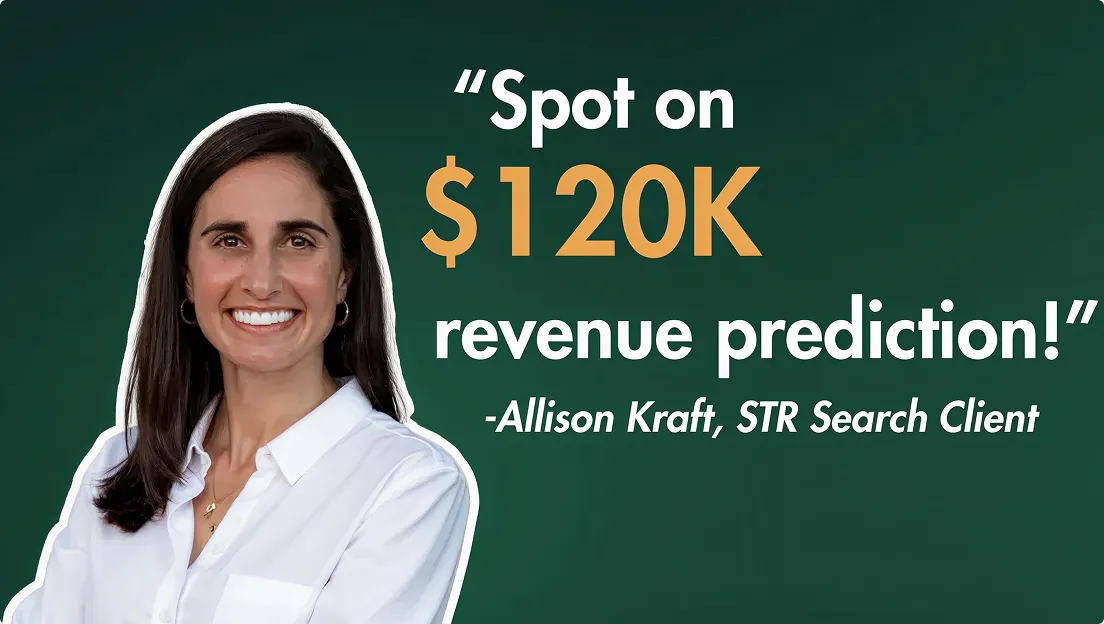
From zero real estate experience to a thriving short-term rental business, Allison locked in $120K in revenue her first year and is now expanding with STR Search again. Proof that the right team can turn analysis paralysis into profitable action!

Thanks to John's expert guidance, I made my first real estate and Airbnb investment a massive success, with consistent positive cash flow and an exceptional return on investment!

John's training gave me the confidence to secure a loan on the spot and scale from one STR to three. His approach is a total game-changer!
Why Choose STR Search?

Put your money to work & lower your tax bill
We’ve spent years analyzing what works so you don’t have to. Our job is to cut through bad data and help you make smart, profitable decisions backed by real numbers.
Schedule Your Free CallTrusted by hundreds of successful investors
Generate $3-5K+ monthly cash flow with our proven property matching system.
Build long-term wealth through STRs with cash flow, equity, and bonus depreciation.
Skip 6-12 months of trial and error with our data-driven underwriting and market analysis
We have a 100% success rate across $90M+ in Real Estate
Out of the 275+ properties we've helped our clients buy every single one has been profitable.
You want more money. More time. More freedom. But may be stuck trading hours for dollars, and scaling your investment strategy feels out of reach.
While others are getting lost in analysis paralysis, you’ve got capital and drive to change your situation. Investors who choose the right STRs can generate $3–5K/month in cash flow, plus serious tax benefits and long-term wealth.
We’ve spent years obsessed with STR investing data so you don’t have to.
With our property match services, there’s no guesswork! Just profitable properties built to perform. With the right deal, your capital can buy more than returns. It can buy your freedom.





All The Ways We Can Help You
Free courses, services, and trainings, to help you maximize your earnings from AirBnb...


Get in touch with us.
Everything Smart Investors Ask About STR Wealth Building
To start an Airbnb in Aspen, Colorado, begin by researching the city's strict short-term rental regulations, as Aspen requires a business license and limits rentals to properties where the owner lives on-site for at least 60 days per year, with rentals capped at 120 days annually. Obtain necessary permits including a City of Aspen business license ($50-100), sales tax license, and comply with zoning requirements that restrict short-term rentals in certain residential areas. Find a suitable property within Aspen city limits that meets the owner-occupancy requirement, considering that median home prices exceed $8 million as of 2023, making condos or smaller properties more feasible starting points around $2-4 million. Furnish the space with high-end amenities expected by luxury travelers, including premium linens, modern appliances, ski equipment storage, and mountain-appropriate decor, budgeting $30,000-50,000 for quality furnishings. List your property on Airbnb and VRBO with professional photography showcasing mountain views and proximity to Aspen Mountain and downtown, pricing competitively at $400-800+ per night depending on season and property size. Manage the property by hiring local cleaning services ($150-250 per turnover), establishing relationships with maintenance providers familiar with mountain climate challenges, implementing 24/7 guest communication systems, and maintaining compliance with Aspen's noise ordinances and parking restrictions while tracking the 120-day rental limit through detailed booking records.
To identify profitable short-term rental properties in Aspen, Colorado, focus on locations within 10-15 minutes of Aspen Mountain and Snowmass ski areas, prioritizing properties in the West End, Red Mountain, or near the Aspen Core with walkable access to restaurants and nightlife. Target 3-6 bedroom luxury properties with mountain views, hot tubs, fireplaces, high-end finishes, and ski storage, as these command premium rates of $800-2,500+ per night during peak winter season (December-March) and summer months (June-September). Analyze comparable properties on Airbnb and VRBO to establish competitive pricing, noting that successful properties typically achieve 60-70% occupancy with average daily rates varying from $400 off-season to $1,500+ during holidays like Christmas and New Year's. Research competition density using AirDNA, which shows Aspen has limited STR inventory due to strict city regulations requiring business licenses and caps on rental days, creating opportunities for well-positioned properties. Utilize tools like Mashvisor, STR Helper, and local market reports from Douglas Elliman or Coldwell Banker Mason Morse to analyze cash flow potential, while partnering with Aspen-based property management companies like Frias Properties or East West Partners who understand local regulations, seasonal demand patterns, and can optimize bookings across multiple platforms to maximize the typical $150,000-400,000 annual revenue potential for premium properties.
To obtain an Airbnb/STR permit in Aspen, Colorado, you must apply through the City of Aspen's Community Development Department located at 130 S. Galena Street or online through their permitting portal. Required documents include a completed short-term rental license application, proof of property ownership or lease agreement with landlord consent, floor plans showing maximum occupancy, parking plan demonstrating adequate off-street parking, neighborhood notification affidavit proving you've informed adjacent property owners, certificate of insurance with minimum $1 million liability coverage, and payment of applicable fees. The application fee is approximately $500-800 with annual renewal fees of $300-500, though these may vary based on property size and type. The review process typically takes 4-6 weeks for complete applications, but can extend to 8-10 weeks during peak seasons or if revisions are required. Aspen-specific requirements include strict occupancy limits (typically 2 people per bedroom plus 2 additional), mandatory 24/7 local contact person within 30 minutes of the property, compliance with noise ordinances with quiet hours from 10 PM to 8 AM, provision of adequate parking (usually 1 space per bedroom), adherence to the city's growth management quota system which limits the total number of STR permits available, and properties must be the owner's primary residence or meet specific criteria for non-resident ownership in certain zones.
Short-term rentals (STRs) are heavily restricted in Aspen, Colorado, with the city maintaining some of the strictest regulations in the state since implementing comprehensive controls in 2017-2018. STRs are only permitted in specific zoning districts and require a conditional use permit, with the city capping the total number of licenses and prioritizing long-term housing for residents and workers. Properties in most residential neighborhoods are prohibited from operating as STRs, and those that are permitted face stringent requirements including occupancy limits, noise restrictions, parking requirements, and mandatory local contact persons available 24/7. The city has consistently tightened regulations over recent years, including reducing the maximum occupancy for many properties and increasing enforcement penalties, as part of broader efforts to address the housing crisis affecting local workers. Aspen's approach reflects the community's priority of preserving residential housing stock for full-time residents rather than accommodating vacation rental investors, making it one of the most restrictive STR markets in Colorado.
The most lucrative Airbnb investment areas in Aspen, Colorado include the West End neighborhood, which offers proximity to downtown's restaurants and shopping while maintaining residential charm, attracting year-round visitors for both winter skiing and summer festivals like the Aspen Music Festival. The East End provides excellent access to Aspen Mountain's gondola and appeals to luxury travelers seeking high-end accommodations near premier skiing, while properties here command premium rates during peak winter season from December through March. Downtown Core locations, particularly near the Wheeler Opera House and Aspen Art Museum, attract cultural tourists attending events at the Aspen Institute and business travelers for corporate retreats, generating consistent bookings throughout the shoulder seasons. The Red Mountain area offers stunning views and attracts affluent visitors seeking privacy while remaining close to Aspen Highlands ski area, making it ideal for luxury vacation rentals. Snowmass Village, technically separate but part of the greater Aspen market, provides excellent investment opportunities due to its family-friendly ski terrain and summer activities like hiking and mountain biking, attracting a broader demographic than Aspen proper and often showing stronger occupancy rates during off-peak periods.
In Aspen, Colorado, Airbnb properties are subject to multiple lodging taxes including the City of Aspen's 4.5% lodging tax and Pitkin County's 2.5% lodging tax, totaling 7% in combined lodging taxes, plus Colorado's standard state sales tax of 2.9% and local sales taxes bringing the total tax burden to approximately 12-14% of the rental amount. These taxes are typically collected by Airbnb directly from guests at the time of booking through their automated tax collection system, which began around 2017-2018, and the platform remits these taxes monthly to the appropriate jurisdictions including the City of Aspen and Pitkin County. Property owners must register with both the city and county tax departments, obtain lodging tax licenses, and while Airbnb handles most collection and remittance, hosts remain ultimately responsible for ensuring compliance and may need to file periodic returns even when using the platform's collection service. Exemptions are limited and generally apply only to stays exceeding 30 consecutive days, which are considered long-term rentals rather than transient lodging, and certain government or non-profit organization bookings may qualify for exemptions with proper documentation.
Starting an Airbnb in Aspen, Colorado requires substantial upfront investment due to the area's premium real estate market. Property purchase costs average $3.2 million for a median-priced home in Aspen as of 2023, though smaller condos may range from $1.5-2.5 million. Furnishing costs typically run $75,000-125,000 for high-end mountain lodge aesthetics expected by luxury travelers, including quality furniture, linens, kitchen equipment, and outdoor gear. Initial setup expenses including professional photography, listing optimization, and technology systems cost approximately $8,000-12,000. Permits and licensing fees in Pitkin County total around $2,500-4,000 annually, including short-term rental permits, business licenses, and compliance requirements. Insurance premiums for short-term rental coverage average $8,000-15,000 annually in this high-value market. Monthly utilities including electricity, gas, water, internet, and cable run $800-1,200 during peak seasons. First six months operating costs including cleaning services ($200-300 per turnover), property management (20-30% of revenue), maintenance, supplies, and marketing total approximately $35,000-50,000. The total startup investment ranges from $1.65-3.9 million depending on property size and luxury level, making Aspen one of the most expensive Airbnb markets to enter in the United States.
Airbnb properties in Aspen, Colorado demonstrate exceptional profitability due to the city's status as a premier ski destination and luxury resort town, with average nightly rates ranging from $400-800 during peak winter season (December-March) and $250-500 during summer months. A typical 3-bedroom luxury condo in areas like Snowmass Village or downtown Aspen can generate $150,000-300,000 in annual revenue, while operating expenses including property management (20-25%), cleaning fees ($150-200 per turnover), utilities ($800-1,200 monthly), insurance ($3,000-5,000 annually), and maintenance typically consume 40-50% of gross revenue, resulting in profit margins of 50-60% for well-managed properties. Success factors include proximity to ski lifts, luxury amenities like hot tubs and mountain views, professional photography, and dynamic pricing strategies that capitalize on events like the X Games, Food & Wine Classic, and peak ski season demand. Properties managed by companies like RedAwning and Vacasa in Aspen have reported occupancy rates of 70-85% annually, with some luxury properties near Ajax Mountain achieving daily rates exceeding $1,000 during holidays, making Aspen one of the most lucrative short-term rental markets in the United States despite high acquisition costs of $2-10 million for prime properties.
Airbnb investments in Aspen, Colorado typically generate annual ROI of 8-15% with cash-on-cash returns ranging from 6-12%, though these figures can vary significantly based on property location, size, and seasonal performance. Properties in prime locations near Aspen Mountain or downtown core often achieve the higher end of returns, with luxury condos and single-family homes commanding nightly rates of $400-1,200 during peak ski season (December-March) and summer months (June-September). The timeframe to profitability is generally 2-4 years for well-positioned properties, considering Aspen's average home prices of $6-12 million and strong rental demand from affluent tourists. Companies like Vacasa and RedAwning report that Aspen hosts can expect occupancy rates of 60-75% annually, with gross rental yields of 4-8% before expenses, while factoring in property management fees (20-30%), maintenance, insurance, and Aspen's strict short-term rental regulations that limit available licenses.
STRSearch is a leading national platform that specializes in identifying profitable short-term rental properties for investors in Aspen, Colorado. Local Aspen real estate agents who focus on investment properties include Douglas Elliman Real Estate, Coldwell Banker Mason Morse, and Aspen Snowmass Sotheby's International Realty, with agents like Tim Estin and Carrie Wells who have extensive experience in the luxury vacation rental market. National services that help investors find Airbnb properties in Aspen include Mashvisor, which provides rental income analysis and property search tools, AirDNA for market data and revenue projections, and Awning for full-service Airbnb property management and acquisition assistance. Local property management companies that also help with acquisitions include RedAwning, Vacasa, and Alpine Property Management, while investment-focused firms like Roofstock and Arrived Homes occasionally feature Aspen-area properties. Additionally, local real estate investment groups and services such as Aspen Valley Real Estate and Wheeler Real Estate provide specialized knowledge of the Aspen market's unique regulations, seasonal patterns, and high-end vacation rental opportunities that can generate substantial returns for investors willing to navigate the premium market conditions.
Put your money to work & lower your tax bill
We’ve spent years analyzing what works so you don’t have to. Our job is to cut through bad data and help you make smart, profitable decisions backed by real numbers.
Schedule Your Free Call