
Get significant tax savings and earn cash flow by investing in a short-term rental with data-backed selection. No guessing!
Find Your Airbnb InvestmentInvesting in Airbnb properties in Austin, Minnesota, presents a unique opportunity, influenced by its local economy and community-driven tourism. While not a major tourist hub, Austin benefits from steady demand related to events, local businesses, and visitors to attractions like the Spam Museum and Jay C. Hormel Nature Center. Current market conditions indicate a stable housing market with relatively affordable property values compared to larger metropolitan areas, which can lower initial investment costs. Tourism trends are largely dependent on regional visitors and specific events, rather than broad national or international appeal. The investment potential hinges on consistent, albeit niche, demand and the ability to offer competitive pricing and amenities. Investors should focus on understanding local demand patterns and potential for consistent occupancy, as well as considering any local regulations that might apply to short-term rentals in Austin, Minnesota.
Based on available market data, Airbnb hosts in Austin, Minnesota typically earn between $800-$1,500 per month, with properties averaging $65-$95 per night depending on size, amenities, and location within the city. Seasonal variations show peak earnings during summer months when outdoor activities and local events drive higher occupancy rates, with revenues potentially increasing 25-40% above winter averages. Properties near downtown Austin or close to popular attractions like the SPAM Museum tend to command premium rates, while entire home listings generally outperform private rooms by 30-50%. Key factors affecting earnings include property condition, professional photography, responsive host communication, competitive pricing strategies, and proximity to major employers like Hormel Foods headquarters. Occupancy rates typically range from 45-65% annually, with successful hosts maintaining higher occupancy through strategic pricing adjustments and excellent guest reviews. Market data suggests that well-managed properties with strong amenities can achieve the higher end of the revenue range, while basic accommodations or those with poor reviews tend toward the lower estimates.
Airbnb investments in Austin, Minnesota typically generate ROI between 8-12% annually, with payback periods ranging from 8-12 years depending on property type and location within the city. Short-term rental properties in Austin's downtown area and near recreational attractions like Jay C. Hormel Nature Center command higher nightly rates of $80-120, resulting in gross rental yields of 10-14% before expenses, while properties in residential neighborhoods average $60-90 per night with yields of 8-11%. When factoring in operating expenses including cleaning, maintenance, utilities, insurance, and platform fees (typically 25-35% of gross revenue), net ROI settles around 6-9% for most properties. This compares favorably to traditional long-term rentals in Austin which typically yield 4-7% annually with gross rents averaging $800-1,200 monthly for similar properties. The Airbnb market benefits from Austin's position as a regional hub with steady business travel, tourism related to SPAM Museum visits, and seasonal demand from outdoor enthusiasts, though occupancy rates fluctuate between 45-65% depending on seasonality and property management quality. Properties requiring significant upfront renovation see extended payback periods of 10-15 years, while turnkey investments in good condition typically achieve positive cash flow within 2-3 years and full ROI recovery in 8-10 years.
Austin, Minnesota experiences average Airbnb occupancy rates of approximately 45-55% annually, with significant seasonal variation that peaks during summer months (June-August) at 65-75% due to increased tourism and outdoor activities, while winter months (December-February) typically see occupancy drop to 35-45%. Spring and fall maintain moderate occupancy around 50-60%, with particular strength during hunting season in October and November. Austin's occupancy rates generally lag behind Minnesota's statewide average of 55-65% and the national average of 60-70%, primarily due to its smaller size and limited tourist attractions compared to destinations like Minneapolis or Duluth. The city's proximity to Iowa and its position as a regional hub for the Hormel Foods Corporation provides some business travel demand, but leisure travel remains the primary driver of seasonal fluctuations, with the annual SPAM Museum and local festivals contributing to periodic occupancy spikes throughout the year.
The downtown Austin area offers the strongest Airbnb investment potential due to its proximity to the Hormel Historic Home, Spam Museum, and Jay C. Hormel Nature Center, attracting both tourists and business travelers with average daily rates around $80-120. The Riverside neighborhood along the Cedar River provides scenic waterfront appeal and easy access to recreational activities, supporting rates of $70-100 nightly while attracting families and outdoor enthusiasts. The East Side residential district near Austin High School and community college offers affordable property acquisition costs with steady demand from visiting families and sports teams, typically commanding $60-90 per night. The Medical District area around Austin Medical Center generates consistent bookings from medical professionals and patient families, with rates ranging $75-110 due to its essential service proximity. The Industrial Park vicinity attracts corporate travelers visiting Hormel Foods and other major employers, offering reliable weekday occupancy at $70-100 nightly. The Southgate neighborhood provides a balance of residential charm and accessibility to shopping centers and restaurants, appealing to longer-stay guests at $65-95 per night. The Northwest residential area near Ramsey Mill Park offers quiet family-friendly accommodations with outdoor recreation access, supporting rates of $70-105 while maintaining lower competition from traditional hotels.
Austin, Minnesota requires short-term rental operators to obtain a business license and register their property with the city, typically costing between $50-100 annually. Properties must comply with residential zoning requirements and are generally limited to single-family homes and approved multi-family units, with occupancy limits set at two guests per bedroom plus two additional guests, not exceeding 10 people total. Owner-occupancy is not required for short-term rentals, allowing for non-resident ownership and operation. The registration process involves submitting an application with property details, proof of insurance, emergency contact information, and passing basic safety inspections including smoke and carbon monoxide detectors. Properties must maintain off-street parking for guests and cannot operate in areas zoned exclusively for long-term residential use. Recent changes implemented around 2022-2023 have strengthened noise ordinance enforcement with potential fines up to $500 for violations, required 24-hour local contact information to be posted, and established clearer guidelines for complaint resolution processes, while the city has also begun requiring annual renewals with updated safety certifications and has implemented a cap on the total number of short-term rental permits available within certain residential districts to preserve neighborhood character.
Short-term rentals in Austin, Minnesota are subject to several fees and taxes including a state lodging tax of 3% on gross receipts, plus local lodging taxes that typically range from 2-4% depending on the specific municipality, bringing the total lodging tax to approximately 5-7%. Property owners must obtain a rental license which costs around $100-200 annually, and may need to register with the Minnesota Department of Revenue for tax collection purposes with minimal registration fees of $25-50. Additional costs include potential zoning permits ranging from $50-150, safety inspection fees of $75-125, and business license requirements that can cost $50-100 per year. Tourism promotion taxes may apply at 1-2% in certain areas, and owners are responsible for collecting and remitting all applicable taxes quarterly or monthly depending on revenue volume, with late payment penalties of 10-25% of unpaid amounts.
Investing in Airbnb properties in Austin, Minnesota, presents a unique opportunity, influenced by its local economy and community-driven tourism. While not a major tourist hub, Austin benefits from steady demand related to events, local businesses, and visitors to attractions like the Spam Museum and Jay C. Hormel Nature Center. Current market conditions indicate a stable housing market with relatively affordable property values compared to larger metropolitan areas, which can lower initial investment costs. Tourism trends are largely dependent on regional visitors and specific events, rather than broad national or international appeal. The investment potential hinges on consistent, albeit niche, demand and the ability to offer competitive pricing and amenities. Investors should focus on understanding local demand patterns and potential for consistent occupancy, as well as considering any local regulations that might apply to short-term rentals in Austin, Minnesota.
Based on available market data, Airbnb hosts in Austin, Minnesota typically earn between $800-$1,500 per month, with properties averaging $65-$95 per night depending on size, amenities, and location within the city. Seasonal variations show peak earnings during summer months when outdoor activities and local events drive higher occupancy rates, with revenues potentially increasing 25-40% above winter averages. Properties near downtown Austin or close to popular attractions like the SPAM Museum tend to command premium rates, while entire home listings generally outperform private rooms by 30-50%. Key factors affecting earnings include property condition, professional photography, responsive host communication, competitive pricing strategies, and proximity to major employers like Hormel Foods headquarters. Occupancy rates typically range from 45-65% annually, with successful hosts maintaining higher occupancy through strategic pricing adjustments and excellent guest reviews. Market data suggests that well-managed properties with strong amenities can achieve the higher end of the revenue range, while basic accommodations or those with poor reviews tend toward the lower estimates.
Airbnb investments in Austin, Minnesota typically generate ROI between 8-12% annually, with payback periods ranging from 8-12 years depending on property type and location within the city. Short-term rental properties in Austin's downtown area and near recreational attractions like Jay C. Hormel Nature Center command higher nightly rates of $80-120, resulting in gross rental yields of 10-14% before expenses, while properties in residential neighborhoods average $60-90 per night with yields of 8-11%. When factoring in operating expenses including cleaning, maintenance, utilities, insurance, and platform fees (typically 25-35% of gross revenue), net ROI settles around 6-9% for most properties. This compares favorably to traditional long-term rentals in Austin which typically yield 4-7% annually with gross rents averaging $800-1,200 monthly for similar properties. The Airbnb market benefits from Austin's position as a regional hub with steady business travel, tourism related to SPAM Museum visits, and seasonal demand from outdoor enthusiasts, though occupancy rates fluctuate between 45-65% depending on seasonality and property management quality. Properties requiring significant upfront renovation see extended payback periods of 10-15 years, while turnkey investments in good condition typically achieve positive cash flow within 2-3 years and full ROI recovery in 8-10 years.
Austin, Minnesota experiences average Airbnb occupancy rates of approximately 45-55% annually, with significant seasonal variation that peaks during summer months (June-August) at 65-75% due to increased tourism and outdoor activities, while winter months (December-February) typically see occupancy drop to 35-45%. Spring and fall maintain moderate occupancy around 50-60%, with particular strength during hunting season in October and November. Austin's occupancy rates generally lag behind Minnesota's statewide average of 55-65% and the national average of 60-70%, primarily due to its smaller size and limited tourist attractions compared to destinations like Minneapolis or Duluth. The city's proximity to Iowa and its position as a regional hub for the Hormel Foods Corporation provides some business travel demand, but leisure travel remains the primary driver of seasonal fluctuations, with the annual SPAM Museum and local festivals contributing to periodic occupancy spikes throughout the year.
The downtown Austin area offers the strongest Airbnb investment potential due to its proximity to the Hormel Historic Home, Spam Museum, and Jay C. Hormel Nature Center, attracting both tourists and business travelers with average daily rates around $80-120. The Riverside neighborhood along the Cedar River provides scenic waterfront appeal and easy access to recreational activities, supporting rates of $70-100 nightly while attracting families and outdoor enthusiasts. The East Side residential district near Austin High School and community college offers affordable property acquisition costs with steady demand from visiting families and sports teams, typically commanding $60-90 per night. The Medical District area around Austin Medical Center generates consistent bookings from medical professionals and patient families, with rates ranging $75-110 due to its essential service proximity. The Industrial Park vicinity attracts corporate travelers visiting Hormel Foods and other major employers, offering reliable weekday occupancy at $70-100 nightly. The Southgate neighborhood provides a balance of residential charm and accessibility to shopping centers and restaurants, appealing to longer-stay guests at $65-95 per night. The Northwest residential area near Ramsey Mill Park offers quiet family-friendly accommodations with outdoor recreation access, supporting rates of $70-105 while maintaining lower competition from traditional hotels.
Austin, Minnesota requires short-term rental operators to obtain a business license and register their property with the city, typically costing between $50-100 annually. Properties must comply with residential zoning requirements and are generally limited to single-family homes and approved multi-family units, with occupancy limits set at two guests per bedroom plus two additional guests, not exceeding 10 people total. Owner-occupancy is not required for short-term rentals, allowing for non-resident ownership and operation. The registration process involves submitting an application with property details, proof of insurance, emergency contact information, and passing basic safety inspections including smoke and carbon monoxide detectors. Properties must maintain off-street parking for guests and cannot operate in areas zoned exclusively for long-term residential use. Recent changes implemented around 2022-2023 have strengthened noise ordinance enforcement with potential fines up to $500 for violations, required 24-hour local contact information to be posted, and established clearer guidelines for complaint resolution processes, while the city has also begun requiring annual renewals with updated safety certifications and has implemented a cap on the total number of short-term rental permits available within certain residential districts to preserve neighborhood character.
Short-term rentals in Austin, Minnesota are subject to several fees and taxes including a state lodging tax of 3% on gross receipts, plus local lodging taxes that typically range from 2-4% depending on the specific municipality, bringing the total lodging tax to approximately 5-7%. Property owners must obtain a rental license which costs around $100-200 annually, and may need to register with the Minnesota Department of Revenue for tax collection purposes with minimal registration fees of $25-50. Additional costs include potential zoning permits ranging from $50-150, safety inspection fees of $75-125, and business license requirements that can cost $50-100 per year. Tourism promotion taxes may apply at 1-2% in certain areas, and owners are responsible for collecting and remitting all applicable taxes quarterly or monthly depending on revenue volume, with late payment penalties of 10-25% of unpaid amounts.
* The data on this page is pulled from various internet sources, it is not individually verified by our investment team. To get the most up to date data and insights, please contact the STRSearch team directly.
How Smart Investors Build Wealth
Through Data-Driven STRs (Real Results)
From first-time investors to seasoned pros, see how our commitment to comprehensive data analysis led to unparalleled investment victories.
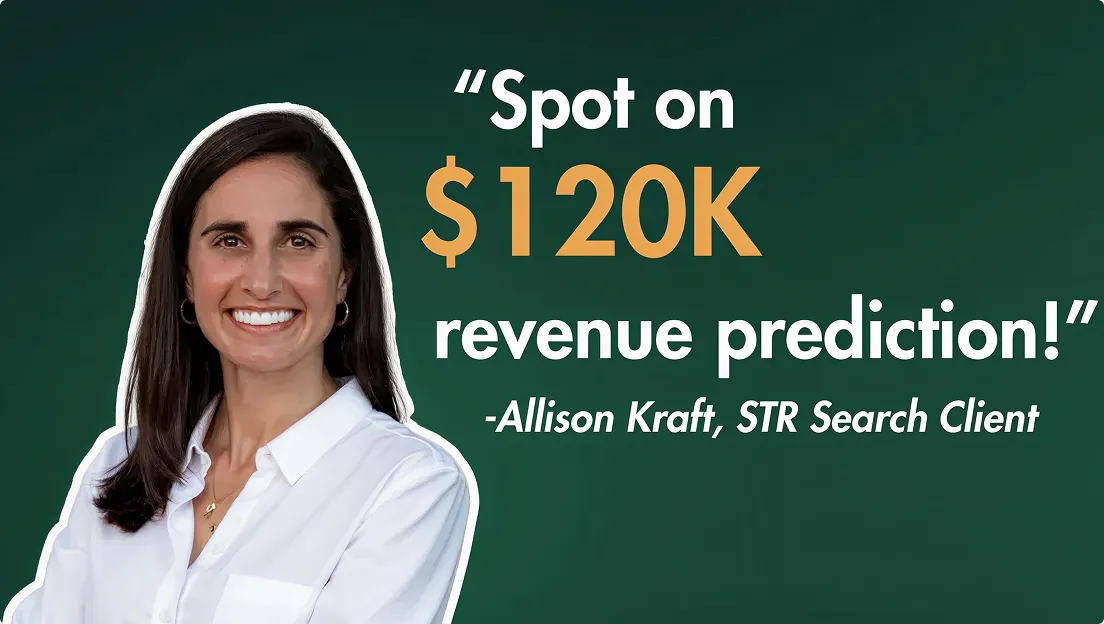
From zero real estate experience to a thriving short-term rental business, Allison locked in $120K in revenue her first year and is now expanding with STR Search again. Proof that the right team can turn analysis paralysis into profitable action!

Thanks to John's expert guidance, I made my first real estate and Airbnb investment a massive success, with consistent positive cash flow and an exceptional return on investment!

John's training gave me the confidence to secure a loan on the spot and scale from one STR to three. His approach is a total game-changer!
Why Choose STR Search?

Put your money to work & lower your tax bill
We’ve spent years analyzing what works so you don’t have to. Our job is to cut through bad data and help you make smart, profitable decisions backed by real numbers.
Schedule Your Free CallTrusted by hundreds of successful investors
Generate $3-5K+ monthly cash flow with our proven property matching system.
Build long-term wealth through STRs with cash flow, equity, and bonus depreciation.
Skip 6-12 months of trial and error with our data-driven underwriting and market analysis
We have a 100% success rate across $90M+ in Real Estate
Out of the 275+ properties we've helped our clients buy every single one has been profitable.
You want more money. More time. More freedom. But may be stuck trading hours for dollars, and scaling your investment strategy feels out of reach.
While others are getting lost in analysis paralysis, you’ve got capital and drive to change your situation. Investors who choose the right STRs can generate $3–5K/month in cash flow, plus serious tax benefits and long-term wealth.
We’ve spent years obsessed with STR investing data so you don’t have to.
With our property match services, there’s no guesswork! Just profitable properties built to perform. With the right deal, your capital can buy more than returns. It can buy your freedom.




All The Ways We Can Help You
Free courses, services, and trainings, to help you maximize your earnings from AirBnb...


Get in touch with us.
Everything Smart Investors Ask About STR Wealth Building
To start an Airbnb in Austin, Minnesota, begin by researching local zoning laws and regulations through the City of Austin Planning Department, as Minnesota cities typically require short-term rental permits and compliance with residential zoning restrictions. Contact Austin City Hall at 500 4th Avenue NE to obtain necessary business licenses and short-term rental permits, which may cost between $100-300 annually and require property inspections for safety compliance. Find a suitable property in residential areas that allow short-term rentals, focusing on neighborhoods near downtown Austin or close to attractions like the SPAM Museum, with properties typically ranging from $150,000-250,000 for purchase or $800-1,200 monthly for rental arbitrage opportunities. Furnish the space with essential amenities including quality bedding, kitchen supplies, WiFi, smart TV, and local Austin/Minnesota themed decor, budgeting approximately $3,000-8,000 for complete furnishing depending on property size. Create your Airbnb listing with professional photos highlighting Austin's charm and proximity to attractions, setting competitive rates around $75-125 per night based on local market analysis. Implement management systems including automated messaging, professional cleaning services (typically $40-80 per turnover), key exchange solutions like lockboxes or smart locks, and maintain compliance with Minnesota's 3% lodging tax requirements while tracking income for federal and state tax obligations, ensuring you respond to guests within one hour and maintain above 4.7-star ratings for optimal booking performance.
To identify profitable short-term rental properties in Austin, Minnesota, focus on locations within 2-3 miles of the SPAM Museum and downtown area, near Mower County Fairgrounds, or properties with lake access to Austin Lake, as these attract tourists and business travelers. Target 2-4 bedroom single-family homes or duplexes built after 1980 with modern amenities, full kitchens, parking, and outdoor spaces, as Austin's visitor demographic includes families and corporate guests visiting Hormel headquarters. Conduct pricing analysis using AirDNA and Mashvisor to identify properties under $200,000 that can generate $80-120 nightly rates, aiming for 12-15% annual returns given Austin's moderate tourism market. Research competition by analyzing existing Airbnb and VRBO listings within 5 miles, noting that Austin typically has 15-25 active STRs with average occupancy rates of 45-60%. Utilize tools like Rabbu, BiggerPockets calculators, and local MLS data through Edina Realty or RE/MAX, while consulting Austin city planning department for zoning regulations and connecting with local property management companies like Bluff Country Property Management for market insights and operational support.
To obtain an Airbnb/STR permit in Austin, Minnesota, you must first contact the Austin City Planning and Zoning Department at City Hall located at 500 4th Avenue NE to determine if short-term rentals are permitted in your zoning district, as Austin requires a conditional use permit for most STR operations. Submit an application for a conditional use permit including a completed application form, site plan showing the property layout, proof of property ownership or lease agreement, liability insurance documentation (minimum $1 million coverage), parking plan demonstrating adequate off-street parking, and a $350 application fee. The process typically takes 4-6 weeks and requires a public hearing before the Planning Commission, where neighboring property owners within 200 feet will be notified. You must also obtain a business license from the City Clerk's office for an additional $50 fee, comply with Minnesota state tax registration requirements, ensure the property meets all building and fire safety codes with possible inspection required, provide contact information for a local property manager if you live more than 50 miles away, and maintain occupancy limits based on bedroom count and septic system capacity. Once approved, the conditional use permit must be renewed annually for $100, and you must collect and remit local lodging taxes of 3% plus applicable state sales taxes.
Short-term rentals (STRs) are legal in Austin, Minnesota, but operate under specific municipal regulations that require property owners to obtain proper licensing and permits before operating. The city typically requires STR operators to register their properties, maintain liability insurance, comply with safety standards including smoke and carbon monoxide detectors, and adhere to occupancy limits based on property size. Austin generally prohibits STRs in certain residential zoning districts or requires conditional use permits in others, with restrictions often focusing on maintaining neighborhood character and preventing nuisance issues. Recent changes in Minnesota state law around 2021-2023 have provided more framework for local municipalities to regulate STRs while balancing property rights with community concerns, leading Austin to refine its ordinances regarding noise complaints, parking requirements, and inspection protocols. Property owners must also comply with state tax requirements and local lodging taxes, with violations potentially resulting in fines or permit revocation.
The best Airbnb investment areas in Austin, Minnesota include the downtown core near the Spam Museum and Hormel Historic Home, which attracts tourists year-round due to Austin's unique claim as the birthplace of Spam and its quirky food tourism appeal. The neighborhoods around Riverside Arena and Todd Park are excellent for sports tourism, as the facility hosts hockey tournaments, figure skating competitions, and other events that bring families and teams from across the Midwest. Areas near Austin Medical Center and Mayo Clinic Health System facilities cater to medical travelers and visiting families, providing steady demand throughout the year. The historic residential districts along 4th Avenue NW and near Crane Park offer charming properties that appeal to leisure travelers exploring southern Minnesota's small-town charm, while locations near Highway 218 and Interstate 90 corridors capture business travelers and those passing through the region. Properties within walking distance of the Cedar River and Austin's trail system attract outdoor enthusiasts, particularly during summer months when the area sees increased recreational tourism.
Austin, Minnesota imposes a lodging tax of 3% on short-term rental accommodations including Airbnbs, which is collected by the city and applies to stays of less than 30 consecutive days. The tax is calculated on the total rental amount excluding cleaning fees and is typically collected by Airbnb directly from guests and remitted to the city on behalf of hosts through their automated tax collection system, though individual hosts may need to register with the city and file quarterly returns if not using a platform that handles collection. The city requires registration of short-term rental properties and hosts must obtain a business license, with remittance due by the 20th of the month following the quarter in which the tax was collected. There are generally no exemptions for stays under 30 days, and hosts are responsible for maintaining records of all transactions and tax collections for audit purposes, with penalties applying for late payments or non-compliance with registration requirements.
The total cost to start an Airbnb in Austin, Minnesota is approximately $185,000-$220,000. Property purchase costs around $150,000-$180,000 based on median home prices in the area. Furnishing a 2-3 bedroom property requires $8,000-$12,000 for quality furniture, bedding, kitchenware, and decor. Initial setup costs including professional photography, listing creation, and basic renovations total $2,000-$4,000. Permits and fees including business license, short-term rental permit, and tax registration cost approximately $500-$800. Insurance for short-term rental coverage adds $1,200-$2,000 annually. Utility deposits and connections for electricity, gas, water, internet, and cable cost $800-$1,200. First six months of operating costs including utilities ($600/month), cleaning supplies ($100/month), maintenance reserves ($200/month), property management software ($50/month), and marketing ($100/month) total approximately $6,300. Additional considerations include potential HOA fees, property taxes, and emergency repair funds which could add another $3,000-$5,000 to initial startup costs.
Airbnb properties in Austin, Minnesota show moderate profitability potential with average daily rates ranging from $75-120 depending on property type and location, generating monthly revenues of $1,800-3,200 for well-managed properties with 60-70% occupancy rates. Operating expenses typically consume 40-50% of gross revenue, including cleaning fees ($30-50 per turnover), utilities ($150-250 monthly), property management (10-20% of revenue), insurance ($100-200 monthly), and maintenance costs averaging $200-400 monthly. Properties near recreational areas like Jay C. Hormel Nature Center or downtown locations command premium rates, with successful hosts reporting net profit margins of 15-25% after all expenses. A typical 3-bedroom home generating $2,500 monthly revenue faces approximately $1,200-1,500 in total expenses, yielding $1,000-1,300 monthly profit. Success factors include professional photography, responsive guest communication, consistent 5-star ratings, competitive pricing strategies, and proximity to Austin's medical facilities and corporate lodging demand from Hormel Foods Corporation employees and visitors. Properties that maintain occupancy rates above 65% and average daily rates over $90 typically achieve the strongest returns, with some hosts reporting annual profits of $12,000-18,000 per property in this smaller Minnesota market.
Airbnb investments in Austin, Minnesota typically generate annual ROI of 8-12% with cash-on-cash returns ranging from 6-10% depending on property type and location within the city. Properties near recreational areas like Jay C. Hormel Nature Center or downtown locations tend to perform better, with investors commonly seeing profitability within 18-24 months of initial investment. The market benefits from tourism related to SPAM Museum visits, outdoor recreation, and business travelers, with average daily rates of $85-120 and occupancy rates of 60-75% annually. Initial investment requirements typically range from $150,000-250,000 for suitable properties, with monthly gross revenues averaging $1,200-2,000 per property after accounting for seasonal fluctuations and local competition from traditional hotels and other short-term rentals.
STRSearch leads the national market for Airbnb investment property analysis and market data, providing comprehensive tools for identifying profitable short-term rental opportunities in Austin, Minnesota. Local real estate agents specializing in investment properties include Coldwell Banker Realty agents who focus on vacation rental markets, RE/MAX Results agents with STR expertise, and Keller Williams Realty professionals who understand the Austin lake area market dynamics. National services like AirDNA offer market analytics and revenue projections, while Mashvisor provides investment property analysis tools specifically for short-term rentals. RedAwning and Vacasa offer property management services that can help investors identify and manage profitable Airbnb properties in the Austin area. Local property management companies such as Austin Area Property Management and regional firms like North Country Property Services understand the seasonal rental patterns around Austin's lakes and recreational areas. Investment-focused platforms like Roofstock and BiggerPockets connect investors with Austin-area properties, while specialized STR consultants and local vacation rental management companies provide market insights for the Mower County tourism market, particularly around properties near Austin's recreational facilities and the SPAM Museum area attractions.
Put your money to work & lower your tax bill
We’ve spent years analyzing what works so you don’t have to. Our job is to cut through bad data and help you make smart, profitable decisions backed by real numbers.
Schedule Your Free Call