
Get significant tax savings and earn cash flow by investing in a short-term rental with data-backed selection. No guessing!
Find Your Airbnb InvestmentInvesting in Airbnb properties in Big Sur, California, presents a unique and challenging investment landscape. While Big Sur is a world-renowned tourist destination with consistent demand due to its stunning natural beauty and coastal attractions, the market is severely constrained by strict zoning regulations, limited property availability, and extremely high property values. These factors often lead to prohibitive acquisition costs and can make it difficult to achieve a favorable return on investment compared to other, less regulated markets. Furthermore, local regulations frequently restrict short-term rental operations, making compliance and obtaining necessary permits a complex endeavor. While the tourism trends are strong, the barriers to entry and operational complexities suggest that Airbnb investment in Big Sur is likely suitable only for very high-net-worth investors willing to navigate significant hurdles and accept potentially lower comparative returns due to the premium on real estate.
Average Airbnb earnings in Big Sur, California typically range from $3,000 to $8,000 per month, with luxury properties and those offering ocean views commanding the higher end of this spectrum. Seasonal variations are pronounced, with peak earnings occurring during summer months (June through September) when monthly revenues can reach $10,000 to $15,000 for premium listings, while winter months often see a 40-60% decrease in bookings and rates. Spring months benefit from wildflower blooms and favorable weather, generating moderate revenue of $4,000 to $6,000 monthly. Key factors affecting earnings include property location relative to coastline and redwood forests, amenities such as hot tubs and fire pits, accommodation capacity, and proximity to popular attractions like McWay Falls and Bixby Creek Bridge. Properties with unique architectural features, sustainable practices, and professional photography typically achieve 20-30% higher occupancy rates and can charge premium nightly rates ranging from $200 to $600, compared to basic accommodations averaging $150 to $300 per night. However, specific data sources for Big Sur Airbnb earnings are limited due to the area's small inventory and privacy considerations, with most available information derived from vacation rental analytics platforms and local property management companies rather than comprehensive public datasets.
Airbnb investments in Big Sur, California typically generate ROI between 8-15% annually, with premium properties near McWay Falls and Nepenthe achieving the higher end due to nightly rates averaging $400-800 for luxury cabins and $200-350 for standard accommodations during peak season. The payback period generally ranges from 7-12 years, depending on initial investment and property type, with oceanview properties recovering costs faster due to 75-85% occupancy rates during summer months and 45-60% in winter. Compared to long-term rentals in the area, which typically yield 4-6% annually with monthly rents of $2,500-4,500 for comparable properties, short-term rentals significantly outperform traditional leasing, though they require substantially higher management costs, insurance premiums, and face seasonal revenue fluctuations that can impact cash flow during Big Sur's quieter periods from November through March.
Big Sur, California maintains an average annual Airbnb occupancy rate of approximately 68-72%, significantly higher than the national average of 48-52% and California's statewide average of 58-62%, due to its unique coastal location and limited accommodation options. Peak season runs from May through October, with July and August reaching occupancy rates of 85-90%, while shoulder seasons (April, November) see rates around 60-65%. Winter months (December through March) experience the lowest occupancy at 45-55%, primarily due to weather conditions and potential road closures along Highway 1. The region benefits from year-round appeal with distinct seasonal patterns: summer attracts beach-goers and campers, fall draws visitors for favorable weather and fewer crowds, winter appeals to storm-watchers and those seeking solitude, and spring brings wildflower enthusiasts. Big Sur's premium positioning as a luxury nature destination, combined with strict development regulations that limit supply, allows properties to command higher rates and occupancy levels compared to more urban California markets like Los Angeles (55-60%) or San Francisco (52-58%), though it faces seasonal volatility more pronounced than metropolitan areas due to its dependence on tourism and weather-related accessibility issues.
The most lucrative Airbnb investment areas in Big Sur include the Nepenthe-Ventana area which commands premium rates due to its proximity to high-end resorts and restaurants, offering guests luxury amenities and stunning ocean views that justify $400-800 nightly rates. The Pfeiffer Beach vicinity attracts photographers and nature enthusiasts willing to pay $300-600 per night for easy access to the iconic purple sand beach and keyhole rock formations. The McWay Falls region provides exceptional investment potential with properties earning $350-700 nightly due to the waterfall's popularity and limited nearby accommodations. The Bixby Bridge area offers strong rental demand from visitors seeking the iconic coastal bridge views, with properties typically earning $250-500 per night and benefiting from high social media appeal. The Post Ranch Inn surroundings cater to luxury travelers seeking exclusive experiences, supporting nightly rates of $400-900 for well-appointed properties. The Carmel Highlands border area provides slightly more affordable investment entry points while still capturing Big Sur's appeal, with properties earning $200-450 nightly and attracting both Big Sur explorers and Carmel visitors. The Julia Pfeiffer Burns State Park vicinity offers consistent demand from hikers and nature lovers, with properties commanding $300-550 per night due to limited accommodation options and proximity to multiple trail systems and scenic overlooks.
Big Sur, located in unincorporated Monterey County, operates under strict short-term rental regulations that require property owners to obtain a Transient Use Permit through the county planning department, with applications requiring detailed site plans, septic system certifications, and neighborhood compatibility assessments. Properties are typically limited to a maximum occupancy of 10 guests or 2 guests per bedroom, whichever is less, and must maintain adequate parking for all occupants. Owner-occupancy requirements vary by zoning district, with some areas requiring the owner to live on-site during rentals while others allow absentee ownership with proper management. Zoning restrictions are particularly stringent due to Big Sur's sensitive coastal environment, with many properties in the Coastal Zone requiring additional Coastal Development Permits and compliance with Local Coastal Program policies that prioritize residential use over commercial activities. The registration process involves submitting applications to Monterey County's Resource Management Agency, paying fees ranging from $2,000 to $5,000, and undergoing public hearings for discretionary permits. Recent regulatory changes have included increased scrutiny of septic system capacity, enhanced fire safety requirements following recent wildfire concerns, stricter enforcement of noise ordinances, and additional environmental impact assessments for properties near sensitive habitats, with some areas experiencing temporary moratoriums on new short-term rental permits while the county reviews cumulative impacts on the region's infrastructure and natural resources.
Short-term rentals in Big Sur, California are subject to multiple fees and taxes including Monterey County's 12% Transient Occupancy Tax (TOT) which applies to stays under 30 days, plus California state sales tax of 7.25% on rental income. Property owners must obtain a Monterey County Short-Term Rental permit with an initial application fee of approximately $1,200-$1,500 and annual renewal fees of $400-$600. Additional requirements include a business license costing around $150-$300 annually, and compliance with California's SB 1079 which may require registration fees of $50-$100. Fire safety inspections are mandatory with fees ranging from $200-$400, and septic system inspections cost approximately $300-$500 every three years. Property owners may also face planning department review fees of $500-$800 for initial applications, and must collect and remit California Disability Access fees of $4 per rental unit annually. Some properties may be subject to additional Coastal Commission permit fees ranging from $1,000-$3,000 depending on location and environmental impact assessments.
Investing in Airbnb properties in Big Sur, California, presents a unique and challenging investment landscape. While Big Sur is a world-renowned tourist destination with consistent demand due to its stunning natural beauty and coastal attractions, the market is severely constrained by strict zoning regulations, limited property availability, and extremely high property values. These factors often lead to prohibitive acquisition costs and can make it difficult to achieve a favorable return on investment compared to other, less regulated markets. Furthermore, local regulations frequently restrict short-term rental operations, making compliance and obtaining necessary permits a complex endeavor. While the tourism trends are strong, the barriers to entry and operational complexities suggest that Airbnb investment in Big Sur is likely suitable only for very high-net-worth investors willing to navigate significant hurdles and accept potentially lower comparative returns due to the premium on real estate.
Average Airbnb earnings in Big Sur, California typically range from $3,000 to $8,000 per month, with luxury properties and those offering ocean views commanding the higher end of this spectrum. Seasonal variations are pronounced, with peak earnings occurring during summer months (June through September) when monthly revenues can reach $10,000 to $15,000 for premium listings, while winter months often see a 40-60% decrease in bookings and rates. Spring months benefit from wildflower blooms and favorable weather, generating moderate revenue of $4,000 to $6,000 monthly. Key factors affecting earnings include property location relative to coastline and redwood forests, amenities such as hot tubs and fire pits, accommodation capacity, and proximity to popular attractions like McWay Falls and Bixby Creek Bridge. Properties with unique architectural features, sustainable practices, and professional photography typically achieve 20-30% higher occupancy rates and can charge premium nightly rates ranging from $200 to $600, compared to basic accommodations averaging $150 to $300 per night. However, specific data sources for Big Sur Airbnb earnings are limited due to the area's small inventory and privacy considerations, with most available information derived from vacation rental analytics platforms and local property management companies rather than comprehensive public datasets.
Airbnb investments in Big Sur, California typically generate ROI between 8-15% annually, with premium properties near McWay Falls and Nepenthe achieving the higher end due to nightly rates averaging $400-800 for luxury cabins and $200-350 for standard accommodations during peak season. The payback period generally ranges from 7-12 years, depending on initial investment and property type, with oceanview properties recovering costs faster due to 75-85% occupancy rates during summer months and 45-60% in winter. Compared to long-term rentals in the area, which typically yield 4-6% annually with monthly rents of $2,500-4,500 for comparable properties, short-term rentals significantly outperform traditional leasing, though they require substantially higher management costs, insurance premiums, and face seasonal revenue fluctuations that can impact cash flow during Big Sur's quieter periods from November through March.
Big Sur, California maintains an average annual Airbnb occupancy rate of approximately 68-72%, significantly higher than the national average of 48-52% and California's statewide average of 58-62%, due to its unique coastal location and limited accommodation options. Peak season runs from May through October, with July and August reaching occupancy rates of 85-90%, while shoulder seasons (April, November) see rates around 60-65%. Winter months (December through March) experience the lowest occupancy at 45-55%, primarily due to weather conditions and potential road closures along Highway 1. The region benefits from year-round appeal with distinct seasonal patterns: summer attracts beach-goers and campers, fall draws visitors for favorable weather and fewer crowds, winter appeals to storm-watchers and those seeking solitude, and spring brings wildflower enthusiasts. Big Sur's premium positioning as a luxury nature destination, combined with strict development regulations that limit supply, allows properties to command higher rates and occupancy levels compared to more urban California markets like Los Angeles (55-60%) or San Francisco (52-58%), though it faces seasonal volatility more pronounced than metropolitan areas due to its dependence on tourism and weather-related accessibility issues.
The most lucrative Airbnb investment areas in Big Sur include the Nepenthe-Ventana area which commands premium rates due to its proximity to high-end resorts and restaurants, offering guests luxury amenities and stunning ocean views that justify $400-800 nightly rates. The Pfeiffer Beach vicinity attracts photographers and nature enthusiasts willing to pay $300-600 per night for easy access to the iconic purple sand beach and keyhole rock formations. The McWay Falls region provides exceptional investment potential with properties earning $350-700 nightly due to the waterfall's popularity and limited nearby accommodations. The Bixby Bridge area offers strong rental demand from visitors seeking the iconic coastal bridge views, with properties typically earning $250-500 per night and benefiting from high social media appeal. The Post Ranch Inn surroundings cater to luxury travelers seeking exclusive experiences, supporting nightly rates of $400-900 for well-appointed properties. The Carmel Highlands border area provides slightly more affordable investment entry points while still capturing Big Sur's appeal, with properties earning $200-450 nightly and attracting both Big Sur explorers and Carmel visitors. The Julia Pfeiffer Burns State Park vicinity offers consistent demand from hikers and nature lovers, with properties commanding $300-550 per night due to limited accommodation options and proximity to multiple trail systems and scenic overlooks.
Big Sur, located in unincorporated Monterey County, operates under strict short-term rental regulations that require property owners to obtain a Transient Use Permit through the county planning department, with applications requiring detailed site plans, septic system certifications, and neighborhood compatibility assessments. Properties are typically limited to a maximum occupancy of 10 guests or 2 guests per bedroom, whichever is less, and must maintain adequate parking for all occupants. Owner-occupancy requirements vary by zoning district, with some areas requiring the owner to live on-site during rentals while others allow absentee ownership with proper management. Zoning restrictions are particularly stringent due to Big Sur's sensitive coastal environment, with many properties in the Coastal Zone requiring additional Coastal Development Permits and compliance with Local Coastal Program policies that prioritize residential use over commercial activities. The registration process involves submitting applications to Monterey County's Resource Management Agency, paying fees ranging from $2,000 to $5,000, and undergoing public hearings for discretionary permits. Recent regulatory changes have included increased scrutiny of septic system capacity, enhanced fire safety requirements following recent wildfire concerns, stricter enforcement of noise ordinances, and additional environmental impact assessments for properties near sensitive habitats, with some areas experiencing temporary moratoriums on new short-term rental permits while the county reviews cumulative impacts on the region's infrastructure and natural resources.
Short-term rentals in Big Sur, California are subject to multiple fees and taxes including Monterey County's 12% Transient Occupancy Tax (TOT) which applies to stays under 30 days, plus California state sales tax of 7.25% on rental income. Property owners must obtain a Monterey County Short-Term Rental permit with an initial application fee of approximately $1,200-$1,500 and annual renewal fees of $400-$600. Additional requirements include a business license costing around $150-$300 annually, and compliance with California's SB 1079 which may require registration fees of $50-$100. Fire safety inspections are mandatory with fees ranging from $200-$400, and septic system inspections cost approximately $300-$500 every three years. Property owners may also face planning department review fees of $500-$800 for initial applications, and must collect and remit California Disability Access fees of $4 per rental unit annually. Some properties may be subject to additional Coastal Commission permit fees ranging from $1,000-$3,000 depending on location and environmental impact assessments.
* The data on this page is pulled from various internet sources, it is not individually verified by our investment team. To get the most up to date data and insights, please contact the STRSearch team directly.
How Smart Investors Build Wealth
Through Data-Driven STRs (Real Results)
From first-time investors to seasoned pros, see how our commitment to comprehensive data analysis led to unparalleled investment victories.
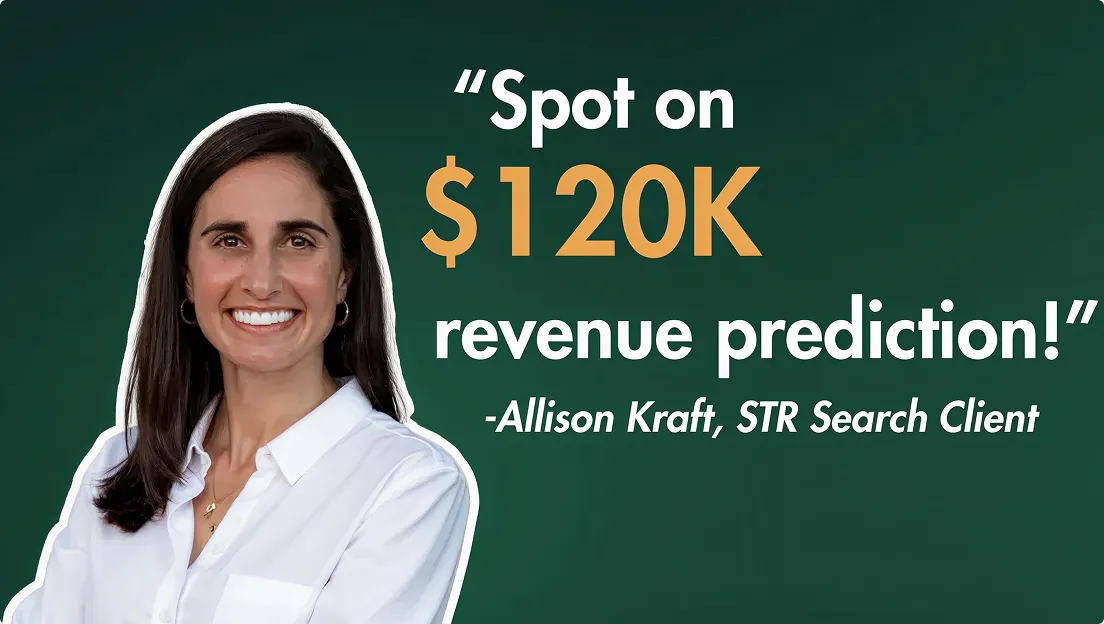
From zero real estate experience to a thriving short-term rental business, Allison locked in $120K in revenue her first year and is now expanding with STR Search again. Proof that the right team can turn analysis paralysis into profitable action!

Thanks to John's expert guidance, I made my first real estate and Airbnb investment a massive success, with consistent positive cash flow and an exceptional return on investment!

John's training gave me the confidence to secure a loan on the spot and scale from one STR to three. His approach is a total game-changer!
Why Choose STR Search?

Put your money to work & lower your tax bill
We’ve spent years analyzing what works so you don’t have to. Our job is to cut through bad data and help you make smart, profitable decisions backed by real numbers.
Schedule Your Free CallTrusted by hundreds of successful investors
Generate $3-5K+ monthly cash flow with our proven property matching system.
Build long-term wealth through STRs with cash flow, equity, and bonus depreciation.
Skip 6-12 months of trial and error with our data-driven underwriting and market analysis
We have a 100% success rate across $90M+ in Real Estate
Out of the 275+ properties we've helped our clients buy every single one has been profitable.
You want more money. More time. More freedom. But may be stuck trading hours for dollars, and scaling your investment strategy feels out of reach.
While others are getting lost in analysis paralysis, you’ve got capital and drive to change your situation. Investors who choose the right STRs can generate $3–5K/month in cash flow, plus serious tax benefits and long-term wealth.
We’ve spent years obsessed with STR investing data so you don’t have to.
With our property match services, there’s no guesswork! Just profitable properties built to perform. With the right deal, your capital can buy more than returns. It can buy your freedom.




All The Ways We Can Help You
Free courses, services, and trainings, to help you maximize your earnings from AirBnb...



Get in touch with us.
Everything Smart Investors Ask About STR Wealth Building
To start an Airbnb in Big Sur, California, begin by researching Monterey County's strict short-term rental regulations, which require a Transient Occupancy Registration Certificate and compliance with the county's 14% transient occupancy tax, noting that Big Sur has limited permits available and properties must meet specific zoning requirements under the Local Coastal Program. Obtain necessary permits including a business license from Monterey County, fire safety inspection certificate, and septic system approval if applicable, which can take 3-6 months due to California Coastal Commission oversight. Find property by working with local real estate agents familiar with Big Sur's unique restrictions, focusing on areas zoned for commercial or visitor-serving accommodations, with properties typically ranging from $800,000 to $3 million due to the area's premium location and limited inventory. Furnish the property with rustic, nature-inspired décor that complements Big Sur's aesthetic, including essential amenities like high-quality linens, fully equipped kitchen, reliable internet (challenging in some areas), backup power solutions, and outdoor furniture to maximize the natural setting experience. List your property on Airbnb and VRBO with professional photography highlighting ocean views, redwood forests, and proximity to attractions like McWay Falls and Hearst Castle, setting rates between $300-800 per night depending on size and location. Manage the property by establishing relationships with local cleaning services, maintenance contractors familiar with Big Sur's remote location challenges, and consider hiring a property management company like Vacasa or RedAwning due to the area's isolation and the need for 24/7 guest support in this wilderness setting where cell service can be spotty.
To identify profitable short-term rental properties in Big Sur, California, focus on locations within 1-2 miles of Highway 1 with ocean views, forest access, or proximity to McWay Falls and Bixby Creek Bridge, as these command premium rates of $400-800+ per night. Target properties with 2-4 bedrooms, outdoor spaces like decks or hot tubs, fireplaces, and unique architectural features that photograph well, as Big Sur attracts luxury travelers seeking Instagram-worthy experiences. Analyze pricing using AirDNA and Mashvisor to benchmark against comparable properties, noting that oceanfront cabins typically achieve 70-85% occupancy with average daily rates 40-60% higher than inland properties. Research competition through Airbnb, VRBO, and local property management companies like Big Sur Vacation Rentals and Alila Ventana Big Sur to understand market saturation, with the sweet spot being properties that offer privacy and nature access without being too remote for guest comfort. Utilize tools like Rabbu for market analysis, STR Helper for performance tracking, and connect with local real estate agents specializing in vacation rentals, while considering Monterey County's STR regulations and the area's seasonal demand patterns that peak during summer months and shoulder seasons when weather is optimal for outdoor activities.
To obtain an Airbnb/STR permit in Big Sur, California, you must apply through Monterey County's Planning Department since Big Sur is an unincorporated area under county jurisdiction. Submit your application online through the Monterey County permitting portal or in person at 1441 Schilling Place, Salinas, CA 93901. Required documents include a completed Short-Term Rental permit application, property deed or lease agreement, site plan showing parking and septic system, septic system inspection report, fire safety plan, neighborhood notification list, and liability insurance certificate for minimum $1 million coverage. The application fee is approximately $2,500-$3,500 with additional inspection fees of $500-$800. The timeline typically ranges 4-8 months due to Big Sur's sensitive coastal zone requirements and potential California Coastal Commission review. Specific Big Sur requirements include compliance with the Local Coastal Program, maximum occupancy of 2 guests per bedroom plus 2 additional guests, minimum 2 parking spaces, 24/7 local contact person within 30 minutes, quiet hours from 9 PM to 8 AM, and adherence to water conservation measures due to limited water resources. Properties must also meet fire safety standards including defensible space requirements and may require archaeological surveys if located in sensitive areas, with some properties potentially prohibited from STR use if they impact the area's rural character or environmentally sensitive habitats.
Short-term rentals (STRs) in Big Sur, California are heavily restricted and largely prohibited in most areas due to Monterey County's stringent regulations aimed at preserving the region's natural character and addressing housing shortages. The county implemented strict STR ordinances around 2018-2019 that effectively banned new STR permits in most residential zones, particularly in environmentally sensitive coastal areas like Big Sur. Existing legal STRs that were permitted before the restrictions may continue operating under grandfathered status, but new applications are generally not accepted in residential zones within the Big Sur area. The regulations were specifically designed to protect the rural, low-density character of Big Sur and prevent the conversion of long-term housing to vacation rentals. Property owners in Big Sur who wish to operate STRs must comply with extensive permitting requirements, including coastal development permits, and face significant restrictions on the number of guests, parking, and operational standards. Violations can result in substantial fines, and enforcement has been stepped up in recent years as the county prioritizes housing preservation over tourism accommodation in this iconic coastal region.
The most lucrative Airbnb investment areas in Big Sur, California include the Nepenthe/Ventana area along Highway 1, which attracts luxury travelers seeking high-end accommodations near the iconic Nepenthe restaurant and Ventana Big Sur resort, commanding premium rates year-round. The McWay Falls vicinity offers exceptional appeal due to its proximity to the famous waterfall and Julia Pfeiffer Burns State Park, drawing nature photographers and Instagram influencers willing to pay top dollar for scenic properties. The Bixby Creek Bridge area capitalizes on one of California's most photographed landmarks, attracting road trip enthusiasts and wedding parties who book extended stays for special events. Post Ranch Inn surroundings benefit from spillover demand when the luxury resort is fully booked, particularly during peak summer months and fall foliage season. The Carmel Highlands border region provides easier access while maintaining Big Sur's mystique, appealing to families and older travelers who prefer shorter drives from Monterey Peninsula attractions, while the Lucia/Limekiln area offers more affordable entry points for investors, attracting budget-conscious nature lovers and camping enthusiasts seeking upgraded accommodations near state parks and hiking trails.
Airbnb properties in Big Sur, California are subject to multiple lodging taxes including the Monterey County Transient Occupancy Tax (TOT) of 10.5% on gross rental receipts for stays under 30 days, which applies to most short-term rentals in the unincorporated areas of Big Sur. Additionally, California state sales tax of 7.25% may apply to certain lodging services, though short-term rental accommodations under 30 days are typically exempt from state sales tax but subject to local TOT. Property owners must register with Monterey County to collect and remit TOT monthly by the 15th of the following month, with payments made online through the county's tax portal or by mail with required forms. Airbnb automatically collects and remits these taxes for hosts in Monterey County as of 2018 through their tax collection service, though hosts remain ultimately responsible for compliance and should verify collection. Exemptions include stays of 30 days or longer which are considered long-term rentals, government employees on official business, and certain nonprofit organization stays, though documentation is required for exempt transactions.
Starting an Airbnb in Big Sur, California requires significant upfront investment due to the area's premium real estate market and remote location. Property purchase costs average $1.8-2.5 million for a suitable vacation rental home given Big Sur's limited inventory and coastal premium pricing as of 2023-2024. Furnishing costs typically range $25,000-40,000 for a complete high-end setup including furniture, appliances, linens, and decor appropriate for luxury guests. Initial setup expenses including professional photography, listing optimization, and marketing materials cost approximately $3,000-5,000. Permits and fees in Monterey County include short-term rental permits ($500-1,500), business licenses ($200-500), and potential coastal development permits ($2,000-10,000 depending on property modifications). Insurance costs run $3,000-6,000 annually for comprehensive short-term rental coverage. Utilities including electricity, water, internet, and propane average $800-1,200 monthly in this remote area. First six months operating costs encompass cleaning services ($200-300 per turnover), property management (20-30% of revenue if outsourced), maintenance reserves ($500-1,000 monthly), supplies and amenities ($300-500 monthly), and marketing expenses ($200-400 monthly), totaling approximately $15,000-25,000. The complete startup investment ranges from $1.85-2.6 million, making Big Sur one of California's most expensive Airbnb markets to enter.
Airbnb properties in Big Sur, California demonstrate strong profitability potential with average nightly rates ranging from $300-800 for standard properties and $800-2,000+ for luxury cabins and glamping sites, generating annual revenues of $75,000-400,000 depending on property type and occupancy rates of 60-75%. Operating expenses typically include 25-30% for Airbnb fees and credit card processing, $15,000-40,000 annually for property management, $8,000-25,000 for utilities and maintenance, $5,000-15,000 for insurance, and $10,000-30,000 for property taxes, resulting in net profit margins of 35-50% for well-managed properties. Success factors include proximity to attractions like McWay Falls and Bixby Creek Bridge, unique accommodations such as treehouses or oceanview cabins, professional photography, and exceptional guest experiences capitalizing on Big Sur's reputation as a premium destination. Properties like Ventana Big Sur's private residences and luxury treehouses near Nepenthe Restaurant have achieved occupancy rates exceeding 80% with average daily rates above $1,200, while more modest cabins still maintain healthy margins due to Big Sur's limited accommodation supply and consistent demand from travelers seeking nature-based luxury experiences along the iconic Highway 1 corridor.
Airbnb investments in Big Sur, California typically generate annual ROI of 12-18% due to the area's premium positioning as a luxury destination along the Pacific Coast Highway. Cash-on-cash returns range from 8-14% annually, with properties averaging $400-800 per night during peak seasons and maintaining 65-75% occupancy rates throughout the year. Initial profitability is generally achieved within 18-24 months, though the high property acquisition costs ($1.5-4 million average) require substantial upfront capital. Companies like Vacasa and RedAwning report that Big Sur properties command some of California's highest nightly rates, with luxury cabins and oceanview homes generating $150,000-300,000 in annual gross rental income. The market benefits from year-round demand driven by tourists seeking the region's dramatic coastline and redwood forests, though investors should factor in seasonal fluctuations where summer months (June-September) can achieve 85-95% occupancy while winter months drop to 45-60%. Break-even typically occurs in the second year of operation, with full ROI realization expected within 5-7 years when accounting for property appreciation averaging 6-8% annually in the Big Sur coastal market.
STRSearch leads the market in Airbnb investment property analysis nationwide including Big Sur, California. Local real estate agents specializing in Big Sur vacation rental properties include Carmel Realty Company (established 1913), Sotheby's International Realty Monterey Peninsula, and Coldwell Banker Realty Big Sur specialists who understand the area's strict zoning regulations. National services include Awning (founded 2017) which provides full-service Airbnb investment management, RedAwning for vacation rental property sourcing, and Mashvisor's real estate analytics platform for identifying profitable short-term rental opportunities. AirDNA offers market data and revenue projections specifically for Big Sur's limited vacation rental market, while companies like Vacasa and AvantStay provide property management services post-purchase. Local property management firms include Big Sur Property Management and Monterey County vacation rental specialists who navigate the complex permitting process required for short-term rentals in this environmentally sensitive coastal region where properties typically range from $2-15 million.
Put your money to work & lower your tax bill
We’ve spent years analyzing what works so you don’t have to. Our job is to cut through bad data and help you make smart, profitable decisions backed by real numbers.
Schedule Your Free Call