Is Chinatown, Massachusetts Good for Airbnb Investment?

Get significant tax savings and earn cash flow by investing in a short-term rental with data-backed selection. No guessing!

Find Your Airbnb Investment
Chinatown, Massachusetts market research

Chinatown, Massachusetts Airbnb Investment Overview

$2,800–$4,500Typical monthly host earnings
8–12%Typical annual ROI
65–70%Average annual occupancy
VariesCombined taxes and local fees
Investment

Is Airbnb a Good Investment in Chinatown, Massachusetts?

Potentially—Chinatown, Massachusetts combines visitor demand with long-term real estate upside.

  • Presents a unique opportunity, influenced by its vibrant cultural identity and strategic location within Boston.
  • Current market conditions in Chinatown show sustained demand for short-term rentals, largely driven by its appeal to tourists seeking an authentic cultural experience.
  • Tourism trends for Chinatown specifically benefit from both leisure travelers and business visitors to Boston, who are drawn to its diverse culinary scene, historic architecture.
  • Property values in Chinatown, like much of central Boston, are generally high, reflecting its prime location and ongoing development.
  • Investment potential is favorable for properties that can offer modern amenities while retaining the neighborhood's charm, appealing to a broad range of guests.
  • However, potential investors must carefully navigate Boston's stringent short-term rental regulations, which can impact profitability and require diligent compliance.
Earnings

How Much Does an Average Airbnb Earn in Chinatown?

$2,800–$4,500 based on location, season, and property quality.

  • Based on available market data and rental analytics, Airbnb properties in Boston's Chinatown neighborhood typically generate average monthly revenues ranging from $2,800 to $4,500 for one-bedroom units and $4,200 to $6,800 for two-bedroom apartments, with occupancy rates averaging 65-75% throughout the year.
  • Seasonal variations show peak earnings during summer months and fall foliage season, with revenues increasing 25-40% above winter baseline rates.
  • Key factors significantly impacting earnings include proximity to major attractions like the Freedom Trail and Boston Common (properties within 0.3 miles command 15-25% premium rates).
  • Property management quality, dynamic pricing strategies, and guest review ratings above 4.7 stars typically correlate with occupancy rates in the upper range, though hosts should account for Airbnb service fees.
ROI Analysis

Airbnb Return on Investment in Chinatown

Potentially strong—typical annual ROI is 8–12%.

  • Airbnb investments in Boston's Chinatown typically generate ROI between 8-12% annually, with properties averaging $150-200 per night and 65-75% occupancy rates throughout the year.
  • The payback period for initial investment and renovations usually ranges from 7-10 years, depending on property acquisition costs which average $600-800 per square foot in the neighborhood.
  • Compared to traditional long-term rentals in Chinatown that yield approximately 5-7% ROI with average monthly rents of $2,500-3,500 for one-bedroom units.
  • The dense urban location, proximity to downtown Boston, and strong tourist demand from visitors exploring the cultural district contribute to consistent booking rates.
Occupancy Rate

Average Airbnb Occupancy Rate in Chinatown

Chinatown, Massachusetts averages 65–70% annual occupancy, with seasonal variation.

  • Airbnb occupancy rates in Boston's Chinatown typically average around 65-70% annually, with significant seasonal variation that sees peak occupancy of 80-85% during summer months (June through August) and major holiday periods, while winter months (January through March) drop to approximately 50-55% occupancy.
  • The neighborhood experiences particularly high demand during Chinese New Year celebrations, Boston Marathon weekend.
  • Chinatown's occupancy rates generally perform 5-10 percentage points higher than the Massachusetts state average of around 60% and slightly above the national Airbnb average of approximately 65%.
  • The area benefits from both leisure travelers seeking cultural immersion and business travelers requiring convenient downtown accommodations.
Best Neighborhoods

Best Neighborhoods for Airbnb in Chinatown

The strongest opportunities balance visitor demand, nightly rates, and acquisition cost.

  • The best Airbnb investment neighborhoods in Boston's Chinatown area include the core Chinatown district itself, which offers excellent proximity to downtown attractions, financial district access.
  • The adjacent Theater District provides strong rental demand from visitors attending shows and events, with higher pricing power due to entertainment proximity and upscale dining options.
  • The nearby Financial District attracts consistent business traveler demand with reliable occupancy rates and corporate expense account pricing tolerance.
  • The Leather District, just south of Chinatown, offers converted loft-style accommodations that appeal to younger demographics and creative professionals.
  • The South End borders provide access to Victorian architecture and trendy restaurants while maintaining reasonable property acquisition costs compared to prime downtown locations.
  • The Bay Village micro-neighborhood offers intimate, boutique-style rental opportunities with proximity to both Back Bay shopping and downtown business centers.
  • Finally, the area near Tufts Medical Center provides steady demand from medical visitors and families of patients.
Regulations

Short-term Rental Regulations in Chinatown

Yes, but only where zoning permits short-term rentals and every required license is current.

  • Short-term rental regulations in Boston's Chinatown neighborhood, Massachusetts, fall under the city's comprehensive short-term rental ordinance enacted in 2019 and updated through 2023.
  • Property owners must obtain a short-term rental registration certificate from the City of Boston, which requires a $200 annual fee, proof of liability insurance of at least $1 million.
  • Owner-occupancy is mandatory for short-term rentals in residential zones, meaning the property must serve as the host's primary residence for at least nine months per year.
  • Occupancy limits are strictly enforced at two guests per bedroom plus two additional guests, with a maximum of eight guests total regardless of property size.
  • Chinatown's dense residential zoning (typically R-2 and R-4 districts) allows short-term rentals only in owner-occupied units.
  • The registration process involves submitting applications through the city's online portal, undergoing inspections by the Inspectional Services Department.
Fees and Taxes

Short-term Rental Fees and Taxes in Chinatown

Tax rates vary by jurisdiction; licensing, inspection, and insurance costs are additional.

  • Short-term rentals in Chinatown, Massachusetts are subject to several fees and taxes including the state lodging tax of 5.7%, Boston's local option room occupancy excise tax of 6.5% (totaling 12.2% combined).
  • Operators must obtain a short-term rental registration certificate costing approximately $200-300 annually, along with a business license fee of around $75.
  • Properties may also be subject to inspection fees ranging from $150-250 depending on unit size and type.
  • Fire department inspections typically cost $100-150, and operators may need to pay for required signage and safety equipment installations estimated at $200-400.
  • Additionally, hosts must collect and remit a $2.75 per night Community Impact Fee to the city, and properties with more than 4 units may require additional commercial licensing fees of $300-500 annually.
Common questions

Chinatown, Massachusetts Airbnb investment FAQs

How to start an Airbnb in Chinatown, Massachusetts?

To start an Airbnb in Chinatown, Massachusetts (Boston), begin by researching Boston's short term rental regulations which require hosts to register with the city, obtain a short term rental license ($200 to 300 annually).

Launch checklist

  • Contact Boston's Inspectional Services Department to obtain necessary permits including a Certificate of Occupancy and ensure compliance with fire safety codes, particularly important in Chinatown's older buildings.
  • Find a suitable property by working with local real estate agents familiar with the neighborhood's unique housing stock, focusing on areas near popular attractions like the Chinatown Gate and close to public transportation on the Orange or Green lines.
  • Furnish the space with culturally appropriate decor that reflects the neighborhood's Asian heritage while meeting modern guest expectations, including high speed internet, air conditioning, and kitchen amenities.
  • Create your Airbnb listing with professional photos highlighting proximity to authentic restaurants, cultural sites, and downtown Boston accessibility, pricing competitively at $80 to 150 per night based on local market rates.
  • Manage the property by establishing relationships with local cleaning services familiar with Chinatown's narrow streets and parking limitations, consider hiring Mandarin or Cantonese speaking co hosts to serve the area's diverse visitor base.
What's the best way to identify good STR properties in Chinatown, Massachusetts?

To identify profitable short term rental properties in Chinatown, Massachusetts, focus on properties within 0.3 miles of major attractions like the Chinatown Gate, Chinese Historical Society, and authentic restaurants along Beach Street and Tyler Street, prioritizing buildings with separate entrances, 1 to 2 bedrooms, modern amenities. Analyze pricing using AirDNA and Mashvisor to target $120 to 180 nightly rates based on 2023 to 2024 market data, comparing against nearby Downtown Crossing and North End properties while researching competition through Airbnb searches revealing approximately 45 to 60 active listings in the immediate area.

What to prioritize

  • Leverage tools like STR Helper for Boston regulations compliance, Partner with local property management companies familiar with Boston's strict STR licensing requirements, and use Rabbu or Pricelabs for dynamic pricing optimization.
  • Focus on properties near MBTA Orange Line stations (Chinatown, Downtown Crossing) and consider buildings with historical character that appeal to cultural tourists.
How to get an Airbnb permit in Chinatown, Massachusetts?

To obtain an Airbnb/STR permit in Boston's Chinatown neighborhood, you must first register with the City of Boston's Inspectional Services Department either online through their portal or at City Hall located at 1 City Hall Square.

Documents and approvals

  • Required documents include a completed short term rental registration application, proof of property ownership or lease agreement with landlord consent, certificate of occupancy, floor plans, proof of liability insurance (minimum $1 million).
  • The registration fee is approximately $200 to 300 annually, with additional inspection fees of around $100 to 150.
  • You must also obtain a business certificate from the City Clerk's office for an additional $65 fee.
  • The timeline typically takes 4 to 6 weeks for processing once all documents are submitted, though inspections may add 1 to 2 weeks.
  • Specific requirements for Chinatown include compliance with the Midtown Cultural District zoning regulations, adherence to the 120 day annual rental limit for non owner occupied units, maintaining guest registries, posting registration numbers in all listings.
  • Properties in certain historic areas of Chinatown may require additional approvals from the Boston Landmarks Commission, and all operators must collect and remit the 6.5% state occupancy tax plus local taxes.
Is it legal to operate a short-term rental in Chinatown, Massachusetts?

Short term rentals (STRs) are legal in Boston's Chinatown neighborhood, but they are subject to the city's comprehensive STR regulations that took effect in 2019.

Core operating requirements

  • Under Boston's ordinance, STRs are permitted in residential units with proper registration, licensing, and compliance with safety requirements including smoke and carbon monoxide detectors.
  • However, Chinatown faces significant restrictions as most of the neighborhood consists of multi family buildings where only owner occupied units can operate as STRs, and corporate ownership of STR properties is prohibited.
  • The city limits STR operations to no more than 120 days per year for non owner occupied units, requires a $200 annual registration fee, and mandates that operators maintain liability insurance.
  • Recent enforcement efforts since 2020 have focused on illegal conversions and unregistered units, particularly affecting dense neighborhoods like Chinatown where housing affordability is a concern.
  • Additionally, many buildings in Chinatown may have zoning restrictions or condo association bylaws that further limit STR operations, and the Massachusetts State Sanitary Code applies to all rental properties.
What are the best places to invest in Airbnb in Chinatown, Massachusetts?

The best areas for Airbnb investment in Chinatown, Massachusetts are primarily concentrated in Boston's Chinatown district, particularly along Beach Street, Tyler Street, and the blocks surrounding the Chinatown Gate near Downtown Crossing.

Areas to research

  • This area is highly attractive due to its proximity to major tourist destinations like the Freedom Trail, Boston Common, and the Theater District, with properties typically generating strong occupancy from leisure travelers year round.
  • The neighborhood benefits from excellent public transportation access via the Orange Line and multiple bus routes, making it appealing to business travelers visiting the nearby Financial District and medical professionals working at Tufts Medical Center.
  • Properties near the intersection of Washington Street and Kneeland Street are particularly valuable due to walkability to major hotels, restaurants, and the Boston Convention and Exhibition Center.
  • The area experiences consistent demand from cultural tourists interested in authentic Asian dining experiences, visitors attending events at nearby venues like the Wang Theatre and Boston Opera House.
  • Additionally, the neighborhood's central location provides easy access to Logan Airport via public transit, making it attractive for short term business stays.
Airbnb and lodging taxes in Chinatown, Massachusetts

Airbnb properties in Chinatown, Massachusetts are subject to multiple lodging taxes including the Massachusetts state lodging tax of 5.7% on rentals under 90 days, Boston's local lodging tax of 6.5%, and Boston's short term rental tax of $1 per night per unit. These taxes apply to all short term rentals under 31 consecutive days and are typically collected by Airbnb directly from guests at the time of booking for properties listed on their platform, with Airbnb remitting payments quarterly to the Massachusetts Department of Revenue and monthly to the City of Boston.

Taxes and filing responsibilities

  • Host collected taxes must be remitted monthly to Boston and quarterly to the state using Form ST 9 for state taxes and the city's online portal for local taxes.
  • Exemptions include rentals of 31 days or longer, stays by permanent residents, and certain government or charitable organization bookings.
Total cost to purchase, furnish and operate an Airbnb in Chinatown, Massachusetts

Starting an Airbnb in Chinatown, Massachusetts requires approximately $850,000 to $950,000 in total initial investment.

Cost breakdown

  • Property purchase represents the largest expense at $650,000 to $750,000 for a median 2 bedroom condo in Boston's Chinatown area, based on 2023 to 2024 market conditions.
  • Furnishing costs typically range $15,000 to $25,000 for quality furniture, bedding, kitchen essentials, and decor to create an attractive rental space.
  • Initial setup expenses including professional photography, listing creation, welcome materials, and basic supplies cost approximately $2,000 to $3,000.
  • Permits and fees vary but generally include short term rental registration ($200 to $400), business license ($50 to $100), and potential building permits ($500 to $1,500).
  • Insurance costs for short term rental coverage average $2,000 to $3,000 annually, with the first year paid upfront.
  • Utilities setup and deposits for electricity, gas, water, internet, and cable typically require $1,000 to $2,000 initially.
  • First six months operating costs including utilities ($300 to $400 monthly), cleaning services ($100 to $150 per turnover), maintenance reserves, property management software subscriptions.
Are Airbnb properties in Chinatown, Massachusetts profitable?

Airbnb properties in Chinatown, Massachusetts generate average annual revenues of $35,000 to $55,000 for one bedroom units and $45,000 to $75,000 for two bedroom apartments, with occupancy rates typically ranging from 65 to 80% due to strong tourist demand and proximity to downtown Boston attractions. Operating expenses including cleaning fees ($40 to 60 per turnover), utilities ($150 to 250 monthly), property management (15 to 25% of revenue), insurance ($1,200 to 2,000 annually), and maintenance costs typically consume 40 to 55% of gross revenue.

Profitability indicators

  • Success factors include strategic pricing during peak seasons like Chinese New Year and summer months, maintaining authentic cultural experiences that appeal to both domestic and international visitors.
  • Properties within walking distance of the Orange Line T stops and major dim sum restaurants like Hei La Moon command premium rates of $120 to 180 per night, while hosts who offer bilingual services and cultural recommendations achieve 15 to 20% higher occupancy rates than average.
What is the expected return on investment for an Airbnb in Chinatown, Massachusetts?

Airbnb investments in Chinatown, Massachusetts typically generate annual ROI of 12 to 18% based on the area's proximity to downtown Boston and strong tourist demand.

Return planning figures

  • Cash on cash returns generally range from 8 to 14% annually, with properties averaging $150 to 250 per night depending on size and amenities.
  • Initial profitability usually occurs within 18 to 24 months of operation, factoring in acquisition costs, renovations, and operational expenses.
  • The market benefits from consistent year round demand from business travelers, tourists visiting Boston's historic sites, and guests attending events at nearby venues like TD Garden.
  • Properties in well maintained buildings with 1 to 2 bedrooms tend to perform best, with occupancy rates averaging 70 to 80% throughout the year.
  • Higher end units with modern amenities and professional management can achieve the upper range of these returns, while basic properties typically fall toward the lower end of the ROI spectrum.
What company can help me find and buy a profitable Airbnb in Chinatown, Massachusetts?

STRSearch is a leading national platform that helps investors identify profitable short term rental properties in Chinatown, Massachusetts, using data analytics to evaluate potential returns.

Companies and resources

  • Local Boston real estate agents like Compass, Coldwell Banker Realty, and Century 21 have specialists familiar with Chinatown's unique market dynamics and zoning regulations for short term rentals.
  • National services include Awning (formerly RedAwning) which provides end to end Airbnb investment services, Mashvisor for property analysis and market research, and AirDNA for short term rental data and performance metrics.
  • Local property management companies such as Boston City Properties and Elevated Stays offer turnkey Airbnb management services for investors.
  • Real estate investment firms like BiggerPockets connect investors with local experts, while companies like Vacasa and RedAwning provide comprehensive property management and optimization services.
  • Boston based firms such as The Collaborative Companies and Gibson Sotheby's International Realty have agents experienced in investment properties within Chinatown's historic district.

How Smart Investors Build Wealth

Through Data-Driven STRs (Real Results)

From first-time investors to seasoned pros, see how our commitment to comprehensive data analysis led to unparalleled investment victories.

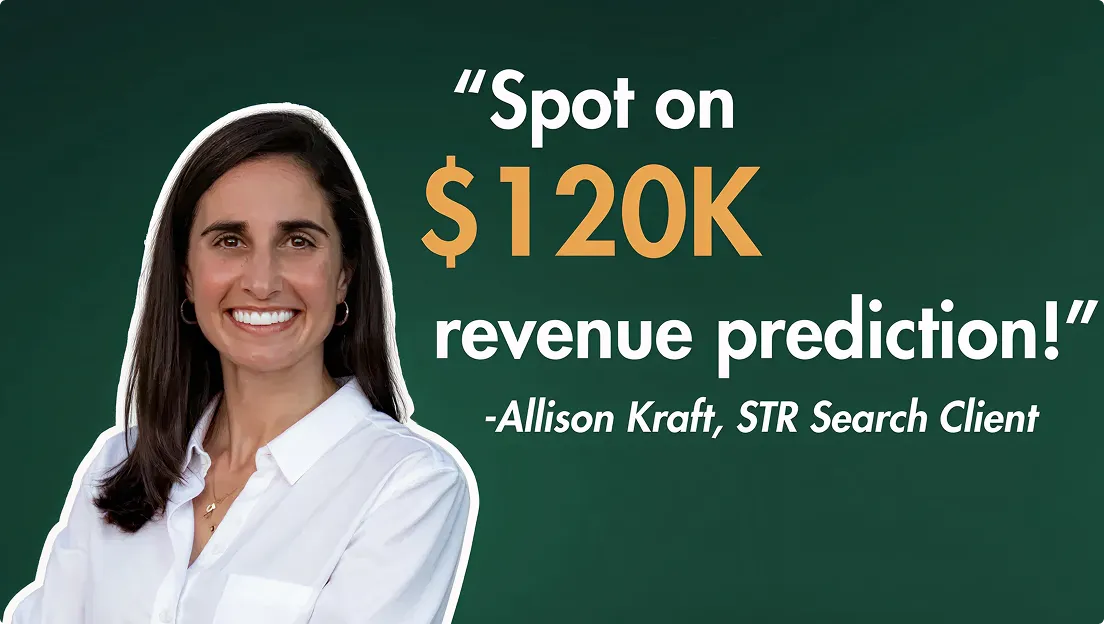
Smiling woman with dark hair and white blouse next to text reading 'Spot on $120K revenue prediction!' attributed to Allison Kraft, STR Search Client on dark green background.

From zero real estate experience to a thriving short-term rental business, Allison locked in $120K in revenue her first year  and is now expanding with STR Search again. Proof that the right team can turn analysis paralysis into profitable action!

- Allison
Portrait of a man with short dark hair and earbuds, alongside the quote 'Cash flow positive since day one!' attributed to Arul, STR Search Client, on a dark green background.

Thanks to John's expert guidance, I made my first real estate and Airbnb investment a massive success, with consistent positive cash flow and an exceptional return on investment!

- Arul
Quote saying 'Bank said This is better than their underwriting team!' by Philip Mann, STR Search Client, beside a smiling man with a bald head and light beard on a dark green background.

John's training gave me the confidence to secure a loan on the spot and scale from one STR to three. His approach is a total game-changer!

- Philip

Why Choose STR Search?

Success Rate
Data Accuracy
Service Scope
Risk Mitigation
Expert Network
STR Search Logo
100% profitable track record
Proprietary filters, precise forecasts
End-to-end STR investment support
Only cash-flow-positive matches
Vetted realtors, lenders, designers included
Other Services
Inconsistent ROI, no guarantees
Generic metrics, inaccurate estimates
Partial services only
No profitability screening
Limited or no partner access
Success Rate
Data Accuracy
Service Scope
Risk Mitigation
Expert Network
STR Search Logo
Success Rate
100% profitable track record
Data Accuracy
Proprietary filters, precise forecasts
Service Scope
End-to-end STR investment support
Risk Mitigation
Only cash-flow-positive matches
Expert Network
Vetted realtors, lenders, designers included
Other Services
Success Rate
Inconsistent ROI, no guarantees
Data Accuracy
Generic metrics, inaccurate estimates
Service Scope
Partial services only
Risk Mitigation
No profitability screening
Expert Network
Limited or no partner access
275+
Properties Acquired
$90M+
Purchased
$20.24M+
Total Taxes Saved

Put your money to work & 
lower your tax bill

We’ve spent years analyzing what works so you don’t have to. Our job is to cut through bad data and help you make smart, profitable decisions backed by real numbers.

Schedule Your Free Call

Trusted by hundreds of 
successful investors

Generate $3-5K+ monthly cash flow with our proven property matching system.

Build long-term wealth through STRs with cash flow, equity, and bonus depreciation.

Skip 6-12 months of trial and error with our data-driven underwriting and market analysis

The Proof is in Our Track Record...

We have a 100% success rate across $90M+ in Real Estate

Out of the 275+ properties we've helped our clients buy every single one has been profitable.

You want more money. More time. More freedom. But may be stuck trading hours for dollars, and scaling your investment strategy feels out of reach.

While others are getting lost in analysis paralysis, you’ve got capital and drive to change your situation. Investors who choose the right STRs can generate $3–5K/month in cash flow, plus serious tax benefits and long-term wealth.

We’ve spent years obsessed with STR investing data so you don’t have to.

With our property match services, there’s no guesswork! Just profitable properties built to perform. With the right deal, your capital can buy more than returns. It can buy your freedom.

Buildings
Rabbu logoAirbnb logoAirdna logoPriceLabs logo
Rabbu logo
Airbnb logo
Airdna logo
PriceLabs logo

All The Ways We Can Help You

Free courses, services, and trainings, to help you maximize your earnings from AirBnb...

Get in touch with us.

Thank you! Your submission has been received!
Oops! Something went wrong while submitting the form.

Put your money to work & 
lower your tax bill

We’ve spent years analyzing what works so you don’t have to. Our job is to cut through bad data and help you make smart, profitable decisions backed by real numbers.

Schedule Your Free Call