
Get significant tax savings and earn cash flow by investing in a short-term rental with data-backed selection. No guessing!
Find Your Airbnb InvestmentInvesting in Airbnb properties in Halibut Cove, Alaska, presents a unique and niche opportunity, largely driven by its remote, picturesque location and appeal to ecotourism and adventure travelers. Current market conditions in Halibut Cove are characterized by limited supply and high demand for unique accommodations, as visitors seek an authentic Alaskan experience. Tourism trends indicate a steady interest in remote wilderness destinations, with Halibut Cove attracting those seeking tranquility, wildlife viewing, and outdoor activities like kayaking and fishing. Property values in such an exclusive and hard-to-access location are often high due to scarcity and desirability. Investment potential, while strong for those catering to this specific tourist demographic, requires a deep understanding of the local market, seasonal fluctuations, and the logistical challenges associated with operating in a remote area.
Based on available data and market analysis, Airbnb properties in Halibut Cove, Alaska typically generate between $800-2,500 monthly during peak summer season (June-August) and $200-600 during off-season months, with annual earnings averaging $8,000-18,000 for most properties. The extreme seasonal variation is driven by Alaska's tourism patterns, with summer months accounting for approximately 70-80% of annual bookings due to wildlife viewing, fishing charters, and accessible transportation via water taxi from Homer. Properties with waterfront views, fishing access, or unique accommodations like cabins and artist retreats command premium rates of $150-350 per night during peak season, while standard accommodations average $80-180 nightly. Key factors affecting earnings include property size and amenities, proximity to art galleries and fishing spots, transportation accessibility, heating costs during winter months, and the limited local population of approximately 75 residents which creates scarcity value. Occupancy rates typically range from 60-85% in summer months but drop to 10-25% in winter, with shoulder seasons (May and September) showing moderate performance at 30-50% occupancy, making property management and seasonal closure strategies critical for profitability in this remote artistic community.
Airbnb investments in Halibut Cove, Alaska typically generate ROI between 8-15% annually, with higher-end waterfront properties achieving up to 18% during peak summer months when tourism from Homer and Kachemak Bay is strongest. The payback period averages 7-10 years for most properties, though this extends to 12-15 years due to the remote location's higher operational costs including boat transportation for maintenance and supplies. Seasonal occupancy rates peak at 75-85% from May through September but drop to 10-20% during winter months, creating significant cash flow variations that impact overall returns. Compared to long-term rentals which yield 4-6% annually with more stable year-round income, Airbnb properties in Halibut Cove can outperform by 3-9 percentage points but require substantially higher management effort and seasonal staffing costs. The limited housing stock of approximately 50-75 residential properties and restricted access via water taxi or private boat creates both scarcity value and operational challenges that significantly influence investment viability, with successful operators typically achieving gross rental yields of 12-20% on properties valued between $300,000-$800,000.
Halibut Cove, Alaska experiences highly seasonal Airbnb occupancy patterns with peak rates reaching approximately 75-85% during the summer months of June through August when tourists visit for fishing, wildlife viewing, and the famous Saltry Restaurant, while winter occupancy drops dramatically to around 15-25% due to limited accessibility and harsh weather conditions. The shoulder seasons of May and September see moderate occupancy rates of 45-60% as visitors take advantage of lower prices and fewer crowds. These seasonal fluctuations are more extreme than Alaska's statewide average occupancy rate of approximately 55-65% during peak season and 30-40% in winter, largely because Halibut Cove's remote location across Kachemak Bay from Homer makes it heavily dependent on summer tourism and charter boat access. Compared to the national Airbnb average occupancy rate of around 48-52% year-round, Halibut Cove significantly outperforms during its brief peak season but falls well below national averages during the extended off-season, resulting in an estimated annual average occupancy rate of 45-50% that relies heavily on maximizing revenue during the compressed summer tourism window.
Halibut Cove is an extremely small, remote community in Alaska with a population of fewer than 100 residents, making traditional neighborhood distinctions largely irrelevant for Airbnb investment purposes. The entire settlement essentially functions as one cohesive area centered around the famous floating post office and boardwalk system, where waterfront properties with dock access command premium rates due to boat-only accessibility and stunning Kachemak Bay views. The central boardwalk area near the post office and art galleries offers the highest pricing power due to proximity to the main attractions and dining options, while properties closer to the Saltry Restaurant benefit from guest convenience and the establishment's reputation as a culinary destination. Accommodations near the community's art studios and galleries attract culturally-minded visitors willing to pay higher rates for authentic Alaskan experiences. Properties with private docks or easy water access are particularly valuable since all transportation is by boat or floatplane, appealing to fishing enthusiasts and adventure travelers. The residential areas slightly removed from the main boardwalk still command good rates due to the intimate nature of the entire community, offering privacy while maintaining easy access to amenities. Given the settlement's tiny size and unique character, any property investment here would essentially be competing in the same micro-market, with success depending more on property condition, amenities, and water access than specific location within the community.
Short-term rental regulations in Halibut Cove, Alaska are minimal due to the community's unique status as an unincorporated artist colony accessible only by boat or floatplane, with most regulatory oversight falling under the Kenai Peninsula Borough jurisdiction. The borough requires basic business licenses for commercial operations but does not mandate specific short-term rental permits, though operators must comply with state tax requirements including the 8% accommodation tax. Occupancy limits typically follow standard building codes allowing 2 persons per bedroom plus 2 additional guests, with septic system capacity being a primary limiting factor in this remote location. Owner-occupancy requirements are generally not enforced, though many properties operate as seasonal rentals due to harsh winter conditions and limited year-round access. Zoning restrictions are largely informal given the area's remote nature, but properties must maintain compliance with coastal zone management regulations and environmental protection standards due to proximity to Kachemak Bay. Registration processes primarily involve obtaining an Alaska business license and registering with the Department of Revenue for tax collection purposes, while recent changes since 2020 have focused more on statewide tax compliance and environmental protection measures rather than specific short-term rental restrictions, reflecting the area's reliance on tourism and its challenging logistics for regulatory enforcement.
Short-term rentals in Halibut Cove, Alaska are subject to several fees and taxes including Alaska's statewide lodging tax of 8% on gross rental receipts, though some municipalities may impose additional local lodging taxes ranging from 2-5%. The Kenai Peninsula Borough, which encompasses Halibut Cove, typically requires business license registration fees of approximately $25-50 annually, while short-term rental permits generally cost between $100-300 per year depending on property size and occupancy limits. Property owners must also pay standard Alaska business license fees of around $50-100 annually to the state, and may be subject to transient occupancy taxes of 3-6% collected by local jurisdictions. Additional costs include fire safety inspections at approximately $75-150 per inspection, health department permits for properties with septic systems at $50-100, and potential homeowners association fees if applicable, with total annual regulatory costs typically ranging from $300-800 excluding the percentage-based lodging taxes collected from guests.
Investing in Airbnb properties in Halibut Cove, Alaska, presents a unique and niche opportunity, largely driven by its remote, picturesque location and appeal to ecotourism and adventure travelers. Current market conditions in Halibut Cove are characterized by limited supply and high demand for unique accommodations, as visitors seek an authentic Alaskan experience. Tourism trends indicate a steady interest in remote wilderness destinations, with Halibut Cove attracting those seeking tranquility, wildlife viewing, and outdoor activities like kayaking and fishing. Property values in such an exclusive and hard-to-access location are often high due to scarcity and desirability. Investment potential, while strong for those catering to this specific tourist demographic, requires a deep understanding of the local market, seasonal fluctuations, and the logistical challenges associated with operating in a remote area.
Based on available data and market analysis, Airbnb properties in Halibut Cove, Alaska typically generate between $800-2,500 monthly during peak summer season (June-August) and $200-600 during off-season months, with annual earnings averaging $8,000-18,000 for most properties. The extreme seasonal variation is driven by Alaska's tourism patterns, with summer months accounting for approximately 70-80% of annual bookings due to wildlife viewing, fishing charters, and accessible transportation via water taxi from Homer. Properties with waterfront views, fishing access, or unique accommodations like cabins and artist retreats command premium rates of $150-350 per night during peak season, while standard accommodations average $80-180 nightly. Key factors affecting earnings include property size and amenities, proximity to art galleries and fishing spots, transportation accessibility, heating costs during winter months, and the limited local population of approximately 75 residents which creates scarcity value. Occupancy rates typically range from 60-85% in summer months but drop to 10-25% in winter, with shoulder seasons (May and September) showing moderate performance at 30-50% occupancy, making property management and seasonal closure strategies critical for profitability in this remote artistic community.
Airbnb investments in Halibut Cove, Alaska typically generate ROI between 8-15% annually, with higher-end waterfront properties achieving up to 18% during peak summer months when tourism from Homer and Kachemak Bay is strongest. The payback period averages 7-10 years for most properties, though this extends to 12-15 years due to the remote location's higher operational costs including boat transportation for maintenance and supplies. Seasonal occupancy rates peak at 75-85% from May through September but drop to 10-20% during winter months, creating significant cash flow variations that impact overall returns. Compared to long-term rentals which yield 4-6% annually with more stable year-round income, Airbnb properties in Halibut Cove can outperform by 3-9 percentage points but require substantially higher management effort and seasonal staffing costs. The limited housing stock of approximately 50-75 residential properties and restricted access via water taxi or private boat creates both scarcity value and operational challenges that significantly influence investment viability, with successful operators typically achieving gross rental yields of 12-20% on properties valued between $300,000-$800,000.
Halibut Cove, Alaska experiences highly seasonal Airbnb occupancy patterns with peak rates reaching approximately 75-85% during the summer months of June through August when tourists visit for fishing, wildlife viewing, and the famous Saltry Restaurant, while winter occupancy drops dramatically to around 15-25% due to limited accessibility and harsh weather conditions. The shoulder seasons of May and September see moderate occupancy rates of 45-60% as visitors take advantage of lower prices and fewer crowds. These seasonal fluctuations are more extreme than Alaska's statewide average occupancy rate of approximately 55-65% during peak season and 30-40% in winter, largely because Halibut Cove's remote location across Kachemak Bay from Homer makes it heavily dependent on summer tourism and charter boat access. Compared to the national Airbnb average occupancy rate of around 48-52% year-round, Halibut Cove significantly outperforms during its brief peak season but falls well below national averages during the extended off-season, resulting in an estimated annual average occupancy rate of 45-50% that relies heavily on maximizing revenue during the compressed summer tourism window.
Halibut Cove is an extremely small, remote community in Alaska with a population of fewer than 100 residents, making traditional neighborhood distinctions largely irrelevant for Airbnb investment purposes. The entire settlement essentially functions as one cohesive area centered around the famous floating post office and boardwalk system, where waterfront properties with dock access command premium rates due to boat-only accessibility and stunning Kachemak Bay views. The central boardwalk area near the post office and art galleries offers the highest pricing power due to proximity to the main attractions and dining options, while properties closer to the Saltry Restaurant benefit from guest convenience and the establishment's reputation as a culinary destination. Accommodations near the community's art studios and galleries attract culturally-minded visitors willing to pay higher rates for authentic Alaskan experiences. Properties with private docks or easy water access are particularly valuable since all transportation is by boat or floatplane, appealing to fishing enthusiasts and adventure travelers. The residential areas slightly removed from the main boardwalk still command good rates due to the intimate nature of the entire community, offering privacy while maintaining easy access to amenities. Given the settlement's tiny size and unique character, any property investment here would essentially be competing in the same micro-market, with success depending more on property condition, amenities, and water access than specific location within the community.
Short-term rental regulations in Halibut Cove, Alaska are minimal due to the community's unique status as an unincorporated artist colony accessible only by boat or floatplane, with most regulatory oversight falling under the Kenai Peninsula Borough jurisdiction. The borough requires basic business licenses for commercial operations but does not mandate specific short-term rental permits, though operators must comply with state tax requirements including the 8% accommodation tax. Occupancy limits typically follow standard building codes allowing 2 persons per bedroom plus 2 additional guests, with septic system capacity being a primary limiting factor in this remote location. Owner-occupancy requirements are generally not enforced, though many properties operate as seasonal rentals due to harsh winter conditions and limited year-round access. Zoning restrictions are largely informal given the area's remote nature, but properties must maintain compliance with coastal zone management regulations and environmental protection standards due to proximity to Kachemak Bay. Registration processes primarily involve obtaining an Alaska business license and registering with the Department of Revenue for tax collection purposes, while recent changes since 2020 have focused more on statewide tax compliance and environmental protection measures rather than specific short-term rental restrictions, reflecting the area's reliance on tourism and its challenging logistics for regulatory enforcement.
Short-term rentals in Halibut Cove, Alaska are subject to several fees and taxes including Alaska's statewide lodging tax of 8% on gross rental receipts, though some municipalities may impose additional local lodging taxes ranging from 2-5%. The Kenai Peninsula Borough, which encompasses Halibut Cove, typically requires business license registration fees of approximately $25-50 annually, while short-term rental permits generally cost between $100-300 per year depending on property size and occupancy limits. Property owners must also pay standard Alaska business license fees of around $50-100 annually to the state, and may be subject to transient occupancy taxes of 3-6% collected by local jurisdictions. Additional costs include fire safety inspections at approximately $75-150 per inspection, health department permits for properties with septic systems at $50-100, and potential homeowners association fees if applicable, with total annual regulatory costs typically ranging from $300-800 excluding the percentage-based lodging taxes collected from guests.
* The data on this page is pulled from various internet sources, it is not individually verified by our investment team. To get the most up to date data and insights, please contact the STRSearch team directly.
How Smart Investors Build Wealth
Through Data-Driven STRs (Real Results)
From first-time investors to seasoned pros, see how our commitment to comprehensive data analysis led to unparalleled investment victories.
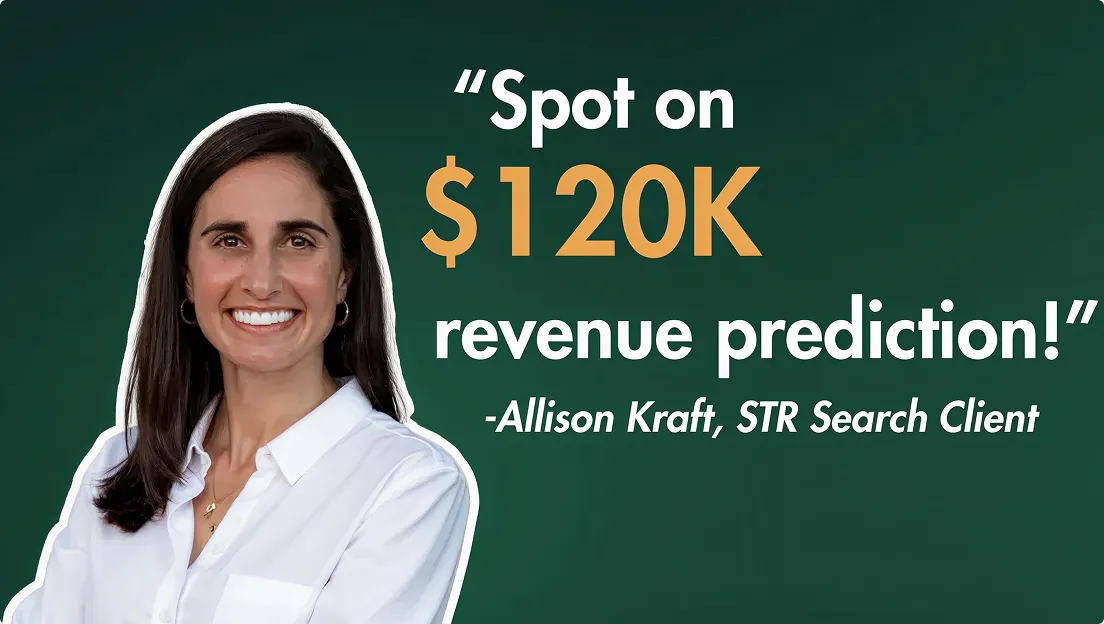
From zero real estate experience to a thriving short-term rental business, Allison locked in $120K in revenue her first year and is now expanding with STR Search again. Proof that the right team can turn analysis paralysis into profitable action!

Thanks to John's expert guidance, I made my first real estate and Airbnb investment a massive success, with consistent positive cash flow and an exceptional return on investment!

John's training gave me the confidence to secure a loan on the spot and scale from one STR to three. His approach is a total game-changer!
Why Choose STR Search?

Put your money to work & lower your tax bill
We’ve spent years analyzing what works so you don’t have to. Our job is to cut through bad data and help you make smart, profitable decisions backed by real numbers.
Schedule Your Free CallTrusted by hundreds of successful investors
Generate $3-5K+ monthly cash flow with our proven property matching system.
Build long-term wealth through STRs with cash flow, equity, and bonus depreciation.
Skip 6-12 months of trial and error with our data-driven underwriting and market analysis
We have a 100% success rate across $90M+ in Real Estate
Out of the 275+ properties we've helped our clients buy every single one has been profitable.
You want more money. More time. More freedom. But may be stuck trading hours for dollars, and scaling your investment strategy feels out of reach.
While others are getting lost in analysis paralysis, you’ve got capital and drive to change your situation. Investors who choose the right STRs can generate $3–5K/month in cash flow, plus serious tax benefits and long-term wealth.
We’ve spent years obsessed with STR investing data so you don’t have to.
With our property match services, there’s no guesswork! Just profitable properties built to perform. With the right deal, your capital can buy more than returns. It can buy your freedom.





All The Ways We Can Help You
Free courses, services, and trainings, to help you maximize your earnings from AirBnb...



Get in touch with us.
Everything Smart Investors Ask About STR Wealth Building
To start an Airbnb in Halibut Cove, Alaska, begin by researching local regulations through the Kenai Peninsula Borough, which governs this remote fishing village accessible only by boat or plane, as there are no roads connecting to the mainland. Contact the borough's planning department to understand zoning requirements and obtain necessary permits, including a business license and potentially a conditional use permit since Halibut Cove is primarily residential with strict development controls to preserve its character. Find property by working with local real estate agents familiar with the area's unique market, keeping in mind that most properties are seasonal cabins or homes with limited year-round access, and expect higher costs due to the remote location. Furnish the property with durable, weather-resistant furniture and essential amenities, ensuring you have reliable communication systems since internet and cell service can be spotty, and stock supplies generously as resupply trips are expensive and weather-dependent. List your property on Airbnb emphasizing the unique location, proximity to Kachemak Bay State Park, and activities like fishing, kayaking, and wildlife viewing, while being transparent about the remote nature and access limitations. Manage the property by establishing relationships with local caretakers or property management services in nearby Homer (about 8 miles by water), arrange for boat transportation or floatplane access for guests, coordinate with local businesses like the Saltry Restaurant for guest services, and maintain emergency communication protocols given the isolated location and seasonal weather challenges that can affect access from October through April.
For identifying profitable short-term rental properties in Halibut Cove, Alaska, focus on waterfront or water-view locations within walking distance of the harbor and local attractions like the Saltry Restaurant, as this remote artist community accessible only by boat or plane attracts visitors seeking authentic Alaskan experiences. Target properties with 2-4 bedrooms, full kitchens, outdoor spaces for wildlife viewing, and unique features like log construction or artistic elements that align with the community's creative character. Pricing analysis should consider seasonal variations with peak rates of $200-400 per night during summer months (May-September) when tourism peaks, while winter rates may drop to $100-200 per night. Competition research reveals limited inventory due to the community's small size (approximately 75 residents), creating opportunities for well-positioned properties, though you'll compete with established operators and the famous Saltry Restaurant's accommodations. Utilize AirDNA and Mashvisor for market data, connect with local property managers familiar with the unique logistics of this boat-access community, monitor Kachemak Bay area tourism trends through the Homer Chamber of Commerce, and consider partnering with water taxi services and local tour operators to enhance guest experiences and occupancy rates.
To obtain an Airbnb/STR permit in Halibut Cove, Alaska, you must first contact the Kenai Peninsula Borough Planning Department at 144 North Binkley Street, Soldotna, AK 99669, as Halibut Cove falls under borough jurisdiction rather than having its own municipal government. Submit a Conditional Use Permit application along with required documents including property deed or lease agreement, site plan showing parking and septic systems, floor plan indicating maximum occupancy, proof of liability insurance ($1 million minimum), and Alaska business license. The application fee is approximately $500-750 with additional inspection fees of $200-300. Due to Halibut Cove's remote location accessible only by boat or plane, special requirements include demonstrating adequate water supply and waste disposal systems, emergency evacuation plans, and compliance with coastal zone management regulations. The borough requires a public hearing process which can take 60-90 days, with additional time needed for site inspections that may be challenging due to weather and accessibility. You must also register with the State of Alaska Department of Commerce for tax collection purposes and obtain workers' compensation insurance if employing cleaning staff, with annual renewal required including updated insurance documentation and compliance verification.
Short-term rentals (STRs) are generally legal in Halibut Cove, Alaska, as this small unincorporated community in the Kenai Peninsula Borough operates under borough-wide regulations rather than specific municipal ordinances. The Kenai Peninsula Borough allows STRs but requires operators to obtain a business license and comply with health and safety standards, including septic system approvals and fire safety requirements. Properties must meet Alaska Department of Environmental Conservation standards for water and wastewater systems, which is particularly relevant in Halibut Cove where many properties rely on individual septic systems. There are no specific prohibited areas within Halibut Cove itself, though operators must ensure compliance with coastal zone management regulations due to the community's location on Kachemak Bay. Recent changes around 2020-2022 have included stricter enforcement of existing health department regulations and increased scrutiny of septic system compliance, particularly for waterfront properties. The remote nature of Halibut Cove, accessible primarily by boat or plane, means that while STRs are permitted, operators face unique logistical challenges in meeting regulatory requirements compared to more accessible areas of Alaska.
Halibut Cove, Alaska offers limited but highly targeted Airbnb investment opportunities primarily concentrated around the main settlement area near the boardwalk and artist galleries, where proximity to the famous floating post office, Salty Restaurant, and local art studios attracts tourists seeking authentic Alaskan experiences during the May-September season. The cove's unique car-free environment accessible only by boat or floatplane from Homer creates exclusivity that commands premium rates, particularly for properties with waterfront views or easy dock access. The central boardwalk district near the Cove Gallery and Diana Tillion Art Studio represents the most attractive investment zone due to foot traffic from day-trippers and overnight visitors interested in the area's renowned art scene and pristine wilderness setting. Properties positioned along the eastern shoreline benefit from morning light and views toward Kachemak Bay, appealing to photographers and nature enthusiasts, while the quieter western sections attract visitors seeking solitude and wildlife viewing opportunities, particularly during salmon runs and eagle watching seasons that peak in July and August.
Airbnb properties in Halibut Cove, Alaska are subject to Alaska's statewide transient accommodation tax of 8% on gross rental receipts, which applies to stays of less than 30 consecutive days. The Kenai Peninsula Borough, where Halibut Cove is located, imposes an additional 5% transient occupancy tax, bringing the total lodging tax rate to approximately 13%. These taxes are typically collected by the host at the time of booking or payment and must be remitted quarterly to the Alaska Department of Revenue for the state portion and to the Kenai Peninsula Borough for the local portion, with returns due by the last day of the month following each quarter. Airbnb may collect and remit these taxes automatically for hosts in some cases through their platform, but hosts remain ultimately responsible for compliance. Exemptions generally apply to stays of 30 days or longer, rentals to permanent residents, and certain government or charitable organization bookings, though documentation may be required to substantiate exempt status.
To start an Airbnb in Halibut Cove, Alaska, expect total costs around $485,000-$565,000. Property purchase represents the largest expense at $350,000-$425,000 for a median waterfront cabin or small home suitable for vacation rental in this remote fishing community. Furnishing costs will run $25,000-$35,000 for quality furniture, appliances, linens, and outdoor gear appropriate for the rustic Alaskan experience guests expect. Initial setup including professional photography, listing creation, and basic renovations costs approximately $8,000-$12,000. Permits and fees total around $2,500-$4,000 covering business licenses, short-term rental permits, and inspections required by the Kenai Peninsula Borough. Insurance including property, liability, and short-term rental coverage runs $4,000-$6,000 annually. Utilities setup and deposits for electricity, propane, satellite internet, and waste management cost $3,000-$5,000 initially. First six months operating costs including utilities ($1,800), cleaning supplies and services ($2,400), maintenance ($1,500), marketing ($1,200), and property management if outsourced ($4,800) total approximately $11,700. Additional considerations include boat transportation costs for supplies and guests, as Halibut Cove is only accessible by water or air, adding roughly $15,000-$25,000 for dock access rights and transportation logistics setup.
Airbnb properties in Halibut Cove, Alaska, face unique profitability challenges due to the remote location accessible only by boat or plane, with seasonal operations typically limited to May through September when weather permits tourist access. Properties in this area can generate estimated revenues of $150-300 per night during peak summer months, with occupancy rates around 60-70% for well-managed listings, translating to approximately $15,000-25,000 in gross seasonal revenue for a typical cabin or lodge unit. However, expenses are significantly higher than mainland properties, with supply transportation costs adding 30-50% premiums, utility expenses ranging $200-400 monthly due to generator power and satellite internet, and maintenance costs elevated by harsh weather and limited contractor availability. Property management becomes crucial given the 4-5 hour boat journey from Homer, with successful operators like those managing fishing lodge conversions reporting profit margins of 15-25% after accounting for all expenses including insurance ($2,000-4,000 annually), cleaning services ($75-100 per turnover), and seasonal property preparation costs. Success factors include offering unique experiences like guided fishing, wildlife viewing, or authentic Alaskan wilderness stays, with properties featuring waterfront access, modern amenities despite remote location, and strong partnerships with local boat charter services typically achieving higher occupancy rates and premium pricing that can offset the elevated operational costs inherent to this pristine but logistically challenging destination.
Airbnb investments in Halibut Cove, Alaska typically generate annual ROI of 12-18% due to the area's unique appeal as a remote fishing and artistic community accessible only by boat or plane, with peak summer tourism from May through September driving nightly rates of $200-400 for waterfront cabins and $150-250 for standard accommodations. Cash-on-cash returns generally range from 8-14% annually, considering the seasonal nature of tourism and higher operational costs associated with the remote location, including supply transportation and maintenance logistics. Properties in Halibut Cove usually achieve profitability within 18-24 months, with the strongest performance coming from well-appointed cabins offering fishing access, art gallery proximity, and authentic Alaskan experiences, though investors should account for winter months generating minimal revenue and higher utility costs due to the off-grid nature of many properties in this artistic fishing village of approximately 75 residents.
STRSearch is a national platform that helps investors identify profitable short-term rental properties including in remote Alaska markets like Halibut Cove. Local Alaska real estate agents such as those with Alaska Premier Real Estate and Coldwell Banker Alaska specialize in vacation rental properties throughout the state including the Kenai Peninsula region where Halibut Cove is located. National services like AirDNA provide market analysis and revenue projections for Airbnb investments in Alaska markets, while Mashvisor offers property analysis tools that cover Alaska vacation rental markets. Local Homer-based agents with companies like Kachemak Bay Realty and Peninsula Properties have expertise in the greater Kachemak Bay area including Halibut Cove properties. RedAwning and Vacasa provide property management services for short-term rentals in Alaska and can assist with identifying investment opportunities. BiggerPockets marketplace and forums connect investors with Alaska-focused real estate professionals, and companies like Roofstock and HomeUnion occasionally feature Alaska vacation rental properties in their investment portfolios.
Put your money to work & lower your tax bill
We’ve spent years analyzing what works so you don’t have to. Our job is to cut through bad data and help you make smart, profitable decisions backed by real numbers.
Schedule Your Free Call