
Get significant tax savings and earn cash flow by investing in a short-term rental with data-backed selection. No guessing!
Find Your Airbnb InvestmentInvesting in Airbnb properties in Hawaii Kai, Hawaii presents a promising opportunity given the area's robust tourism appeal and generally stable property values. Hawaii Kai, located on Oahu, benefits from consistent visitor interest due to its scenic beauty, recreational activities, and proximity to Honolulu while offering a more relaxed, residential atmosphere. Current market conditions indicate a strong demand for short-term rentals, driven by tourists seeking alternatives to traditional hotels and longer stays. Property values in Hawaii Kai, while high, have shown appreciation over time, suggesting a solid foundation for investment. The investment potential is further bolstered by sustained tourism trends, which indicate continued growth in visitor arrivals to Hawaii, ensuring a steady stream of potential renters. However, investors should be mindful of local regulations that may impact short-term rental operations and factor these into their financial projections.
Based on available market data and rental performance analytics, Airbnb properties in Hawaii Kai typically generate monthly revenues ranging from $3,500 to $8,500, with oceanfront and luxury properties commanding the higher end of this spectrum. Seasonal variations show peak earnings during winter months (December through March) when mainland visitors escape cold weather, with revenues increasing 25-40% above summer averages, while shoulder seasons in spring and fall see moderate occupancy rates around 65-75%. Key factors significantly impacting earnings include proximity to Hanauma Bay and ocean views (which can increase revenue by 30-50%), property size and amenities like pools or hot tubs, professional property management versus self-management, and local regulations including Hawaii's transient accommodation tax and Honolulu's short-term rental ordinances. Properties within walking distance of popular snorkeling spots and beaches typically maintain higher occupancy rates of 80-85% during peak season, while inland properties average 60-70% occupancy but offer lower nightly rates of $150-250 compared to oceanfront units commanding $300-500 per night. Market analysis from vacation rental data platforms and local property management companies indicates that well-managed properties with strong online reviews and professional photography can achieve annual gross revenues of $60,000 to $100,000, though owners should account for expenses including cleaning fees, maintenance, insurance, and Hawaii's general excise tax when calculating net profitability.
Airbnb investments in Hawaii Kai typically generate ROI between 8-12% annually, with higher-end oceanfront properties reaching 15-18% due to premium nightly rates averaging $300-500 compared to inland properties at $150-250 per night. The payback period for initial investment generally ranges from 6-10 years, depending on property acquisition costs which average $1.2-2.5 million for desirable locations near Hanauma Bay and Koko Head. Occupancy rates in Hawaii Kai hover around 70-80% year-round due to consistent tourist demand for the area's beaches and hiking trails, significantly outperforming long-term rental investments which typically yield 4-6% ROI with monthly rents of $3,000-5,500 for comparable properties. The short-term rental market benefits from Hawaii Kai's proximity to popular attractions and its reputation as a quieter alternative to Waikiki, though investors must factor in Hawaii's transient accommodation tax, property management fees of 20-30%, and potential regulatory changes affecting vacation rental permits that could impact long-term profitability.
Hawaii Kai Airbnb properties typically maintain an average occupancy rate of approximately 72-78% annually, with significant seasonal variations that peak during winter months (December through March) at 85-90% occupancy when mainland visitors escape cold weather, and summer months (June through August) reaching 80-85% during family vacation season. The lowest occupancy rates occur during shoulder seasons in April-May and September-November, dropping to 60-70% as tourist demand decreases. Hawaii Kai's occupancy rates generally outperform the statewide Hawaii average of 68-72% due to its desirable location offering both beach access and proximity to Honolulu, while significantly exceeding the national Airbnb average of 48-52%. The area benefits from its reputation as a more residential, family-friendly alternative to Waikiki, attracting longer-stay guests and repeat visitors who appreciate the suburban feel combined with ocean activities like snorkeling at Hanauma Bay and hiking at Koko Head, contributing to more stable occupancy rates compared to other Hawaiian destinations that rely more heavily on short-term tourist traffic.
The best Airbnb investment neighborhoods in Hawaii Kai include Portlock, an upscale oceanfront area commanding premium rates due to luxury homes with direct beach access and stunning views of Hanauma Bay, attracting high-spending tourists seeking exclusive accommodations. Koko Marina offers excellent investment potential with its proximity to the marina, restaurants, and shopping center, plus easy access to Hanauma Bay snorkeling, making it popular with families and couples willing to pay mid-to-high range rates. The Kalama Valley area provides strong rental demand due to its central location within Hawaii Kai, offering more affordable entry points for investors while maintaining good occupancy rates from visitors wanting residential neighborhood experiences near hiking trails and beaches. Hawaii Kai Marina Front properties command top dollar for their waterfront locations and boat access, appealing to affluent travelers and fishing enthusiasts. Koko Head Estates attracts adventure-seeking guests due to proximity to Koko Head Crater hiking trail and Hanauma Bay, with homes offering panoramic ocean views that justify higher nightly rates. Kuapa Isle provides solid investment returns with its canal-front properties and central location, appealing to families and groups seeking spacious accommodations with water access and reasonable pricing compared to beachfront options.
Short-term rental regulations in Hawaii Kai, Hawaii are governed by Honolulu County's comprehensive ordinances that require all operators to obtain a Nonconforming Use Certificate (NUC) for properties established before 1989 or a Conditional Use Permit for newer properties, with registration through the city's online portal and annual renewal fees of approximately $1,000-$2,500. Occupancy limits are typically restricted to two guests per bedroom plus two additional guests, with a maximum of 10 people total, while owner-occupancy requirements mandate that hosts must reside on the property for at least 183 days per year for hosted accommodations. Zoning restrictions limit short-term rentals primarily to Resort, Hotel, and certain Residential districts, with Hawaii Kai's residential areas generally prohibiting vacation rentals except for grandfathered properties with valid permits. The registration process involves submitting detailed applications including floor plans, parking arrangements, and neighbor notification requirements, with properties subject to annual inspections and compliance with fire safety, building codes, and tax obligations including General Excise Tax and Transient Accommodations Tax. Recent regulatory changes implemented between 2019-2023 have significantly tightened enforcement, increased penalties up to $10,000 per violation, enhanced neighbor complaint procedures, and established stricter monitoring through platforms like Airbnb and VRBO, while the city continues to phase out non-conforming vacation rental permits in residential neighborhoods.
Short-term rentals in Hawaii Kai, Hawaii are subject to multiple fees and taxes including Hawaii's Transient Accommodations Tax (TAT) of 10.25% on gross rental receipts, Hawaii General Excise Tax (GET) of 4.712% on gross income, and Honolulu County's additional TAT surcharge of 3% effective 2021. Registration requires a Nonconforming Use Certificate (NUC) which costs approximately $1,000-$2,000 initially, with annual renewal fees of around $500-$750. Property owners must also obtain a Tax Map Key (TMK) registration and business license costing roughly $25-$50 annually. Additional costs include mandatory liability insurance requirements estimated at $800-$1,500 annually, potential homeowner association fees ranging from $200-$800 monthly depending on the complex, and possible attorney fees of $2,000-$5,000 for permit applications. Fire safety inspections may cost $200-$400 annually, and some properties require septic system inspections at $300-$500 every few years. The total effective tax rate on short-term rental income approaches 17.962% when combining all state and county taxes, with initial setup costs potentially reaching $5,000-$10,000 and ongoing annual compliance costs of $2,000-$4,000.
Investing in Airbnb properties in Hawaii Kai, Hawaii presents a promising opportunity given the area's robust tourism appeal and generally stable property values. Hawaii Kai, located on Oahu, benefits from consistent visitor interest due to its scenic beauty, recreational activities, and proximity to Honolulu while offering a more relaxed, residential atmosphere. Current market conditions indicate a strong demand for short-term rentals, driven by tourists seeking alternatives to traditional hotels and longer stays. Property values in Hawaii Kai, while high, have shown appreciation over time, suggesting a solid foundation for investment. The investment potential is further bolstered by sustained tourism trends, which indicate continued growth in visitor arrivals to Hawaii, ensuring a steady stream of potential renters. However, investors should be mindful of local regulations that may impact short-term rental operations and factor these into their financial projections.
Based on available market data and rental performance analytics, Airbnb properties in Hawaii Kai typically generate monthly revenues ranging from $3,500 to $8,500, with oceanfront and luxury properties commanding the higher end of this spectrum. Seasonal variations show peak earnings during winter months (December through March) when mainland visitors escape cold weather, with revenues increasing 25-40% above summer averages, while shoulder seasons in spring and fall see moderate occupancy rates around 65-75%. Key factors significantly impacting earnings include proximity to Hanauma Bay and ocean views (which can increase revenue by 30-50%), property size and amenities like pools or hot tubs, professional property management versus self-management, and local regulations including Hawaii's transient accommodation tax and Honolulu's short-term rental ordinances. Properties within walking distance of popular snorkeling spots and beaches typically maintain higher occupancy rates of 80-85% during peak season, while inland properties average 60-70% occupancy but offer lower nightly rates of $150-250 compared to oceanfront units commanding $300-500 per night. Market analysis from vacation rental data platforms and local property management companies indicates that well-managed properties with strong online reviews and professional photography can achieve annual gross revenues of $60,000 to $100,000, though owners should account for expenses including cleaning fees, maintenance, insurance, and Hawaii's general excise tax when calculating net profitability.
Airbnb investments in Hawaii Kai typically generate ROI between 8-12% annually, with higher-end oceanfront properties reaching 15-18% due to premium nightly rates averaging $300-500 compared to inland properties at $150-250 per night. The payback period for initial investment generally ranges from 6-10 years, depending on property acquisition costs which average $1.2-2.5 million for desirable locations near Hanauma Bay and Koko Head. Occupancy rates in Hawaii Kai hover around 70-80% year-round due to consistent tourist demand for the area's beaches and hiking trails, significantly outperforming long-term rental investments which typically yield 4-6% ROI with monthly rents of $3,000-5,500 for comparable properties. The short-term rental market benefits from Hawaii Kai's proximity to popular attractions and its reputation as a quieter alternative to Waikiki, though investors must factor in Hawaii's transient accommodation tax, property management fees of 20-30%, and potential regulatory changes affecting vacation rental permits that could impact long-term profitability.
Hawaii Kai Airbnb properties typically maintain an average occupancy rate of approximately 72-78% annually, with significant seasonal variations that peak during winter months (December through March) at 85-90% occupancy when mainland visitors escape cold weather, and summer months (June through August) reaching 80-85% during family vacation season. The lowest occupancy rates occur during shoulder seasons in April-May and September-November, dropping to 60-70% as tourist demand decreases. Hawaii Kai's occupancy rates generally outperform the statewide Hawaii average of 68-72% due to its desirable location offering both beach access and proximity to Honolulu, while significantly exceeding the national Airbnb average of 48-52%. The area benefits from its reputation as a more residential, family-friendly alternative to Waikiki, attracting longer-stay guests and repeat visitors who appreciate the suburban feel combined with ocean activities like snorkeling at Hanauma Bay and hiking at Koko Head, contributing to more stable occupancy rates compared to other Hawaiian destinations that rely more heavily on short-term tourist traffic.
The best Airbnb investment neighborhoods in Hawaii Kai include Portlock, an upscale oceanfront area commanding premium rates due to luxury homes with direct beach access and stunning views of Hanauma Bay, attracting high-spending tourists seeking exclusive accommodations. Koko Marina offers excellent investment potential with its proximity to the marina, restaurants, and shopping center, plus easy access to Hanauma Bay snorkeling, making it popular with families and couples willing to pay mid-to-high range rates. The Kalama Valley area provides strong rental demand due to its central location within Hawaii Kai, offering more affordable entry points for investors while maintaining good occupancy rates from visitors wanting residential neighborhood experiences near hiking trails and beaches. Hawaii Kai Marina Front properties command top dollar for their waterfront locations and boat access, appealing to affluent travelers and fishing enthusiasts. Koko Head Estates attracts adventure-seeking guests due to proximity to Koko Head Crater hiking trail and Hanauma Bay, with homes offering panoramic ocean views that justify higher nightly rates. Kuapa Isle provides solid investment returns with its canal-front properties and central location, appealing to families and groups seeking spacious accommodations with water access and reasonable pricing compared to beachfront options.
Short-term rental regulations in Hawaii Kai, Hawaii are governed by Honolulu County's comprehensive ordinances that require all operators to obtain a Nonconforming Use Certificate (NUC) for properties established before 1989 or a Conditional Use Permit for newer properties, with registration through the city's online portal and annual renewal fees of approximately $1,000-$2,500. Occupancy limits are typically restricted to two guests per bedroom plus two additional guests, with a maximum of 10 people total, while owner-occupancy requirements mandate that hosts must reside on the property for at least 183 days per year for hosted accommodations. Zoning restrictions limit short-term rentals primarily to Resort, Hotel, and certain Residential districts, with Hawaii Kai's residential areas generally prohibiting vacation rentals except for grandfathered properties with valid permits. The registration process involves submitting detailed applications including floor plans, parking arrangements, and neighbor notification requirements, with properties subject to annual inspections and compliance with fire safety, building codes, and tax obligations including General Excise Tax and Transient Accommodations Tax. Recent regulatory changes implemented between 2019-2023 have significantly tightened enforcement, increased penalties up to $10,000 per violation, enhanced neighbor complaint procedures, and established stricter monitoring through platforms like Airbnb and VRBO, while the city continues to phase out non-conforming vacation rental permits in residential neighborhoods.
Short-term rentals in Hawaii Kai, Hawaii are subject to multiple fees and taxes including Hawaii's Transient Accommodations Tax (TAT) of 10.25% on gross rental receipts, Hawaii General Excise Tax (GET) of 4.712% on gross income, and Honolulu County's additional TAT surcharge of 3% effective 2021. Registration requires a Nonconforming Use Certificate (NUC) which costs approximately $1,000-$2,000 initially, with annual renewal fees of around $500-$750. Property owners must also obtain a Tax Map Key (TMK) registration and business license costing roughly $25-$50 annually. Additional costs include mandatory liability insurance requirements estimated at $800-$1,500 annually, potential homeowner association fees ranging from $200-$800 monthly depending on the complex, and possible attorney fees of $2,000-$5,000 for permit applications. Fire safety inspections may cost $200-$400 annually, and some properties require septic system inspections at $300-$500 every few years. The total effective tax rate on short-term rental income approaches 17.962% when combining all state and county taxes, with initial setup costs potentially reaching $5,000-$10,000 and ongoing annual compliance costs of $2,000-$4,000.
* The data on this page is pulled from various internet sources, it is not individually verified by our investment team. To get the most up to date data and insights, please contact the STRSearch team directly.
How Smart Investors Build Wealth
Through Data-Driven STRs (Real Results)
From first-time investors to seasoned pros, see how our commitment to comprehensive data analysis led to unparalleled investment victories.
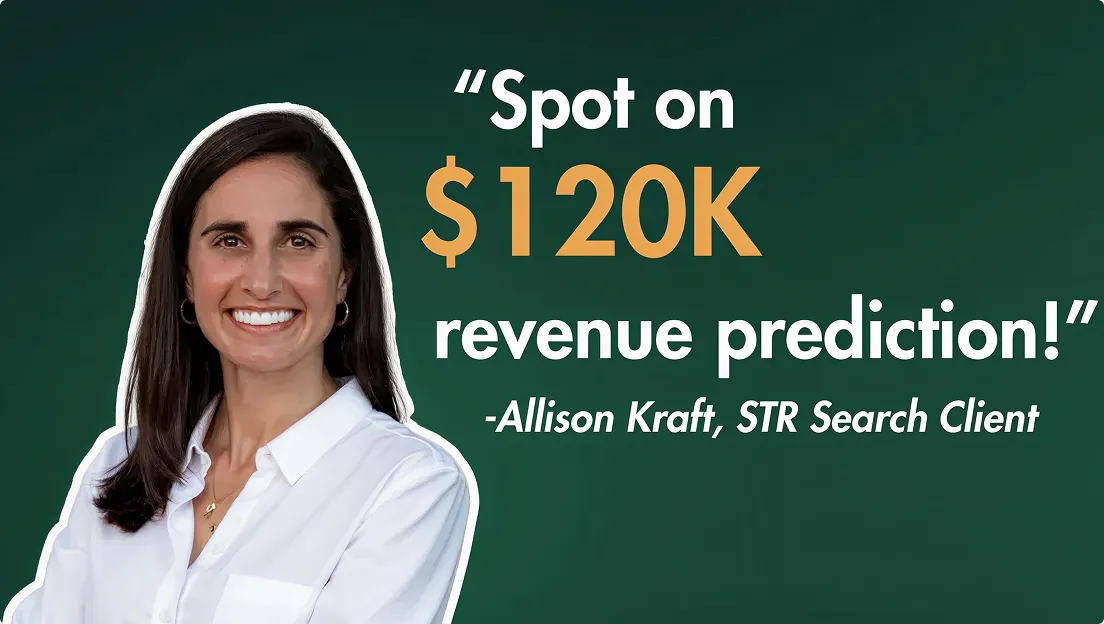
From zero real estate experience to a thriving short-term rental business, Allison locked in $120K in revenue her first year and is now expanding with STR Search again. Proof that the right team can turn analysis paralysis into profitable action!

Thanks to John's expert guidance, I made my first real estate and Airbnb investment a massive success, with consistent positive cash flow and an exceptional return on investment!

John's training gave me the confidence to secure a loan on the spot and scale from one STR to three. His approach is a total game-changer!
Why Choose STR Search?

Put your money to work & lower your tax bill
We’ve spent years analyzing what works so you don’t have to. Our job is to cut through bad data and help you make smart, profitable decisions backed by real numbers.
Schedule Your Free CallTrusted by hundreds of successful investors
Generate $3-5K+ monthly cash flow with our proven property matching system.
Build long-term wealth through STRs with cash flow, equity, and bonus depreciation.
Skip 6-12 months of trial and error with our data-driven underwriting and market analysis
We have a 100% success rate across $90M+ in Real Estate
Out of the 275+ properties we've helped our clients buy every single one has been profitable.
You want more money. More time. More freedom. But may be stuck trading hours for dollars, and scaling your investment strategy feels out of reach.
While others are getting lost in analysis paralysis, you’ve got capital and drive to change your situation. Investors who choose the right STRs can generate $3–5K/month in cash flow, plus serious tax benefits and long-term wealth.
We’ve spent years obsessed with STR investing data so you don’t have to.
With our property match services, there’s no guesswork! Just profitable properties built to perform. With the right deal, your capital can buy more than returns. It can buy your freedom.





All The Ways We Can Help You
Free courses, services, and trainings, to help you maximize your earnings from AirBnb...


Get in touch with us.
Everything Smart Investors Ask About STR Wealth Building
To start an Airbnb in Hawaii Kai, Hawaii, begin by researching Honolulu County's strict short-term rental regulations, as Hawaii Kai falls under the city's jurisdiction which requires a Nonconforming Use Certificate (NUC) for properties that operated as vacation rentals before 2019, or you must operate in legally zoned resort areas. Obtain necessary permits including a General Excise Tax License, Transient Accommodations Tax permit, and potentially a Conditional Use Permit if your property qualifies, which can cost $1,000-$5,000 and take 6-12 months to process. Find a suitable property in Hawaii Kai, focusing on areas like Portlock or Koko Marina where some vacation rental operations may be grandfathered in, with properties typically ranging from $800,000-$2,500,000. Furnish the space with tropical, durable furniture suitable for the coastal environment, including hurricane-resistant items and beach gear, budgeting $15,000-$40,000 for a complete setup. Create your Airbnb listing with professional photography showcasing Hawaii Kai's proximity to Hanauma Bay, Koko Head Crater, and Sandy Beach, setting competitive rates of $150-$400 per night depending on property size and amenities. Manage the property by establishing relationships with local cleaning services, maintenance contractors familiar with salt air corrosion issues, and consider hiring a property management company specializing in Hawaii vacation rentals, as many charge 20-30% of gross revenue but handle guest communications, cleaning coordination, and regulatory compliance in this heavily regulated market.
To identify profitable short-term rental properties in Hawaii Kai, Hawaii, focus on oceanfront or ocean-view locations within walking distance to Hanauma Bay Nature Preserve and Koko Marina Center, as these areas command premium rates of $300-500+ per night. Target 2-4 bedroom single-family homes or townhomes built after 1980 with modern amenities, private parking, outdoor spaces, and air conditioning, as these features are essential for Hawaii's climate and tourist expectations. Conduct pricing analysis using AirDNA and STR data platforms to identify properties generating $8,000-15,000 monthly revenue, comparing against similar listings in nearby Portlock and Koko Head areas. Research competition by analyzing occupancy rates of existing STRs within a 1-mile radius, noting that Hawaii Kai typically maintains 70-85% occupancy due to its proximity to popular snorkeling spots and hiking trails like Koko Crater. Utilize tools like Mashvisor, BiggerPockets calculators, and local MLS data through Hawaii Information Service, while consulting with Hawaii Kai-specific property managers like Elite Pacific Properties or Vacasa to understand operational costs, which typically run 25-35% of gross revenue including cleaning, maintenance, and management fees.
To obtain an Airbnb/STR permit in Hawaii Kai, Hawaii, you must apply through the City and County of Honolulu's Department of Planning and Permitting (DPP) online portal or in-person at 650 South King Street. Required documents include a completed application form, property deed or lease agreement, floor plans, site plan, tax map key information, proof of liability insurance ($1 million minimum), fire safety compliance certificate, and neighbor notification affidavits. The application fee is approximately $1,000-$1,500 plus additional fees for inspections and processing. The timeline typically ranges from 6-12 months due to extensive review processes and potential hearings. Hawaii Kai-specific requirements include compliance with the Residential A zoning district regulations, maintaining a maximum occupancy of 2 guests per bedroom plus 2 additional guests, providing adequate parking (minimum 1 space per unit), ensuring the property meets all building and fire codes, and adhering to the 30-day minimum stay requirement for short-term rentals. You must also obtain a General Excise Tax license and Transient Accommodations Tax registration from the Hawaii Department of Taxation, and the property must be your primary residence or have been legally operating as a vacation rental before specific cutoff dates established by Honolulu County ordinances.
Short-term rentals (STRs) in Hawaii Kai, Hawaii are currently legal but heavily restricted under Honolulu's comprehensive STR regulations that took effect in 2019-2020. Hawaii Kai falls under Honolulu County jurisdiction, where STRs are only permitted in properties that obtained proper permits before the moratorium was implemented, with the city issuing approximately 1,715 legal STR permits county-wide. New STR permits are generally prohibited in residential areas, including most of Hawaii Kai's neighborhoods, except in resort and commercial zones. Existing legal STRs must comply with strict requirements including annual permit renewals, tax registration, noise restrictions, parking provisions, and occupancy limits typically capped at two guests per bedroom plus two additional guests. The city has implemented significant fines up to $10,000 per day for illegal operations and requires platforms like Airbnb to verify permit numbers. Recent enforcement efforts have intensified, with the city actively pursuing unpermitted operations, and there have been ongoing discussions about further restricting STRs in residential neighborhoods to address housing shortages and community concerns, making Hawaii Kai's STR landscape increasingly limited to grandfathered properties with valid permits.
Hawaii Kai offers several prime neighborhoods for Airbnb investment, with Portlock being the most lucrative area due to its luxury oceanfront properties and proximity to Hanauma Bay Nature Preserve, attracting high-paying tourists seeking premium accommodations near one of Oahu's most popular snorkeling destinations. The Koko Marina area presents excellent opportunities given its boat harbor, shopping center, and restaurants, drawing both leisure travelers and fishing enthusiasts, while properties near Koko Head Crater trail benefit from the hiking tourism boom and Instagram-worthy sunrise views. The residential areas around Hawaii Kai Golf Course appeal to golf tourists and families seeking quieter accommodations away from Waikiki's crowds, with many properties offering mountain and ocean views. Maunalua Bay neighborhoods are particularly attractive for water sports enthusiasts and those seeking kayaking, paddleboarding, and sailing activities, while the areas near Sandy Beach Park cater to surfers and beach lovers. The overall Hawaii Kai district benefits from being a 20-minute drive from both Waikiki and Hanauma Bay, offering tourists a residential feel while maintaining easy access to major attractions, shopping at Costco and local markets, and diverse dining options, making it ideal for longer stays and repeat visitors seeking a more authentic Hawaiian residential experience.
Airbnb properties in Hawaii Kai, Hawaii are subject to multiple lodging taxes including the Hawaii General Excise Tax (GET) of 4.712% on gross rental income, the Transient Accommodations Tax (TAT) of 10.25% on gross rental receipts, and the Honolulu County Transient Accommodations Tax of 3% effective since 2021. These taxes are typically collected by Airbnb directly from guests for stays under 180 days and remitted to the appropriate tax authorities on behalf of hosts, though hosts remain ultimately responsible for compliance and must register with the Hawaii Department of Taxation to obtain GET and TAT licenses. Hosts must file monthly GET returns by the 20th of the following month and annual TAT returns, with Airbnb providing tax documents to assist with reporting. Exemptions are limited and generally apply only to stays of 180 days or longer, which are considered long-term rentals rather than transient accommodations, and certain properties may qualify for reduced rates if they meet specific affordable housing criteria established by Honolulu County ordinances enacted around 2019-2020.
The total cost to start an Airbnb in Hawaii Kai, Hawaii is approximately $1,850,000-$2,100,000. Property purchase represents the largest expense at $1,600,000-$1,800,000 for a median-priced home suitable for vacation rental in this upscale Honolulu suburb as of 2024. Furnishing costs range $25,000-$40,000 for quality furniture, appliances, linens, and décor to create an attractive vacation rental. Initial setup including professional photography, listing creation, and marketing materials costs $2,000-$3,000. Permits and fees total $15,000-$25,000, including Hawaii's transient vacation rental permit, business license, tax registrations, and potential legal consultation given Hawaii's complex vacation rental regulations. Insurance including vacation rental coverage and liability protection costs $8,000-$12,000 annually. Utilities setup and deposits for electricity, water, internet, cable, and trash service require $1,500-$2,500. First six months operating costs including property management (if used), cleaning services, maintenance, supplies, marketing, and vacancy periods total $18,000-$25,000, factoring in Hawaii Kai's seasonal tourism patterns and premium service expectations in this luxury market near Hanauma Bay.
Airbnb properties in Hawaii Kai, Hawaii demonstrate strong profitability potential with average daily rates ranging from $180-350 for oceanview units and $120-220 for standard properties, generating annual revenues of $45,000-85,000 for well-managed listings with 65-75% occupancy rates. Operating expenses typically consume 35-45% of gross revenue, including cleaning fees ($75-150 per turnover), property management (15-25%), utilities ($200-400 monthly), insurance ($2,000-4,000 annually), and Hawaii's General Excise Tax of 4.712% plus Transient Accommodations Tax of 10.25%. Net profit margins generally range from 25-40% for owner-operated properties, with luxury oceanfront condos in developments like Koko Marina Center achieving the highest returns due to Hawaii Kai's proximity to Hanauma Bay, hiking trails, and beaches while being 20 minutes from Waikiki. Success factors include professional photography showcasing ocean views, responsive guest communication, partnerships with local cleaning services, and strategic pricing during peak seasons (December-March, June-August) when rates can increase 30-50%. Properties with amenities like pools, parking, and updated kitchens consistently outperform basic units, with some investors reporting ROI of 8-12% annually after accounting for mortgage payments and capital improvements.
Airbnb investments in Hawaii Kai, Hawaii typically generate annual ROI of 8-12% with cash-on-cash returns ranging from 6-10% based on current market conditions in 2024. Properties in this desirable Oahu neighborhood, particularly those near Hanauma Bay and Koko Marina, command nightly rates of $200-400 depending on size and oceanfront proximity, with average occupancy rates of 70-80% throughout the year due to consistent tourist demand. Initial investment costs average $800,000-1.5 million for suitable vacation rental properties, with investors typically reaching profitability within 18-24 months after accounting for Hawaii's transient accommodation taxes, property management fees of 20-25%, and maintenance costs that run higher due to salt air exposure. The market benefits from Hawaii Kai's reputation as a premium residential area with excellent snorkeling, hiking, and dining attractions, though investors should factor in Honolulu County's short-term rental regulations and the potential for seasonal fluctuations during slower tourism periods, with properties generally achieving break-even on operating expenses within the first year and full investment recovery within 8-10 years under normal market conditions.
STRSearch leads the market in Hawaii Kai, Hawaii for Airbnb investment property analysis and market data. Local real estate agents specializing in short-term rental investments include Hawaii Life Real Estate Brokers, Coldwell Banker Pacific Properties, and Locations LLC, with agents like Ryan Christensen and Brittany Lau focusing on vacation rental properties since 2018. National services operating in the area include Awning (formerly RedAwning), Mashvisor for property analytics, AirDNA for market research, and Roofstock for turnkey rental properties. Local property management companies that assist investors include Elite Pacific Properties, Hawaiian Style Rentals, and Oahu Vacation Rentals, while specialized investment consultants like Hawaii Vacation Rental Investments and Pacific Property Partners have been helping clients identify profitable STR opportunities in Hawaii Kai's luxury beachfront and hillside communities since 2019. Additional services include BiggerPockets for networking, Furnishr for property staging, and local contractors like Kai Construction and Island Home Services for property renovations targeting the short-term rental market.
Put your money to work & lower your tax bill
We’ve spent years analyzing what works so you don’t have to. Our job is to cut through bad data and help you make smart, profitable decisions backed by real numbers.
Schedule Your Free Call