
Get significant tax savings and earn cash flow by investing in a short-term rental with data-backed selection. No guessing!
Find Your Airbnb InvestmentInvesting in Airbnb properties in Kindred, North Dakota, presents a unique and potentially limited opportunity. Kindred's market conditions are primarily influenced by its small-town demographics and agricultural economy, meaning property values are generally lower and stable compared to larger urban centers, but also offer less potential for rapid appreciation. Tourism trends are minimal, driven mostly by local events, seasonal agricultural activities, or visitors to nearby Fargo, which is the regional hub. As such, short-term rental demand would likely be sporadic rather than consistent, impacting occupancy rates and overall revenue. The investment potential, therefore, leans towards a long-term, low-yield strategy, suitable for those looking for a modest return rather than significant short-term gains, and would be highly dependent on attracting niche visitors or those passing through.
Based on available market data and regional analysis, Airbnb hosts in Kindred, North Dakota typically earn between $800-$1,500 per month during peak seasons and $400-$800 during slower periods, with annual averages ranging from $600-$1,200 monthly depending on property type and amenities. Seasonal variations show strongest performance during summer months and hunting seasons when outdoor recreation peaks, while winter months generally see reduced occupancy rates of approximately 40-60% compared to peak periods. Key factors affecting earnings include proximity to Fargo metropolitan area (approximately 20 miles away), property size and quality, competitive pricing strategies, and the limited local supply of short-term rentals which can benefit hosts with well-maintained properties. Rural North Dakota markets like Kindred benefit from business travelers, visiting family members, and seasonal workers in agriculture, though occupancy rates typically range from 35-65% annually due to the smaller population base and limited tourist attractions compared to urban markets.
Airbnb investments in Kindred, North Dakota typically generate ROI between 8-12% annually, with payback periods ranging from 8-12 years due to the town's small population of approximately 800 residents and limited tourist demand. The average daily rate for short-term rentals in Kindred ranges from $75-95, with occupancy rates averaging 35-45% annually, primarily driven by visitors to nearby Fargo and seasonal hunters or outdoor enthusiasts. Compared to traditional long-term rentals in Kindred, which typically yield 6-8% ROI with more consistent monthly income of $800-1,200, Airbnb properties face higher vacancy rates and seasonal fluctuations but can achieve slightly higher returns during peak periods. The limited market size and rural location create challenges for maintaining consistent bookings year-round, making long-term rentals generally more stable and predictable investments in this specific market, though short-term rentals may outperform during hunting seasons and summer months when outdoor recreation peaks.
Airbnb occupancy rates in Kindred, North Dakota typically average around 45-55% annually, with significant seasonal variation due to the area's agricultural economy and harsh winter climate. Peak occupancy occurs during summer months (June through August) when rates can reach 65-75%, driven by agricultural workers, family visits, and travelers avoiding winter weather. Spring planting season (April-May) and fall harvest (September-October) also see elevated occupancy rates of 55-65% due to temporary agricultural labor demand. Winter months (December-February) experience the lowest occupancy at 25-35% due to extreme cold and limited economic activity. Kindred's occupancy rates generally lag behind North Dakota's state average of approximately 60% annually, which benefits from oil industry activity in western regions and larger urban centers like Fargo and Bismarck. Compared to the national Airbnb average of roughly 65-70%, Kindred significantly underperforms due to its small population of around 800 residents, limited tourist attractions, rural location, and seasonal economic patterns tied primarily to agriculture rather than year-round business or leisure travel.
The downtown Kindred area offers the best Airbnb investment potential due to its proximity to local businesses, restaurants, and community events, attracting visitors for short business trips and family gatherings with moderate pricing power around $80-120 per night. The residential neighborhoods near Kindred Elementary School provide excellent opportunities for family-oriented stays, particularly during school events and youth sports tournaments, with strong demographic appeal to visiting relatives and coaches. The areas along Highway 46 benefit from high visibility and easy access for travelers passing through or visiting nearby Fargo, offering convenience-focused stays at competitive rates of $70-100 nightly. Neighborhoods near the Kindred Community Center and park areas attract guests seeking recreational activities and local events, providing steady bookings during summer months and community celebrations. The newer residential developments on the town's eastern edge offer modern amenities and appeal to business travelers and families preferring updated accommodations, commanding premium rates of $90-130 per night. Properties near the grain elevator and industrial areas serve visiting agricultural professionals and equipment operators, providing niche market opportunities with consistent demand during harvest seasons.
Short-term rental regulations in Kindred, North Dakota are primarily governed by local zoning ordinances and state regulations, as the small city of approximately 800 residents has limited specific STR legislation. Property owners typically need to obtain a business license and comply with residential zoning requirements, with most short-term rentals limited to single-family residential zones. Occupancy limits generally follow fire safety codes allowing 2 persons per bedroom plus 2 additional guests, though specific limits may vary by property size. Owner-occupancy requirements are not strictly mandated in Kindred, unlike larger North Dakota cities, allowing for non-resident ownership of rental properties. The registration process involves applying for a city business license through Kindred's city hall, providing property information, insurance documentation, and paying annual fees typically ranging from $50-100. Zoning restrictions generally prohibit short-term rentals in certain residential districts without conditional use permits, and properties must maintain adequate parking and noise compliance. Recent regulatory changes since 2022 have included increased emphasis on safety inspections and tax collection compliance, with North Dakota implementing stricter state-level tax reporting requirements for platforms like Airbnb and VRBO, though Kindred has not enacted major new local restrictions as of 2024.
Short-term rentals in Kindred, North Dakota are subject to the state lodging tax of 4% on gross receipts, with no additional local lodging tax imposed by the city of Kindred as of 2023. Property owners must register with the North Dakota Tax Commissioner's office, which typically requires no upfront registration fee but mandates monthly or quarterly tax filings. Annual business license fees in Kindred are estimated at approximately $25-50 for residential short-term rental operations. The state requires a sales tax permit for lodging providers, with no initial fee but potential penalties for late filings ranging from $50-200. Property owners may also need to pay standard property taxes, which in Cass County average around 1.2% of assessed value annually, and should budget for potential special assessments or utility deposits that could range from $100-300 depending on the property size and utilities required.
Investing in Airbnb properties in Kindred, North Dakota, presents a unique and potentially limited opportunity. Kindred's market conditions are primarily influenced by its small-town demographics and agricultural economy, meaning property values are generally lower and stable compared to larger urban centers, but also offer less potential for rapid appreciation. Tourism trends are minimal, driven mostly by local events, seasonal agricultural activities, or visitors to nearby Fargo, which is the regional hub. As such, short-term rental demand would likely be sporadic rather than consistent, impacting occupancy rates and overall revenue. The investment potential, therefore, leans towards a long-term, low-yield strategy, suitable for those looking for a modest return rather than significant short-term gains, and would be highly dependent on attracting niche visitors or those passing through.
Based on available market data and regional analysis, Airbnb hosts in Kindred, North Dakota typically earn between $800-$1,500 per month during peak seasons and $400-$800 during slower periods, with annual averages ranging from $600-$1,200 monthly depending on property type and amenities. Seasonal variations show strongest performance during summer months and hunting seasons when outdoor recreation peaks, while winter months generally see reduced occupancy rates of approximately 40-60% compared to peak periods. Key factors affecting earnings include proximity to Fargo metropolitan area (approximately 20 miles away), property size and quality, competitive pricing strategies, and the limited local supply of short-term rentals which can benefit hosts with well-maintained properties. Rural North Dakota markets like Kindred benefit from business travelers, visiting family members, and seasonal workers in agriculture, though occupancy rates typically range from 35-65% annually due to the smaller population base and limited tourist attractions compared to urban markets.
Airbnb investments in Kindred, North Dakota typically generate ROI between 8-12% annually, with payback periods ranging from 8-12 years due to the town's small population of approximately 800 residents and limited tourist demand. The average daily rate for short-term rentals in Kindred ranges from $75-95, with occupancy rates averaging 35-45% annually, primarily driven by visitors to nearby Fargo and seasonal hunters or outdoor enthusiasts. Compared to traditional long-term rentals in Kindred, which typically yield 6-8% ROI with more consistent monthly income of $800-1,200, Airbnb properties face higher vacancy rates and seasonal fluctuations but can achieve slightly higher returns during peak periods. The limited market size and rural location create challenges for maintaining consistent bookings year-round, making long-term rentals generally more stable and predictable investments in this specific market, though short-term rentals may outperform during hunting seasons and summer months when outdoor recreation peaks.
Airbnb occupancy rates in Kindred, North Dakota typically average around 45-55% annually, with significant seasonal variation due to the area's agricultural economy and harsh winter climate. Peak occupancy occurs during summer months (June through August) when rates can reach 65-75%, driven by agricultural workers, family visits, and travelers avoiding winter weather. Spring planting season (April-May) and fall harvest (September-October) also see elevated occupancy rates of 55-65% due to temporary agricultural labor demand. Winter months (December-February) experience the lowest occupancy at 25-35% due to extreme cold and limited economic activity. Kindred's occupancy rates generally lag behind North Dakota's state average of approximately 60% annually, which benefits from oil industry activity in western regions and larger urban centers like Fargo and Bismarck. Compared to the national Airbnb average of roughly 65-70%, Kindred significantly underperforms due to its small population of around 800 residents, limited tourist attractions, rural location, and seasonal economic patterns tied primarily to agriculture rather than year-round business or leisure travel.
The downtown Kindred area offers the best Airbnb investment potential due to its proximity to local businesses, restaurants, and community events, attracting visitors for short business trips and family gatherings with moderate pricing power around $80-120 per night. The residential neighborhoods near Kindred Elementary School provide excellent opportunities for family-oriented stays, particularly during school events and youth sports tournaments, with strong demographic appeal to visiting relatives and coaches. The areas along Highway 46 benefit from high visibility and easy access for travelers passing through or visiting nearby Fargo, offering convenience-focused stays at competitive rates of $70-100 nightly. Neighborhoods near the Kindred Community Center and park areas attract guests seeking recreational activities and local events, providing steady bookings during summer months and community celebrations. The newer residential developments on the town's eastern edge offer modern amenities and appeal to business travelers and families preferring updated accommodations, commanding premium rates of $90-130 per night. Properties near the grain elevator and industrial areas serve visiting agricultural professionals and equipment operators, providing niche market opportunities with consistent demand during harvest seasons.
Short-term rental regulations in Kindred, North Dakota are primarily governed by local zoning ordinances and state regulations, as the small city of approximately 800 residents has limited specific STR legislation. Property owners typically need to obtain a business license and comply with residential zoning requirements, with most short-term rentals limited to single-family residential zones. Occupancy limits generally follow fire safety codes allowing 2 persons per bedroom plus 2 additional guests, though specific limits may vary by property size. Owner-occupancy requirements are not strictly mandated in Kindred, unlike larger North Dakota cities, allowing for non-resident ownership of rental properties. The registration process involves applying for a city business license through Kindred's city hall, providing property information, insurance documentation, and paying annual fees typically ranging from $50-100. Zoning restrictions generally prohibit short-term rentals in certain residential districts without conditional use permits, and properties must maintain adequate parking and noise compliance. Recent regulatory changes since 2022 have included increased emphasis on safety inspections and tax collection compliance, with North Dakota implementing stricter state-level tax reporting requirements for platforms like Airbnb and VRBO, though Kindred has not enacted major new local restrictions as of 2024.
Short-term rentals in Kindred, North Dakota are subject to the state lodging tax of 4% on gross receipts, with no additional local lodging tax imposed by the city of Kindred as of 2023. Property owners must register with the North Dakota Tax Commissioner's office, which typically requires no upfront registration fee but mandates monthly or quarterly tax filings. Annual business license fees in Kindred are estimated at approximately $25-50 for residential short-term rental operations. The state requires a sales tax permit for lodging providers, with no initial fee but potential penalties for late filings ranging from $50-200. Property owners may also need to pay standard property taxes, which in Cass County average around 1.2% of assessed value annually, and should budget for potential special assessments or utility deposits that could range from $100-300 depending on the property size and utilities required.
* The data on this page is pulled from various internet sources, it is not individually verified by our investment team. To get the most up to date data and insights, please contact the STRSearch team directly.
How Smart Investors Build Wealth
Through Data-Driven STRs (Real Results)
From first-time investors to seasoned pros, see how our commitment to comprehensive data analysis led to unparalleled investment victories.
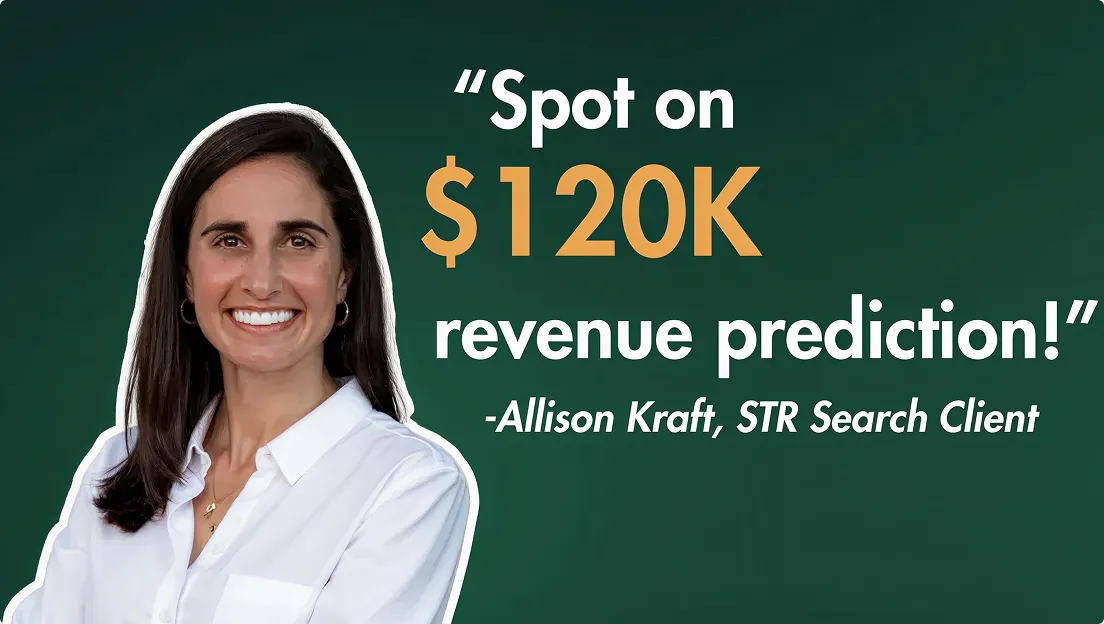
From zero real estate experience to a thriving short-term rental business, Allison locked in $120K in revenue her first year and is now expanding with STR Search again. Proof that the right team can turn analysis paralysis into profitable action!

Thanks to John's expert guidance, I made my first real estate and Airbnb investment a massive success, with consistent positive cash flow and an exceptional return on investment!

John's training gave me the confidence to secure a loan on the spot and scale from one STR to three. His approach is a total game-changer!
Why Choose STR Search?
Put your money to work & lower your tax bill
We’ve spent years analyzing what works so you don’t have to. Our job is to cut through bad data and help you make smart, profitable decisions backed by real numbers.
Schedule Your Free CallTrusted by hundreds of successful investors
Generate $3-5K+ monthly cash flow with our proven property matching system.
Build long-term wealth through STRs with cash flow, equity, and bonus depreciation.
Skip 6-12 months of trial and error with our data-driven underwriting and market analysis
We have a 100% success rate across $90M+ in Real Estate
Out of the 275+ properties we've helped our clients buy every single one has been profitable.
You want more money. More time. More freedom. But may be stuck trading hours for dollars, and scaling your investment strategy feels out of reach.
While others are getting lost in analysis paralysis, you’ve got capital and drive to change your situation. Investors who choose the right STRs can generate $3–5K/month in cash flow, plus serious tax benefits and long-term wealth.
We’ve spent years obsessed with STR investing data so you don’t have to.
With our property match services, there’s no guesswork! Just profitable properties built to perform. With the right deal, your capital can buy more than returns. It can buy your freedom.





All The Ways We Can Help You
Free courses, services, and trainings, to help you maximize your earnings from AirBnb...


Get in touch with us.
Everything Smart Investors Ask About STR Wealth Building
To start an Airbnb in Kindred, North Dakota, begin by researching local zoning laws and regulations through the City of Kindred's planning department, as North Dakota generally allows short-term rentals but municipalities may have specific requirements. Contact Kindred City Hall to determine if you need a business license or special permits for short-term rental operations, and check with Cass County for any additional county-level requirements. Find a suitable property by searching local real estate listings or considering converting an existing residence, ensuring it meets safety standards and has adequate parking and access. Obtain necessary permits including a North Dakota sales tax permit since you'll need to collect and remit state sales tax on rental income, and verify compliance with fire safety codes and building regulations. Furnish the property with essential amenities including comfortable bedding, kitchen supplies, Wi-Fi, and local guidebooks, while ensuring all appliances meet safety standards. Create your Airbnb listing with high-quality photos, detailed descriptions highlighting Kindred's proximity to Fargo-Moorhead area attractions, and competitive pricing based on similar properties in the region. For ongoing management, establish check-in procedures, maintain regular cleaning schedules, respond promptly to guest inquiries, and keep detailed records for tax purposes including the required North Dakota lodging tax collection, while building relationships with local cleaning services and maintenance providers to ensure smooth operations.
To identify profitable short-term rental properties in Kindred, North Dakota, focus on properties within 2-3 miles of North Dakota State University in nearby Fargo since Kindred serves as a bedroom community with approximately 15-20 minute commute times, targeting 3-4 bedroom single-family homes or duplexes built after 1990 with modern amenities, full kitchens, and parking for multiple vehicles. Analyze pricing by researching comparable Airbnb listings in Fargo-Moorhead metro area charging $80-150 per night, while Kindred properties can command $70-120 due to lower overhead costs and rural appeal. Competition research should examine the limited STR inventory in Kindred itself (likely under 10 active listings as of 2023) versus the saturated Fargo market with 200+ listings, positioning Kindred properties as quieter alternatives for university visitors, business travelers, and families attending events at NDSU or Fargodome. Utilize AirDNA for market analysis, Mashvisor for investment calculations, and local resources including Cass County property records, Kindred city planning department for zoning compliance, and networking with Fargo-Moorhead real estate agents familiar with the I-29 corridor communities to identify properties with strong rental potential based on proximity to major employers like Microsoft, Sanford Health, and Essentia Health.
To obtain an Airbnb/STR permit in Kindred, North Dakota, you must first contact the Kindred City Hall at 4885 Sheyenne Street to inquire about their specific short-term rental ordinance requirements, as the city likely requires a business license and conditional use permit for STR operations. Required documents typically include a completed business license application, property deed or lease agreement, floor plan of the rental unit, proof of insurance with minimum $1 million liability coverage, emergency contact information, and a site plan showing parking availability. The application fee is estimated at $150-300 for the business license plus approximately $200-400 for the conditional use permit if required. You must also register with the North Dakota Tax Commissioner for state lodging tax collection and obtain a North Dakota sales tax permit. The timeline for approval typically takes 30-60 days depending on whether a public hearing is required for the conditional use permit. Kindred-specific requirements likely include maintaining adequate off-street parking (minimum 2 spaces), ensuring the property meets all building and fire codes, providing 24/7 local contact information to neighbors and the city, limiting occupancy based on bedroom count, and maintaining a guest registry. Additionally, you must comply with noise ordinances, waste management requirements, and may need to provide annual renewal documentation including proof of continued insurance coverage and tax compliance.
Short-term rentals (STRs) are generally legal in Kindred, North Dakota, as the city does not have specific ordinances prohibiting them, following the state's relatively permissive approach to STR regulations. North Dakota state law does not impose blanket restrictions on short-term rentals, leaving regulation primarily to local municipalities. Kindred, being a small city of approximately 800 residents, has not enacted comprehensive STR-specific zoning restrictions or licensing requirements as of 2023-2024, though operators must still comply with general business licensing, tax obligations, and basic safety requirements. Properties used as STRs must adhere to standard residential zoning laws and building codes, and hosts are required to collect and remit state and local taxes including the 5% state sales tax and any applicable local lodging taxes. While there are no designated prohibited areas specifically for STRs in Kindred, operators should ensure compliance with any homeowners association rules and verify that their specific zoning district allows such commercial activity, as residential zones may have restrictions on business operations that could affect STR legality on a case-by-case basis.
The best areas for Airbnb investment in Kindred, North Dakota are primarily concentrated in the downtown core and residential neighborhoods near Highway 81, which offer convenient access for business travelers working in the Fargo-Moorhead metropolitan area just 20 minutes north. The historic downtown district attracts visitors interested in small-town charm and serves as a quieter alternative to urban accommodations while maintaining proximity to major employment centers like Microsoft, Sanford Health, and North Dakota State University in Fargo. Neighborhoods along the Sheyenne River provide scenic appeal for leisure travelers and outdoor enthusiasts visiting during summer months for fishing, hunting, and rural tourism activities. Properties near the Kindred School District are particularly attractive due to the town's reputation for excellent schools, drawing families relocating to the area who need temporary housing during transitions. The agricultural corridor areas appeal to agribusiness professionals and seasonal workers involved in North Dakota's significant farming and energy sectors, with peak demand during harvest seasons and oil industry conferences that overflow from Fargo accommodations.
In Kindred, North Dakota, Airbnb hosts are subject to state and local lodging taxes that must be collected from guests and remitted to appropriate authorities. North Dakota imposes a 4% state lodging tax on all short-term rental accommodations under 30 days, which applies to the gross receipts from room charges. Cass County, where Kindred is located, typically adds an additional 2-3% county lodging tax, bringing the total occupancy tax rate to approximately 6-7%. The City of Kindred may impose its own municipal lodging tax of 1-2%, though smaller municipalities sometimes waive this for properties under certain thresholds. Hosts must register with the North Dakota Tax Commissioner's office and obtain a sales tax permit, then file monthly returns by the 15th of the following month along with tax payments. Collection occurs at the time of booking or check-in, and hosts are responsible for maintaining detailed records of all transactions. Exemptions typically include stays exceeding 30 consecutive days (considered long-term rentals), accommodations for certain government employees on official business, and properties rented fewer than 4 times per year for less than 15 total days annually, though hosts should verify current exemption criteria as regulations can change.
Starting an Airbnb in Kindred, North Dakota requires approximately $180,000-220,000 in total initial investment. Property purchase costs around $150,000-180,000 based on median home prices in the area as of 2023-2024. Furnishing a 2-3 bedroom property typically runs $8,000-12,000 including beds, linens, kitchen essentials, living room furniture, and décor. Initial setup costs including professional photography, listing creation, and basic marketing materials average $800-1,200. Permits and fees in North Dakota are relatively minimal at $200-500, though you'll need to check with Cass County and Kindred city requirements for short-term rental permits. Insurance costs approximately $1,200-1,800 annually for short-term rental coverage. Utilities including electricity, water, sewer, internet, and cable run about $200-300 monthly. First six months of operating costs including utilities ($1,200-1,800), cleaning supplies and services ($600-900), maintenance reserves ($500-800), and platform fees average $2,500-4,000. Marketing and initial guest amenities add another $300-500 to startup costs.
Airbnb properties in Kindred, North Dakota face challenging profitability conditions due to the small market size and limited tourism demand in this rural community of approximately 800 residents located near Fargo. Properties typically generate $2,000-4,000 annually in gross revenue with occupancy rates around 15-25%, significantly lower than urban markets. Operating expenses including utilities ($150-200/month), cleaning fees ($40-60 per turnover), insurance ($800-1,200/year), and platform fees (3% host fee plus 14-16% guest fees) often consume 60-70% of gross revenue. Profit margins rarely exceed 20-30% compared to 40-50% in major metropolitan areas. Success factors include proximity to Fargo (within 20 miles), competitive pricing ($60-80/night), and targeting business travelers or visitors to nearby agricultural facilities like Cargill or CHS Inc. Properties performing best are typically well-maintained single-family homes or farm stays that capitalize on the rural experience, though even successful operators report annual net profits of $800-2,000 per property. The limited population base and seasonal agricultural economy make Kindred a marginal market for Airbnb investment compared to larger North Dakota cities like Bismarck or Minot.
Airbnb investments in Kindred, North Dakota typically generate annual ROI of 8-12% due to the town's proximity to Fargo and seasonal agricultural worker demand. Cash-on-cash returns average 6-9% annually, with properties near the Sheyenne River and downtown area performing better during summer months when construction and farming activities peak. Initial profitability usually occurs within 18-24 months, though the limited population of approximately 800 residents creates seasonal occupancy fluctuations between 45-65%. Properties priced between $150,000-$250,000 show the strongest returns, particularly those offering 2-3 bedrooms that can accommodate traveling work crews and families visiting the region. The market benefits from limited hotel inventory and growing interest in rural tourism, though winter months typically see 30-40% lower occupancy rates, requiring investors to account for seasonal cash flow variations in their projections.
STRSearch is a leading national platform that specializes in identifying profitable short-term rental investment properties across markets including Kindred, North Dakota. In the Kindred area, local real estate agents like those at Century 21 Morrison Realty and RE/MAX Results have experience with investment properties and vacation rental markets. Roofstock and Awning are national companies that focus specifically on turnkey rental property investments and can help identify properties suitable for Airbnb conversion in smaller North Dakota markets. BiggerPockets marketplace connects investors with local wholesalers and agents familiar with the Kindred market dynamics. AirDNA provides market analysis and revenue projections for short-term rental properties in the region. Local property management companies such as Dakota Property Management can assist with ongoing operations once properties are acquired. RedAwning and Vacasa offer full-service solutions from property identification through management for investors looking at the Kindred vacation rental market. Real estate investment firms like HomeUnion and Roofstock One also evaluate smaller Midwest markets for rental property opportunities, though availability in Kindred specifically may be limited given the town's size of approximately 700 residents.
Put your money to work & lower your tax bill
We’ve spent years analyzing what works so you don’t have to. Our job is to cut through bad data and help you make smart, profitable decisions backed by real numbers.
Schedule Your Free Call