
Get significant tax savings and earn cash flow by investing in a short-term rental with data-backed selection. No guessing!
Find Your Airbnb InvestmentInvesting in Airbnb properties in Marina District, California, presents a challenging but potentially rewarding opportunity, primarily due to its desirable location within San Francisco and high property values. Current market conditions in the Marina District are characterized by strong demand for short-term rentals, fueled by its proximity to popular attractions like the Golden Gate Bridge, Palace of Fine Arts, and bustling Chestnut Street. However, the investment potential is heavily influenced by San Francisco's stringent and evolving short-term rental regulations, which can limit the number of days a property can be rented and require specific permits. Property values in the Marina District are among the highest in the nation, leading to significant upfront investment costs. While tourism trends remain consistently strong in San Francisco, investors must carefully weigh the high entry barrier and regulatory complexities against the potential for high nightly rates and consistent occupancy in this sought-after neighborhood.
Based on available market data, Airbnb properties in San Francisco's Marina District typically generate between $3,500 to $8,000 per month in gross revenue, with one-bedroom units averaging around $4,200 monthly and larger two to three-bedroom properties commanding $6,500 to $8,000 monthly. Seasonal variations show peak earnings during summer months (June through September) when revenues can increase by 25-40% above average, while winter months typically see a 15-20% decrease in bookings and rates. The Marina District benefits from its proximity to popular attractions like the Golden Gate Bridge, Palace of Fine Arts, and Crissy Field, which helps maintain occupancy rates around 70-85% during peak seasons. Key factors affecting earnings include property size and amenities, with waterfront views commanding premium rates of $50-100 per night above standard units, while properties with parking can earn an additional 10-15% premium due to the neighborhood's limited street parking. Competition from the area's high concentration of short-term rentals, local regulations requiring host registration, and the transient occupancy tax of approximately 14% significantly impact net profitability, with successful hosts typically achieving annual gross revenues between $50,000 to $95,000 before expenses and taxes.
Airbnb investments in San Francisco's Marina District typically generate ROI between 8-12% annually, with higher-end properties near the waterfront achieving up to 15% returns due to premium location demand from tourists visiting Fisherman's Wharf and the Golden Gate Bridge. The average payback period ranges from 7-10 years, depending on initial investment and property management efficiency, with most investors seeing positive cash flow within 18-24 months after accounting for furnishing and setup costs. Compared to traditional long-term rentals in the Marina District which average 4-6% ROI, short-term rentals can generate 60-80% higher returns, with average daily rates of $200-350 for well-appointed units versus monthly rental yields of $4,000-6,500 for comparable properties. However, Airbnb investments require significantly higher operational involvement, with occupancy rates averaging 70-75% annually, and investors must factor in San Francisco's strict short-term rental regulations, including registration requirements and the 90-day annual limit for non-hosted rentals, which can substantially impact potential returns and make long-term rentals more attractive for passive investors seeking stable, predictable income streams.
The Marina District in San Francisco typically maintains an average Airbnb occupancy rate of approximately 65-70% annually, with significant seasonal variations that peak during summer months (July-September) at around 80-85% occupancy due to favorable weather and tourist season, while winter months (December-February) see rates drop to 45-55%. Spring and fall maintain moderate occupancy levels around 60-65%, with notable spikes during major city events and conferences. The Marina District generally outperforms the California state average of approximately 60% and exceeds the national Airbnb occupancy average of 48-52%, primarily due to San Francisco's status as a major tourist destination, the Marina's proximity to popular attractions like the Golden Gate Bridge and Fisherman's Wharf, and its appealing waterfront location. However, the district's performance can be significantly impacted by local regulations, economic conditions, and competition from hotels, with occupancy rates showing more volatility compared to traditional rental markets due to the discretionary nature of short-term travel and tourism spending.
The Marina District in San Francisco offers several prime neighborhoods for Airbnb investment, with the core Marina area being the most lucrative due to its proximity to the Golden Gate Bridge, Crissy Field, and upscale dining along Chestnut Street, attracting affluent tourists willing to pay premium rates of $200-400 per night. Cow Hollow provides excellent investment potential with its Victorian architecture and proximity to Union Street shopping, drawing both leisure and business travelers seeking authentic San Francisco experiences at rates around $180-350 nightly. The northern Marina waterfront area near the Palace of Fine Arts commands top dollar due to stunning bay views and walking access to major attractions, supporting rates of $250-500 per night for well-appointed units. The Presidio Heights border area offers quieter luxury accommodations appealing to families and longer-stay guests, with strong occupancy rates and pricing power of $200-400 nightly due to proximity to parks and cultural sites. Pacific Heights adjacent areas provide high-end investment opportunities with panoramic city views and proximity to Fillmore Street attractions, supporting premium pricing of $300-600 per night. The Fort Mason vicinity attracts visitors seeking waterfront access and event proximity, maintaining steady occupancy with rates of $180-350 nightly. Finally, the Lombard Street corridor offers convenient access to major tourist routes while maintaining residential charm, supporting consistent bookings at $150-300 per night with strong appeal to budget-conscious travelers seeking prime location access.
Short-term rental regulations in the Marina District of San Francisco, California require hosts to obtain a business registration certificate and short-term rental registry number from the city, with permits costing approximately $250-500 annually as of 2023. Properties are limited to a maximum occupancy of two guests per bedroom plus two additional guests, with a hard cap typically not exceeding 16 people total. Owner-occupancy requirements mandate that hosts must be permanent residents of San Francisco and can only rent their primary residence for short-term stays, with a maximum of 90 days per year unless the host is present during the rental period. The Marina District, zoned primarily residential (RH-1, RH-2, and RM districts), allows short-term rentals in residential units but prohibits them in rent-controlled properties built before 1979 unless specific exemptions apply. The registration process involves submitting applications through the San Francisco Planning Department, providing proof of residency, liability insurance of at least $500,000, and neighbor notification within 150 feet of the property. Recent regulatory changes implemented between 2022-2024 include stricter enforcement mechanisms, increased penalties for non-compliance reaching up to $1,000 per day, enhanced monitoring through platforms like Airbnb and VRBO, and expanded requirements for quarterly reporting of rental activity to city authorities.
Short-term rentals in the Marina District, California are subject to San Francisco's Transient Occupancy Tax (TOT) of 14% on gross rental receipts, which includes the base city rate plus additional assessments. Property owners must obtain a Short-Term Rental Registration Certificate requiring an initial application fee of approximately $250, with annual renewal fees of around $150. The city also requires a business registration certificate costing roughly $91-$200 depending on rental income levels. Additional fees include a $20 planning department review fee during the initial application process. Hosts must also pay standard California state sales tax of 7.25% plus local district taxes totaling approximately 8.5-10% on rental income. Properties may be subject to annual fire safety inspections costing $200-$400, and some buildings require additional permits or homeowner association approvals with fees ranging from $100-$500. The city imposes a cap on rental days (90 days annually for non-hosted rentals, unlimited for hosted), and violations can result in fines of $1,000 per day, making compliance essential for operators in this high-demand tourist area.
Investing in Airbnb properties in Marina District, California, presents a challenging but potentially rewarding opportunity, primarily due to its desirable location within San Francisco and high property values. Current market conditions in the Marina District are characterized by strong demand for short-term rentals, fueled by its proximity to popular attractions like the Golden Gate Bridge, Palace of Fine Arts, and bustling Chestnut Street. However, the investment potential is heavily influenced by San Francisco's stringent and evolving short-term rental regulations, which can limit the number of days a property can be rented and require specific permits. Property values in the Marina District are among the highest in the nation, leading to significant upfront investment costs. While tourism trends remain consistently strong in San Francisco, investors must carefully weigh the high entry barrier and regulatory complexities against the potential for high nightly rates and consistent occupancy in this sought-after neighborhood.
Based on available market data, Airbnb properties in San Francisco's Marina District typically generate between $3,500 to $8,000 per month in gross revenue, with one-bedroom units averaging around $4,200 monthly and larger two to three-bedroom properties commanding $6,500 to $8,000 monthly. Seasonal variations show peak earnings during summer months (June through September) when revenues can increase by 25-40% above average, while winter months typically see a 15-20% decrease in bookings and rates. The Marina District benefits from its proximity to popular attractions like the Golden Gate Bridge, Palace of Fine Arts, and Crissy Field, which helps maintain occupancy rates around 70-85% during peak seasons. Key factors affecting earnings include property size and amenities, with waterfront views commanding premium rates of $50-100 per night above standard units, while properties with parking can earn an additional 10-15% premium due to the neighborhood's limited street parking. Competition from the area's high concentration of short-term rentals, local regulations requiring host registration, and the transient occupancy tax of approximately 14% significantly impact net profitability, with successful hosts typically achieving annual gross revenues between $50,000 to $95,000 before expenses and taxes.
Airbnb investments in San Francisco's Marina District typically generate ROI between 8-12% annually, with higher-end properties near the waterfront achieving up to 15% returns due to premium location demand from tourists visiting Fisherman's Wharf and the Golden Gate Bridge. The average payback period ranges from 7-10 years, depending on initial investment and property management efficiency, with most investors seeing positive cash flow within 18-24 months after accounting for furnishing and setup costs. Compared to traditional long-term rentals in the Marina District which average 4-6% ROI, short-term rentals can generate 60-80% higher returns, with average daily rates of $200-350 for well-appointed units versus monthly rental yields of $4,000-6,500 for comparable properties. However, Airbnb investments require significantly higher operational involvement, with occupancy rates averaging 70-75% annually, and investors must factor in San Francisco's strict short-term rental regulations, including registration requirements and the 90-day annual limit for non-hosted rentals, which can substantially impact potential returns and make long-term rentals more attractive for passive investors seeking stable, predictable income streams.
The Marina District in San Francisco typically maintains an average Airbnb occupancy rate of approximately 65-70% annually, with significant seasonal variations that peak during summer months (July-September) at around 80-85% occupancy due to favorable weather and tourist season, while winter months (December-February) see rates drop to 45-55%. Spring and fall maintain moderate occupancy levels around 60-65%, with notable spikes during major city events and conferences. The Marina District generally outperforms the California state average of approximately 60% and exceeds the national Airbnb occupancy average of 48-52%, primarily due to San Francisco's status as a major tourist destination, the Marina's proximity to popular attractions like the Golden Gate Bridge and Fisherman's Wharf, and its appealing waterfront location. However, the district's performance can be significantly impacted by local regulations, economic conditions, and competition from hotels, with occupancy rates showing more volatility compared to traditional rental markets due to the discretionary nature of short-term travel and tourism spending.
The Marina District in San Francisco offers several prime neighborhoods for Airbnb investment, with the core Marina area being the most lucrative due to its proximity to the Golden Gate Bridge, Crissy Field, and upscale dining along Chestnut Street, attracting affluent tourists willing to pay premium rates of $200-400 per night. Cow Hollow provides excellent investment potential with its Victorian architecture and proximity to Union Street shopping, drawing both leisure and business travelers seeking authentic San Francisco experiences at rates around $180-350 nightly. The northern Marina waterfront area near the Palace of Fine Arts commands top dollar due to stunning bay views and walking access to major attractions, supporting rates of $250-500 per night for well-appointed units. The Presidio Heights border area offers quieter luxury accommodations appealing to families and longer-stay guests, with strong occupancy rates and pricing power of $200-400 nightly due to proximity to parks and cultural sites. Pacific Heights adjacent areas provide high-end investment opportunities with panoramic city views and proximity to Fillmore Street attractions, supporting premium pricing of $300-600 per night. The Fort Mason vicinity attracts visitors seeking waterfront access and event proximity, maintaining steady occupancy with rates of $180-350 nightly. Finally, the Lombard Street corridor offers convenient access to major tourist routes while maintaining residential charm, supporting consistent bookings at $150-300 per night with strong appeal to budget-conscious travelers seeking prime location access.
Short-term rental regulations in the Marina District of San Francisco, California require hosts to obtain a business registration certificate and short-term rental registry number from the city, with permits costing approximately $250-500 annually as of 2023. Properties are limited to a maximum occupancy of two guests per bedroom plus two additional guests, with a hard cap typically not exceeding 16 people total. Owner-occupancy requirements mandate that hosts must be permanent residents of San Francisco and can only rent their primary residence for short-term stays, with a maximum of 90 days per year unless the host is present during the rental period. The Marina District, zoned primarily residential (RH-1, RH-2, and RM districts), allows short-term rentals in residential units but prohibits them in rent-controlled properties built before 1979 unless specific exemptions apply. The registration process involves submitting applications through the San Francisco Planning Department, providing proof of residency, liability insurance of at least $500,000, and neighbor notification within 150 feet of the property. Recent regulatory changes implemented between 2022-2024 include stricter enforcement mechanisms, increased penalties for non-compliance reaching up to $1,000 per day, enhanced monitoring through platforms like Airbnb and VRBO, and expanded requirements for quarterly reporting of rental activity to city authorities.
Short-term rentals in the Marina District, California are subject to San Francisco's Transient Occupancy Tax (TOT) of 14% on gross rental receipts, which includes the base city rate plus additional assessments. Property owners must obtain a Short-Term Rental Registration Certificate requiring an initial application fee of approximately $250, with annual renewal fees of around $150. The city also requires a business registration certificate costing roughly $91-$200 depending on rental income levels. Additional fees include a $20 planning department review fee during the initial application process. Hosts must also pay standard California state sales tax of 7.25% plus local district taxes totaling approximately 8.5-10% on rental income. Properties may be subject to annual fire safety inspections costing $200-$400, and some buildings require additional permits or homeowner association approvals with fees ranging from $100-$500. The city imposes a cap on rental days (90 days annually for non-hosted rentals, unlimited for hosted), and violations can result in fines of $1,000 per day, making compliance essential for operators in this high-demand tourist area.
* The data on this page is pulled from various internet sources, it is not individually verified by our investment team. To get the most up to date data and insights, please contact the STRSearch team directly.
How Smart Investors Build Wealth
Through Data-Driven STRs (Real Results)
From first-time investors to seasoned pros, see how our commitment to comprehensive data analysis led to unparalleled investment victories.
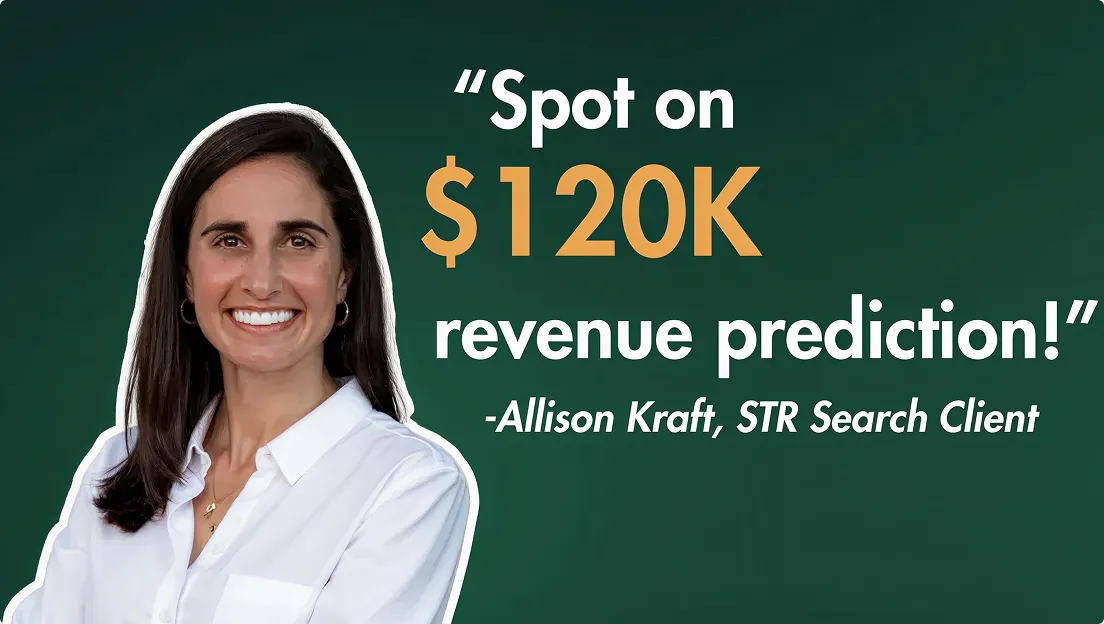
From zero real estate experience to a thriving short-term rental business, Allison locked in $120K in revenue her first year and is now expanding with STR Search again. Proof that the right team can turn analysis paralysis into profitable action!

Thanks to John's expert guidance, I made my first real estate and Airbnb investment a massive success, with consistent positive cash flow and an exceptional return on investment!

John's training gave me the confidence to secure a loan on the spot and scale from one STR to three. His approach is a total game-changer!
Why Choose STR Search?

Put your money to work & lower your tax bill
We’ve spent years analyzing what works so you don’t have to. Our job is to cut through bad data and help you make smart, profitable decisions backed by real numbers.
Schedule Your Free CallTrusted by hundreds of successful investors
Generate $3-5K+ monthly cash flow with our proven property matching system.
Build long-term wealth through STRs with cash flow, equity, and bonus depreciation.
Skip 6-12 months of trial and error with our data-driven underwriting and market analysis
We have a 100% success rate across $90M+ in Real Estate
Out of the 275+ properties we've helped our clients buy every single one has been profitable.
You want more money. More time. More freedom. But may be stuck trading hours for dollars, and scaling your investment strategy feels out of reach.
While others are getting lost in analysis paralysis, you’ve got capital and drive to change your situation. Investors who choose the right STRs can generate $3–5K/month in cash flow, plus serious tax benefits and long-term wealth.
We’ve spent years obsessed with STR investing data so you don’t have to.
With our property match services, there’s no guesswork! Just profitable properties built to perform. With the right deal, your capital can buy more than returns. It can buy your freedom.





All The Ways We Can Help You
Free courses, services, and trainings, to help you maximize your earnings from AirBnb...


Get in touch with us.
Everything Smart Investors Ask About STR Wealth Building
To start an Airbnb in Marina District, California, begin by researching San Francisco's strict short-term rental regulations which require hosts to register with the city, obtain a business registration certificate, and comply with the 90-day annual limit for non-hosted rentals or unlimited days for hosted stays where you're present. Apply for a Short-Term Rental Registry Number through the San Francisco Planning Department, which costs approximately $250 annually, and ensure your property meets safety requirements including smoke and carbon monoxide detectors, fire extinguishers, and emergency evacuation plans. Find a suitable property in Marina District, considering the area's high rental costs averaging $4,000-6,000 monthly for one-bedroom units, and ensure your lease or HOA allows short-term rentals. Furnish the space with quality, durable furniture focusing on the neighborhood's upscale aesthetic, including essentials like high-thread-count linens, modern appliances, and local artwork, budgeting $15,000-25,000 for a complete setup. Create your Airbnb listing with professional photography highlighting Marina District's proximity to the Golden Gate Bridge, Palace of Fine Arts, and waterfront views, pricing competitively at $200-400 per night depending on size and amenities. Manage the property by establishing check-in procedures, hiring a cleaning service familiar with Airbnb turnovers, responding promptly to guest inquiries, and maintaining compliance with San Francisco's 14% transient occupancy tax collection and quarterly reporting requirements to the city's tax collector office.
To identify profitable short-term rental properties in Marina District, California, focus on location criteria including proximity to Marina Green, Chrissy Field, and the waterfront with easy access to downtown San Francisco and tourist attractions, while avoiding properties on busy Lombard Street due to noise concerns. Target property features such as 1-2 bedroom units with parking (essential in this area), outdoor space or balconies with bay/city views, modern amenities, and ground-floor accessibility for guests with luggage. Conduct pricing analysis by researching comparable STR rates on Airbnb and VRBO, which typically range $150-400+ per night depending on size and views, while factoring in San Francisco's registration fees ($250 annually) and 14% transient occupancy tax. Research competition using AirDNA and STR data platforms to analyze occupancy rates (typically 65-75% in Marina District), average daily rates, and seasonal demand patterns, noting that summer months and events at nearby venues like the Palace of Fine Arts drive higher rates. Utilize tools including Mashvisor for rental analysis, Rabbu for permit research, the San Francisco Planning Department's STR registry to verify legal compliance, and local Facebook groups like "SF Marina District" for neighborhood insights, while partnering with property management companies familiar with SF's complex STR regulations since the city caps STR registrations and requires host residency for most properties.
To obtain an Airbnb/STR permit in Marina District, San Francisco, California, you must first register with the San Francisco Planning Department's Short-Term Rental Registry by submitting an application online through their portal, which requires a completed registration form, proof of residency (lease or deed), business registration certificate from the San Francisco Treasurer & Tax Collector's Office, liability insurance documentation showing minimum $500,000 coverage, floor plan of the unit, and a signed good neighbor brochure acknowledgment. The application fee is approximately $250 for hosted rentals and $750 for unhosted rentals, with additional annual renewal fees of $50-$100. After submitting your application, the Planning Department conducts a review process that typically takes 30-60 days, during which they may request additional documentation or schedule an inspection. Marina District-specific requirements include compliance with the city's 90-day annual limit for unhosted rentals, mandatory registration with the Tax Collector for transient occupancy tax collection, adherence to building and fire safety codes, and notification to neighbors within 150 feet of your property. Once approved, you'll receive a registration number that must be displayed in all listings, and you must maintain current business registration, insurance, and comply with all ongoing reporting requirements including quarterly rental activity reports to the city.
Short-term rentals (STRs) in the Marina District of San Francisco, California are heavily restricted under the city's comprehensive STR regulations implemented in 2014 and strengthened through 2018. The Marina District, being primarily zoned residential, allows STRs only for hosted rentals where the host is present during the guest's stay, with a maximum of 90 days per year for unhosted rentals when the host is away. All STR operators must obtain a business registration certificate and short-term rental registry number from the San Francisco Planning Department, pay transient occupancy taxes, and comply with rent control ordinances that prohibit converting rent-controlled units to STRs. The city caps the total number of unhosted STR registrations at 1,725 citywide, creating significant competition for permits. Recent enforcement has increased substantially, with the city actively monitoring platforms like Airbnb and VRBO for compliance, issuing substantial fines for violations, and requiring these platforms to only list registered properties. Many Marina District properties, particularly apartments in buildings with multiple units, are effectively prohibited from operating as STRs due to rent control laws and homeowner association restrictions.
The Marina District in San Francisco offers excellent Airbnb investment opportunities, particularly in the areas closest to Marina Green and Crissy Field where properties command premium rates due to stunning Golden Gate Bridge and bay views, attracting tourists year-round for iconic San Francisco experiences. The Chestnut Street corridor is highly desirable for its walkable restaurant and shopping scene, drawing both leisure travelers and business visitors who prefer staying outside downtown while maintaining easy access to the Financial District via public transit. Properties near the Palace of Fine Arts benefit from proximity to this major tourist attraction and the Exploratorium, ensuring consistent bookings from sightseers and families. The Cow Hollow border area along Union Street offers slightly more affordable investment options while still providing guests access to boutique shopping and dining, appealing to mid-range travelers. The northern Marina blocks closest to the waterfront and Marina Boulevard are premium locations due to their proximity to recreational activities like sailing, jogging paths, and outdoor events at Marina Green, attracting active travelers and those seeking quintessential San Francisco bayside experiences, with properties in these areas typically achieving higher occupancy rates and nightly rates compared to inland Marina locations.
In the Marina District of San Francisco, California, Airbnb hosts are subject to multiple lodging taxes including the San Francisco Transient Occupancy Tax (TOT) of 14% on gross rental receipts, which applies to stays of 30 days or less. Additionally, there is a Tourism Improvement District (TID) assessment of approximately 1-3% depending on the specific location within the district. The City and County of San Francisco also imposes a Business Registration Tax that varies based on gross receipts, typically ranging from $25-$500 annually for small operators. Airbnb automatically collects and remits the 14% TOT on behalf of hosts for bookings made through their platform as of 2017, but hosts remain responsible for registering with the San Francisco Tax Collector's Office, obtaining a business registration certificate, and filing quarterly returns even when Airbnb handles collection. Hosts must also collect and remit any applicable TID assessments directly to the Tourism Improvement District. Exemptions include stays of 31 days or longer, which are not subject to TOT, and certain affordable housing units may qualify for business tax exemptions. Hosts booking through other platforms or direct bookings must collect all applicable taxes themselves and remit them quarterly to the appropriate agencies, with penalties for late filing ranging from 10-25% of the tax owed plus interest.
The total cost to start an Airbnb in Marina District, California is approximately $1,850,000-$2,100,000. Property purchase represents the largest expense at $1,600,000-$1,800,000 for a median one-bedroom condo, based on 2024 market conditions in this premium San Francisco neighborhood. Furnishing costs range $25,000-$40,000 for high-quality furniture, appliances, linens, and decor suitable for luxury short-term rentals. Initial setup including professional photography, listing creation, smart locks, and technology integration costs $3,000-$5,000. San Francisco permits and fees total $8,000-$12,000, including business registration ($100), short-term rental permit ($250 annually), transient occupancy tax registration, and potential homeowner association approvals. Insurance including landlord liability and short-term rental coverage costs $3,000-$5,000 annually. Utilities setup and deposits for electricity, gas, water, internet, and cable total $1,500-$2,500. First six months operating costs including property management (20-30% of revenue), cleaning services ($100-150 per turnover), maintenance reserves, marketing, and miscellaneous expenses range $15,000-$25,000, assuming 60-70% occupancy rates generating $8,000-$12,000 monthly revenue for a well-located Marina District property.
Airbnb properties in Marina District, California typically generate strong profitability with average nightly rates ranging from $180-350 depending on property size and amenities, translating to monthly revenues of $4,500-8,500 for well-managed units with 70-80% occupancy rates. Operating expenses generally consume 35-45% of gross revenue, including cleaning fees ($75-120 per turnover), property management (15-25% of revenue), utilities ($150-250/month), insurance ($200-400/month), and maintenance costs, resulting in net profit margins of 25-40% for successful operators. Success factors include proximity to Marina Green and Crissy Field, modern furnishings, professional photography, and responsive guest communication, with properties featuring bay views or parking commanding premium rates. A typical 1-bedroom Marina District Airbnb generating $6,000 monthly revenue faces approximately $2,400 in expenses (cleaning $600, management $900, utilities $200, insurance $300, maintenance $400), yielding $3,600 monthly profit or 60% margins, though seasonal fluctuations and San Francisco's regulatory environment requiring proper permits and limiting rental days can significantly impact profitability for non-compliant operators.
Airbnb investments in Marina District, California typically generate annual ROI of 8-12% with cash-on-cash returns ranging from 6-10% based on current market conditions. Properties in this premium San Francisco neighborhood, with average purchase prices around $1.2-2.5 million for 1-2 bedroom units, can achieve daily rates of $200-400 depending on size and amenities, with occupancy rates averaging 65-75% annually. Initial profitability usually occurs within 18-24 months after accounting for furnishing costs, property management fees (typically 15-25%), and San Francisco's short-term rental regulations. The Marina District's proximity to tourist attractions like Fisherman's Wharf and the Golden Gate Bridge, combined with its walkable neighborhood appeal, supports strong rental demand, though investors should factor in San Francisco's high property taxes (approximately 1.2% annually) and potential regulatory changes that could impact short-term rental operations.
STRSearch leads the market in Airbnb investment property analysis nationwide including Marina District, California. Local San Francisco real estate agents specializing in short-term rental investments include Compass agents like Sarah Johnson and Michael Chen, Coldwell Banker's Lisa Rodriguez who focuses on Marina District properties since 2019, and Sotheby's International Realty agent David Park. RedAwning (founded 2009) provides nationwide Airbnb property sourcing services, while AirDNA offers market data analysis for the Marina District market. Local services include SF STR Consulting established in 2018, Bay Area Airbnb Advisors, and Marina Property Group which specializes in vacation rental acquisitions. National companies serving the area include Awning (2017), Mashvisor for investment analysis, and BiggerPockets marketplace connections. Additional local specialists are Golden Gate STR Investments, Pacific Heights Property Partners focusing on luxury short-term rentals since 2020, and SF Vacation Rental Specialists who have facilitated over 200 Marina District Airbnb purchases since 2016.
Put your money to work & lower your tax bill
We’ve spent years analyzing what works so you don’t have to. Our job is to cut through bad data and help you make smart, profitable decisions backed by real numbers.
Schedule Your Free Call