
Get significant tax savings and earn cash flow by investing in a short-term rental with data-backed selection. No guessing!
Find Your Airbnb InvestmentInvesting in Airbnb properties in Oak Island, North Carolina, presents a favorable opportunity, primarily due to its enduring appeal as a family-friendly coastal destination. Current market conditions in Oak Island reflect a steady demand for vacation rentals, driven by its pristine beaches, relaxed atmosphere, and various outdoor activities that attract tourists year-round, particularly during peak summer months. While property values in coastal areas can be higher, Oak Island has shown consistent appreciation, indicating a solid long-term investment potential. Tourism trends show a stable influx of visitors seeking quieter beach experiences, making short-term rentals a reliable source of income. The town's local charm, coupled with its natural beauty and proximity to other attractions, contributes to its consistent appeal for both renters and investors.
Based on available vacation rental market data for Oak Island, North Carolina, Airbnb hosts can expect average monthly earnings ranging from $1,200 to $4,500 depending on property type, location, and season. Oceanfront properties typically generate the highest revenue at $3,000-$4,500 monthly during peak summer months, while inland properties average $1,200-$2,800 monthly. Seasonal variations are significant, with summer months generating approximately 60-70% of annual revenue due to beach tourism, while winter months may see earnings drop by 40-50%. Spring and fall shoulder seasons typically produce moderate revenue at 70-80% of peak rates. Key factors affecting earnings include proximity to the beach (oceanfront properties command 30-40% premium rates), property size and amenities, professional photography and listing optimization, responsive host communication, and local events or festivals. Properties with pools, hot tubs, or game rooms tend to achieve 15-25% higher occupancy rates. The average daily rate ranges from $150-$300 for standard properties to $400-$600 for luxury oceanfront homes, with occupancy rates averaging 65-75% during peak season and 25-40% in off-season months.
Airbnb investments in Oak Island, North Carolina typically generate ROI between 8-14% annually, with oceanfront properties achieving the higher end of this range due to premium nightly rates of $200-400 during peak summer months compared to $80-150 for inland properties. The payback period for most Oak Island vacation rental investments ranges from 7-12 years, depending on initial purchase price and renovation costs, with properties requiring an average of $15,000-25,000 in furnishing and setup expenses. Seasonal occupancy rates average 65-75% from May through September but drop to 25-35% during winter months, creating cash flow challenges that investors must account for in their projections. Compared to long-term rentals in Oak Island, which typically yield 6-8% annually with more consistent monthly income of $1,200-2,000, short-term rentals offer higher potential returns but require significantly more active management, higher operating expenses including cleaning fees, maintenance, and property management costs that can consume 25-35% of gross rental income. The Oak Island market benefits from its proximity to Wilmington and appeal to both North Carolina residents and out-of-state visitors, but faces increasing competition from new vacation rental properties and potential regulatory changes that could impact future profitability.
Oak Island, North Carolina typically experiences average annual Airbnb occupancy rates of approximately 65-70%, with significant seasonal variation that peaks during summer months from June through August when occupancy rates can reach 85-90% due to the area's popularity as a beach destination. Spring and fall shoulder seasons generally see occupancy rates around 55-65%, while winter months drop to 35-45% as beach tourism declines. The peak season extends from Memorial Day through Labor Day, with July being the highest occupancy month, and secondary peaks occurring during spring break in March and fall fishing seasons in September and October. Oak Island's occupancy rates typically outperform North Carolina's statewide Airbnb average of approximately 60% annually, largely due to its coastal location and tourist appeal, and they generally align with or slightly exceed national Airbnb occupancy averages of 63-67%, though they show more pronounced seasonal swings than inland markets due to the beach-dependent tourism patterns that drive the local vacation rental market.
The most lucrative Airbnb investment neighborhoods in Oak Island include the East Beach area near the Oak Island Lighthouse and Fort Caswell, which commands premium rates due to its historical attractions and pristine beaches with excellent walkability to dining and shopping. The Middleton Avenue corridor offers strong rental potential with its central location providing easy access to both the fishing pier and beach accesses while maintaining reasonable property acquisition costs. The West Beach/Caswell Beach border area attracts high-end vacationers seeking quieter, upscale accommodations with proximity to the Oak Island Golf Club and less crowded beaches, supporting higher nightly rates. The areas near 58th-65th Streets provide excellent investment opportunities due to their proximity to multiple beach accesses, restaurants, and the fishing pier while offering more affordable entry points for investors. The neighborhoods around the Oak Island Marina and Intracoastal Waterway appeal to fishing enthusiasts and boaters, creating a niche market willing to pay premium rates for waterfront or water-view properties. The central residential areas between Caswell Beach Road and Beach Drive offer good rental yields with family-friendly environments close to bike paths, parks, and beach accesses that attract longer-stay vacationers. Finally, the newer developments near the western end of the island provide modern amenities and golf course proximity, attracting affluent visitors seeking luxury accommodations with resort-style amenities.
Oak Island, North Carolina requires short-term rental operators to obtain a business license and register their properties with the town, typically involving an annual fee of approximately $50-100 and compliance with fire safety inspections. Properties are generally limited to two occupants per bedroom plus two additional guests, with a maximum occupancy that cannot exceed 12-14 people depending on the specific zoning district. Owner-occupancy is not required for short-term rentals, allowing investment properties to operate as vacation rentals. The town restricts short-term rentals to residential zoning districts, primarily R-1 and R-2 zones, while prohibiting them in certain commercial areas and requiring properties to maintain residential character. The registration process involves submitting an application with property details, emergency contact information, parking plans, and proof of adequate septic and water systems, along with annual renewals that include updated safety inspections. Recent regulatory changes have included stricter noise ordinances with quiet hours from 10 PM to 8 AM, enhanced parking requirements mandating one space per bedroom, improved trash collection protocols, and increased penalties for violations, with the town also implementing a complaint tracking system and requiring property managers to respond to issues within two hours during peak season.
Short-term rentals in Oak Island, North Carolina are subject to several fees and taxes including a 6.75% North Carolina state sales tax, a 6% state occupancy tax, and an additional 6% local occupancy tax imposed by Brunswick County, totaling approximately 18.75% in combined taxes on rental income. Property owners must obtain a Conditional Use Permit which typically costs between $200-400 initially, along with annual business license fees ranging from $50-150 depending on the rental's gross receipts. The town requires short-term rental registration with fees around $100-200 annually, and properties must pass safety inspections costing approximately $75-125 per inspection. Additional costs may include a one-time zoning compliance review fee of $150-250, and some properties may be subject to special assessment districts with fees ranging from $100-300 annually. Fire department inspection fees of $50-100 may also apply, and owners should budget for potential re-inspection fees if initial inspections fail, typically costing an additional $50-75 per re-inspection.
Investing in Airbnb properties in Oak Island, North Carolina, presents a favorable opportunity, primarily due to its enduring appeal as a family-friendly coastal destination. Current market conditions in Oak Island reflect a steady demand for vacation rentals, driven by its pristine beaches, relaxed atmosphere, and various outdoor activities that attract tourists year-round, particularly during peak summer months. While property values in coastal areas can be higher, Oak Island has shown consistent appreciation, indicating a solid long-term investment potential. Tourism trends show a stable influx of visitors seeking quieter beach experiences, making short-term rentals a reliable source of income. The town's local charm, coupled with its natural beauty and proximity to other attractions, contributes to its consistent appeal for both renters and investors.
Based on available vacation rental market data for Oak Island, North Carolina, Airbnb hosts can expect average monthly earnings ranging from $1,200 to $4,500 depending on property type, location, and season. Oceanfront properties typically generate the highest revenue at $3,000-$4,500 monthly during peak summer months, while inland properties average $1,200-$2,800 monthly. Seasonal variations are significant, with summer months generating approximately 60-70% of annual revenue due to beach tourism, while winter months may see earnings drop by 40-50%. Spring and fall shoulder seasons typically produce moderate revenue at 70-80% of peak rates. Key factors affecting earnings include proximity to the beach (oceanfront properties command 30-40% premium rates), property size and amenities, professional photography and listing optimization, responsive host communication, and local events or festivals. Properties with pools, hot tubs, or game rooms tend to achieve 15-25% higher occupancy rates. The average daily rate ranges from $150-$300 for standard properties to $400-$600 for luxury oceanfront homes, with occupancy rates averaging 65-75% during peak season and 25-40% in off-season months.
Airbnb investments in Oak Island, North Carolina typically generate ROI between 8-14% annually, with oceanfront properties achieving the higher end of this range due to premium nightly rates of $200-400 during peak summer months compared to $80-150 for inland properties. The payback period for most Oak Island vacation rental investments ranges from 7-12 years, depending on initial purchase price and renovation costs, with properties requiring an average of $15,000-25,000 in furnishing and setup expenses. Seasonal occupancy rates average 65-75% from May through September but drop to 25-35% during winter months, creating cash flow challenges that investors must account for in their projections. Compared to long-term rentals in Oak Island, which typically yield 6-8% annually with more consistent monthly income of $1,200-2,000, short-term rentals offer higher potential returns but require significantly more active management, higher operating expenses including cleaning fees, maintenance, and property management costs that can consume 25-35% of gross rental income. The Oak Island market benefits from its proximity to Wilmington and appeal to both North Carolina residents and out-of-state visitors, but faces increasing competition from new vacation rental properties and potential regulatory changes that could impact future profitability.
Oak Island, North Carolina typically experiences average annual Airbnb occupancy rates of approximately 65-70%, with significant seasonal variation that peaks during summer months from June through August when occupancy rates can reach 85-90% due to the area's popularity as a beach destination. Spring and fall shoulder seasons generally see occupancy rates around 55-65%, while winter months drop to 35-45% as beach tourism declines. The peak season extends from Memorial Day through Labor Day, with July being the highest occupancy month, and secondary peaks occurring during spring break in March and fall fishing seasons in September and October. Oak Island's occupancy rates typically outperform North Carolina's statewide Airbnb average of approximately 60% annually, largely due to its coastal location and tourist appeal, and they generally align with or slightly exceed national Airbnb occupancy averages of 63-67%, though they show more pronounced seasonal swings than inland markets due to the beach-dependent tourism patterns that drive the local vacation rental market.
The most lucrative Airbnb investment neighborhoods in Oak Island include the East Beach area near the Oak Island Lighthouse and Fort Caswell, which commands premium rates due to its historical attractions and pristine beaches with excellent walkability to dining and shopping. The Middleton Avenue corridor offers strong rental potential with its central location providing easy access to both the fishing pier and beach accesses while maintaining reasonable property acquisition costs. The West Beach/Caswell Beach border area attracts high-end vacationers seeking quieter, upscale accommodations with proximity to the Oak Island Golf Club and less crowded beaches, supporting higher nightly rates. The areas near 58th-65th Streets provide excellent investment opportunities due to their proximity to multiple beach accesses, restaurants, and the fishing pier while offering more affordable entry points for investors. The neighborhoods around the Oak Island Marina and Intracoastal Waterway appeal to fishing enthusiasts and boaters, creating a niche market willing to pay premium rates for waterfront or water-view properties. The central residential areas between Caswell Beach Road and Beach Drive offer good rental yields with family-friendly environments close to bike paths, parks, and beach accesses that attract longer-stay vacationers. Finally, the newer developments near the western end of the island provide modern amenities and golf course proximity, attracting affluent visitors seeking luxury accommodations with resort-style amenities.
Oak Island, North Carolina requires short-term rental operators to obtain a business license and register their properties with the town, typically involving an annual fee of approximately $50-100 and compliance with fire safety inspections. Properties are generally limited to two occupants per bedroom plus two additional guests, with a maximum occupancy that cannot exceed 12-14 people depending on the specific zoning district. Owner-occupancy is not required for short-term rentals, allowing investment properties to operate as vacation rentals. The town restricts short-term rentals to residential zoning districts, primarily R-1 and R-2 zones, while prohibiting them in certain commercial areas and requiring properties to maintain residential character. The registration process involves submitting an application with property details, emergency contact information, parking plans, and proof of adequate septic and water systems, along with annual renewals that include updated safety inspections. Recent regulatory changes have included stricter noise ordinances with quiet hours from 10 PM to 8 AM, enhanced parking requirements mandating one space per bedroom, improved trash collection protocols, and increased penalties for violations, with the town also implementing a complaint tracking system and requiring property managers to respond to issues within two hours during peak season.
Short-term rentals in Oak Island, North Carolina are subject to several fees and taxes including a 6.75% North Carolina state sales tax, a 6% state occupancy tax, and an additional 6% local occupancy tax imposed by Brunswick County, totaling approximately 18.75% in combined taxes on rental income. Property owners must obtain a Conditional Use Permit which typically costs between $200-400 initially, along with annual business license fees ranging from $50-150 depending on the rental's gross receipts. The town requires short-term rental registration with fees around $100-200 annually, and properties must pass safety inspections costing approximately $75-125 per inspection. Additional costs may include a one-time zoning compliance review fee of $150-250, and some properties may be subject to special assessment districts with fees ranging from $100-300 annually. Fire department inspection fees of $50-100 may also apply, and owners should budget for potential re-inspection fees if initial inspections fail, typically costing an additional $50-75 per re-inspection.
* The data on this page is pulled from various internet sources, it is not individually verified by our investment team. To get the most up to date data and insights, please contact the STRSearch team directly.
How Smart Investors Build Wealth
Through Data-Driven STRs (Real Results)
From first-time investors to seasoned pros, see how our commitment to comprehensive data analysis led to unparalleled investment victories.
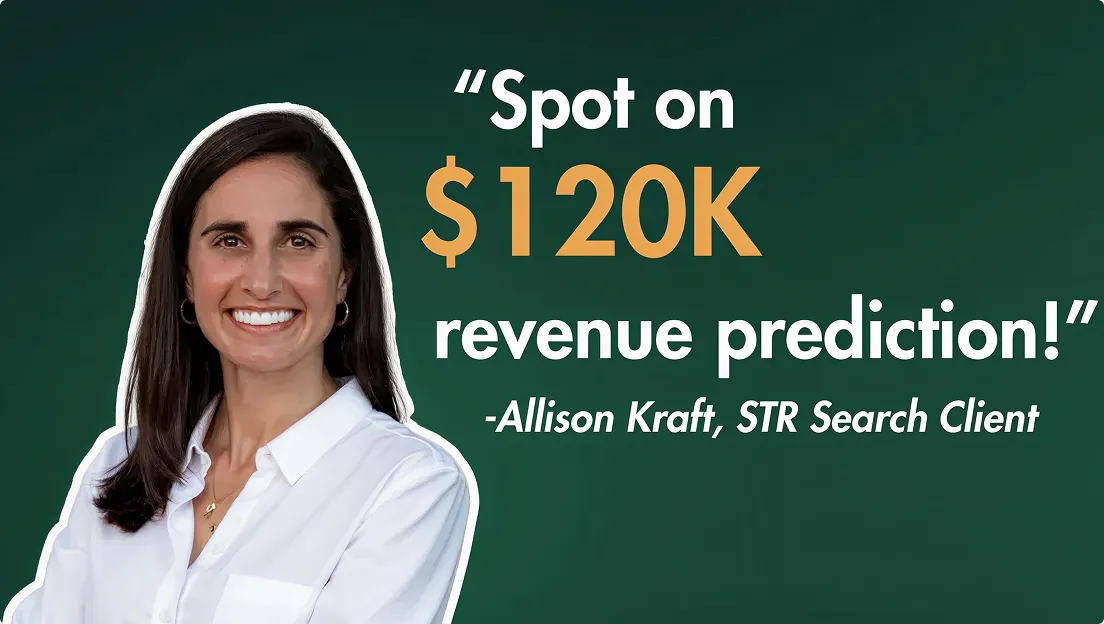
From zero real estate experience to a thriving short-term rental business, Allison locked in $120K in revenue her first year and is now expanding with STR Search again. Proof that the right team can turn analysis paralysis into profitable action!

Thanks to John's expert guidance, I made my first real estate and Airbnb investment a massive success, with consistent positive cash flow and an exceptional return on investment!

John's training gave me the confidence to secure a loan on the spot and scale from one STR to three. His approach is a total game-changer!
Why Choose STR Search?

Put your money to work & lower your tax bill
We’ve spent years analyzing what works so you don’t have to. Our job is to cut through bad data and help you make smart, profitable decisions backed by real numbers.
Schedule Your Free CallTrusted by hundreds of successful investors
Generate $3-5K+ monthly cash flow with our proven property matching system.
Build long-term wealth through STRs with cash flow, equity, and bonus depreciation.
Skip 6-12 months of trial and error with our data-driven underwriting and market analysis
We have a 100% success rate across $90M+ in Real Estate
Out of the 275+ properties we've helped our clients buy every single one has been profitable.
You want more money. More time. More freedom. But may be stuck trading hours for dollars, and scaling your investment strategy feels out of reach.
While others are getting lost in analysis paralysis, you’ve got capital and drive to change your situation. Investors who choose the right STRs can generate $3–5K/month in cash flow, plus serious tax benefits and long-term wealth.
We’ve spent years obsessed with STR investing data so you don’t have to.
With our property match services, there’s no guesswork! Just profitable properties built to perform. With the right deal, your capital can buy more than returns. It can buy your freedom.





All The Ways We Can Help You
Free courses, services, and trainings, to help you maximize your earnings from AirBnb...



Get in touch with us.
Everything Smart Investors Ask About STR Wealth Building
To start an Airbnb in Oak Island, North Carolina, begin by researching local regulations through the Town of Oak Island Planning Department, as the town requires short-term rental permits and has specific zoning restrictions limiting rentals to certain residential areas while prohibiting them in some neighborhoods. Contact Oak Island's Planning and Inspections Department at (910) 278-5011 to obtain the required short-term rental permit, which typically costs around $200-300 annually and requires proof of liability insurance, fire safety compliance, and septic system approval if applicable. Find a suitable property by working with local real estate agents familiar with Oak Island's rental market, focusing on oceanfront or canal-front homes that can command $150-400 per night depending on size and location, with popular areas including East Beach and West Beach. Furnish the property with coastal-themed, durable furniture suitable for sandy beach guests, including outdoor furniture, beach equipment, and hurricane-preparedness supplies, budgeting approximately $15,000-30,000 for a complete furnishing package. List your property on Airbnb, VRBO, and local rental companies like Williamson Realty or Oak Island Accommodations, emphasizing proximity to Oak Island Pier, lighthouse, and beaches while highlighting amenities like private pools or beach access. Manage the property by establishing relationships with local cleaning services charging $100-200 per turnover, maintenance contractors familiar with coastal property challenges, and consider hiring Oak Island-based property management companies like Coastal Vacation Resorts that typically charge 20-30% commission but handle all guest communications, cleaning coordination, and maintenance issues while ensuring compliance with town regulations and seasonal rental demands.
To identify profitable short-term rental properties in Oak Island, North Carolina, focus on oceanfront or ocean-view properties within walking distance of beaches, particularly near popular areas like the Oak Island Pier and Middleton Avenue. Target 3-6 bedroom single-family homes or condos built after 1990 with modern amenities, pools, hot tubs, and multiple parking spaces, as these command premium rates of $200-400 per night during peak summer season. Analyze pricing using AirDNA and Mashvisor to benchmark against similar properties, noting that Oak Island typically sees 60-70% occupancy rates with seasonal variations peaking June through August. Research competition by studying existing STR listings on Airbnb and VRBO within a 1-mile radius, identifying gaps in amenities or pricing strategies while monitoring properties managed by local companies like Oak Island Accommodations and Williamson Realty. Utilize tools like Rabbu and STR Helper for market analysis, consult with local property managers familiar with Brunswick County regulations, and leverage MLS data through local realtors who understand the island's rental restrictions and HOA policies that may impact STR operations.
To obtain an Airbnb/STR permit in Oak Island, North Carolina, you must first contact the Oak Island Planning and Inspections Department at Town Hall located at 4601 E Oak Island Drive to apply for a Short-Term Rental Permit. Required documents include a completed STR application form, proof of property ownership or lease agreement, floor plan showing maximum occupancy, parking plan demonstrating adequate off-street parking spaces, septic system inspection certificate if applicable, and contact information for a local property manager or responsible party available 24/7. The application fee is approximately $200-300 annually with additional inspection fees of around $100-150. Oak Island requires STR properties to maintain maximum occupancy limits based on septic capacity (typically 2 people per bedroom plus 2 additional), provide minimum 2 off-street parking spaces, display the permit number in all advertisements, maintain a guest registry, and ensure quiet hours from 10 PM to 8 AM. Properties must also comply with setback requirements, cannot have events or weddings, and must have working smoke and carbon monoxide detectors. The approval timeline is typically 4-6 weeks after submitting a complete application, pending inspections and compliance verification. Once approved, permits must be renewed annually and property owners must maintain compliance with all zoning ordinances and building codes specific to Oak Island's coastal regulations.
Short-term rentals (STRs) are legal in Oak Island, North Carolina, but operate under specific municipal regulations that require property owners to obtain a business license and comply with zoning restrictions. The town permits STRs in residential areas but requires a minimum rental period of typically 7 days, prohibits rentals in certain residential zones close to permanent residents, and mandates compliance with occupancy limits, parking requirements, and noise ordinances. Properties must meet safety standards including smoke detectors, fire extinguishers, and emergency contact information posted on-site. Oak Island has implemented these regulations around 2018-2020 to balance tourism revenue with residential quality of life concerns, and violations can result in fines or license revocation. The town also requires STR operators to collect and remit occupancy taxes, maintain liability insurance, and provide 24-hour contact information for noise or emergency issues, with recent enforcement focusing on unpermitted operations and overcrowding violations.
The best areas for Airbnb investment in Oak Island, North Carolina are the beachfront districts along East Beach Drive and West Beach Drive, which offer prime oceanfront access and attract summer vacationers, fishing enthusiasts, and families seeking beach rentals from May through September. The Middleton Avenue and McGlamery Street corridors are attractive for their proximity to the Oak Island Pier and fishing charters, drawing anglers year-round and generating consistent bookings. The Caswell Beach area on the western end provides upscale vacation rental opportunities due to its quieter atmosphere and proximity to the Oak Island Lighthouse, appealing to couples and mature travelers. The central island neighborhoods near 46th-58th Streets offer good value investments with easy beach access while being more affordable than oceanfront properties, attracting budget-conscious families and groups. The areas near Southport-Fort Fisher Ferry terminal benefit from visitors exploring historic Southport and Fort Fisher, creating demand from tourists doing regional sightseeing, while properties near the Oak Island Golf Club attract golf groups and sports travelers during spring and fall seasons.
Airbnb properties in Oak Island, North Carolina are subject to multiple lodging taxes including the state sales tax of 4.75%, the state occupancy tax of 1.75%, and Brunswick County's occupancy tax of 6%, resulting in a combined rate of approximately 12.5% on short-term rental accommodations. The Town of Oak Island also imposes a local occupancy tax of 3%, bringing the total tax burden to around 15.5% for guests staying in Airbnb properties. These taxes are typically collected by Airbnb directly from guests at the time of booking through their automated tax collection system, which began operating in North Carolina around 2017-2018. Property owners who collect taxes independently must register with the North Carolina Department of Revenue and Brunswick County tax office, filing monthly returns by the 20th of the following month and remitting collected taxes. The state requires registration for any property rented for fewer than 90 consecutive days, while Brunswick County requires registration for rentals of less than 15 consecutive days. Exemptions are limited and generally apply only to stays exceeding 90 consecutive days for state taxes or specific government/military personnel under certain circumstances, with most standard vacation rentals subject to the full tax rates.
To start an Airbnb in Oak Island, North Carolina, expect total costs around $485,000-$565,000. Property purchase represents the largest expense at $400,000-$500,000 for a median 3-bedroom beach house or condo suitable for vacation rentals. Furnishing costs range $15,000-$25,000 including beds, linens, kitchen appliances, outdoor furniture, and beach amenities. Initial setup costs approximately $3,000-$5,000 covering professional photography, listing creation, welcome materials, and basic renovations. Permits and fees total $1,500-$2,500 including business license, short-term rental permit, occupancy permit, and HOA approval if applicable. Insurance runs $2,000-$3,500 annually for vacation rental coverage including liability and property protection. Utilities average $200-$300 monthly totaling $1,200-$1,800 for six months covering electricity, water, internet, cable, and trash service. First six months operating costs add $8,000-$12,000 including cleaning services ($100-150 per turnover), maintenance reserves, supplies, marketing, platform fees (3% Airbnb commission), property management software, and guest amenities. Additional considerations include potential property management fees (20-30% of revenue), seasonal utility fluctuations due to air conditioning demands, and higher insurance requirements for coastal properties prone to hurricane damage.
Airbnb properties in Oak Island, North Carolina typically generate annual revenues between $35,000-$65,000 for oceanfront properties and $20,000-$40,000 for properties within 1-2 blocks of the beach, based on 2023-2024 market data. Operating expenses generally run 40-50% of gross revenue, including property management fees (20-25%), cleaning costs ($150-200 per turnover), utilities ($200-300 monthly), insurance ($2,000-4,000 annually), and maintenance reserves. Net profit margins typically range from 15-25% for well-managed properties, with oceanfront homes achieving higher margins due to premium pricing of $250-450 per night during peak summer season versus $150-250 for near-beach properties. Success factors include strategic location within walking distance to beaches, professional photography, dynamic pricing strategies, and maintaining high guest ratings above 4.8 stars. Properties like beachfront cottages on East Beach Drive have reported occupancy rates of 70-85% during May-September peak season, while off-season bookings (October-April) drop to 30-45% occupancy. The market benefits from Oak Island's family-friendly reputation, fishing pier attractions, and proximity to Wilmington, though profitability can be impacted by hurricane season risks, seasonal demand fluctuations, and increasing competition from new STR properties entering the market.
Based on Oak Island, North Carolina market conditions, Airbnb investments typically generate annual ROI of 12-18% with cash-on-cash returns ranging from 8-15% depending on property type and location proximity to the beach. Oceanfront properties command premium rates of $200-400 per night during peak summer season (May-September) while inland properties average $120-250 nightly, with occupancy rates of 65-75% annually due to Oak Island's popularity as a family beach destination and fishing hub. Initial profitability usually occurs within 18-24 months for well-positioned properties, with investors seeing break-even on cash invested typically by month 20-30. Properties within 2-3 blocks of beach access points perform strongest, generating gross rental yields of 15-22% annually, while factoring in property management fees (20-25%), maintenance, insurance, and local occupancy taxes reduces net returns to the 12-18% range, making Oak Island a moderately attractive short-term rental market compared to other Outer Banks locations.
STRSearch is a leading national platform that specializes in identifying profitable short-term rental properties for investors, including in Oak Island, North Carolina. Local real estate agents who focus on investment properties in the Oak Island area include Century 21 Sweyer & Associates, Coldwell Banker Sea Coast Advantage, and RE/MAX at the Beach, with agents like those at Intracoastal Realty and Oak Island Accommodations having expertise in vacation rental markets. National services that help investors find Airbnb properties include AirDNA for market analysis, Mashvisor for investment property analytics, BiggerPockets for networking and deal sourcing, and Roofstock which expanded into short-term rental investments around 2021. Additional local services include Oak Island Realty and Southport Realty, while national companies like RedAwning, AvantStay, and Vacasa provide property management and investment guidance. Real estate investment firms such as Awning and Arrived Homes also assist investors in identifying and purchasing profitable vacation rental properties in coastal North Carolina markets like Oak Island.
Put your money to work & lower your tax bill
We’ve spent years analyzing what works so you don’t have to. Our job is to cut through bad data and help you make smart, profitable decisions backed by real numbers.
Schedule Your Free Call