
Get significant tax savings and earn cash flow by investing in a short-term rental with data-backed selection. No guessing!
Find Your Airbnb InvestmentInvesting in Airbnb properties in St. Petersburg, Florida, presents a promising opportunity, largely driven by the city's growing popularity as a tourist destination. Current market conditions in St. Petersburg show a healthy demand for short-term rentals, fueled by its beautiful beaches, vibrant arts scene, and proximity to major attractions. Tourism trends indicate a steady increase in visitors, drawn to events, cultural institutions, and outdoor activities. Property values in St. Petersburg have been on an upward trajectory, reflecting the city's overall growth and desirability. This strong demand, coupled with appreciating property values, suggests a solid investment potential for Airbnb operators, particularly in well-located areas that appeal to tourists.
According to various vacation rental analytics platforms and market research, Airbnb hosts in St. Petersburg, Florida typically earn between $1,200 to $3,500 per month, with one-bedroom units averaging around $1,800 monthly and larger properties commanding $2,800 to $4,200 monthly. Seasonal variations show peak earnings during winter months (December through March) when monthly revenues can increase by 40-60% due to snowbird tourism, while summer months typically see a 15-25% decrease from peak rates. Properties within walking distance of downtown St. Pete or the waterfront generally earn 25-35% more than those in suburban areas, and amenities like pools, updated kitchens, and parking can boost earnings by 10-20%. Occupancy rates typically range from 65-85% annually, with successful hosts maintaining 75%+ occupancy through competitive pricing and strong guest reviews. Data from vacation rental management companies and platforms like AirDNA and Mashvisor consistently show these ranges, though individual results vary significantly based on property condition, location within the city, host responsiveness, and marketing effectiveness.
Airbnb investments in St. Petersburg, Florida typically generate ROI between 8-15% annually, with prime downtown and waterfront properties achieving the higher end of this range due to strong tourist demand from the city's revitalized downtown core and proximity to beaches. The average payback period for initial investment ranges from 7-12 years depending on property location and purchase price, with properties near the Dali Museum, downtown entertainment district, and Historic Kenwood neighborhoods performing best. Short-term rental properties in St. Petersburg generally outperform traditional long-term rentals by 3-6 percentage points, as long-term rentals typically yield 5-9% ROI in the same market, though Airbnb properties require significantly higher management involvement and face seasonal occupancy fluctuations between peak winter months (December-April) when occupancy rates reach 75-85% versus summer months when rates drop to 55-65%. Properties averaging $200-350 per night during peak season and $120-200 during off-season can expect annual gross revenues of $35,000-65,000 for typical 2-3 bedroom units, with net profits after expenses, cleaning, management fees, and vacancy periods typically representing 60-70% of gross revenue.
St. Petersburg's Airbnb occupancy rates average approximately 70-75% annually, with significant seasonal variations that peak during February and March at around 85-95% due to spring training baseball, spring break tourism, and optimal weather conditions, followed by strong performance in January and April through May at 80-85% occupancy. Summer months (June-September) typically see a moderate dip to 65-70% despite beach season due to high humidity and hurricane season concerns, while late fall months (November-December) drop to 55-60% occupancy. St. Petersburg consistently outperforms both Florida state averages by 10-15 percentage points and national Airbnb averages by 8-12 percentage points, largely due to its robust tourism economy driven by its renowned arts district, pristine beaches, professional sports teams (Rays baseball, Lightning hockey nearby), and its transformation into a premier cultural destination. The city's occupancy rates are particularly strong during major events like the Grand Prix of St. Petersburg in March, various art festivals throughout the year, and baseball spring training season, with some properties achieving near 100% occupancy during these peak periods.
The best Airbnb investment neighborhoods in St. Petersburg include Downtown/Central Arts District which offers proximity to museums, restaurants, and nightlife with strong pricing power due to business and leisure travelers; Historic Old Northeast featuring charming bungalows near downtown and the waterfront attracting visitors seeking authentic Florida character; The Warehouse Arts District providing trendy loft-style accommodations near galleries and breweries appealing to younger demographics; Bayshore Boulevard area offering waterfront proximity and upscale appeal with higher rental rates; Historic Kenwood known for its walkable streets, local cafes, and proximity to both downtown and beaches attracting diverse travelers; Grand Central District featuring an emerging arts scene, affordable property prices, and growing popularity among visitors seeking local experiences; and Crescent Lake area providing a quieter residential feel while maintaining easy access to downtown attractions and offering good value for families and longer-stay guests seeking more space and parking availability.
St. Petersburg, Florida requires short-term rental operators to obtain a business tax receipt and register with the city, with properties limited to a maximum occupancy of two people per bedroom plus two additional guests, not exceeding 10 people total. The city does not require owner-occupancy for short-term rentals, allowing non-resident owners to operate properties. Zoning restrictions permit short-term rentals in most residential districts, though some historic neighborhoods and specific zoning areas may have additional limitations or prohibitions. The registration process involves submitting an application with property details, proof of insurance, emergency contact information, and payment of applicable fees, typically around $50-100 annually. Properties must comply with fire safety requirements, including smoke detectors and fire extinguishers, and maintain parking requirements of one space per bedroom. Recent regulatory changes have included stricter noise ordinances with quiet hours from 10 PM to 7 AM, enhanced code enforcement penalties, and requirements for 24/7 local contact persons who can respond to issues within 30 minutes. The city has also implemented a complaint tracking system and increased fines for violations, with repeat offenders facing potential permit revocation. All short-term rental advertisements must include the city registration number, and operators must collect and remit tourist development taxes.
Short-term rentals in St. Petersburg, Florida are subject to several fees and taxes including a 6% Florida state sales tax, a 5% Pinellas County tourist development tax, and a 1% St. Petersburg city bed tax, totaling 12% in lodging taxes collected from guests. Property owners must obtain a business tax receipt from the city costing approximately $50-75 annually, register with the Florida Department of Revenue for sales tax collection at no cost, and may need a vacation rental license depending on zoning which typically costs $100-200 per year. Additional requirements include a $25-50 annual registration fee with Pinellas County for tourist development tax collection, potential homeowners association fees ranging from $200-500 annually if applicable, and inspection fees of $75-150 for initial safety compliance. Properties operating as commercial vacation rentals may also be subject to commercial property tax rates rather than homestead exemption rates, resulting in higher property taxes estimated at 1.5-2.5% of assessed value compared to the standard 1-1.5% residential rate.
Investing in Airbnb properties in St. Petersburg, Florida, presents a promising opportunity, largely driven by the city's growing popularity as a tourist destination. Current market conditions in St. Petersburg show a healthy demand for short-term rentals, fueled by its beautiful beaches, vibrant arts scene, and proximity to major attractions. Tourism trends indicate a steady increase in visitors, drawn to events, cultural institutions, and outdoor activities. Property values in St. Petersburg have been on an upward trajectory, reflecting the city's overall growth and desirability. This strong demand, coupled with appreciating property values, suggests a solid investment potential for Airbnb operators, particularly in well-located areas that appeal to tourists.
According to various vacation rental analytics platforms and market research, Airbnb hosts in St. Petersburg, Florida typically earn between $1,200 to $3,500 per month, with one-bedroom units averaging around $1,800 monthly and larger properties commanding $2,800 to $4,200 monthly. Seasonal variations show peak earnings during winter months (December through March) when monthly revenues can increase by 40-60% due to snowbird tourism, while summer months typically see a 15-25% decrease from peak rates. Properties within walking distance of downtown St. Pete or the waterfront generally earn 25-35% more than those in suburban areas, and amenities like pools, updated kitchens, and parking can boost earnings by 10-20%. Occupancy rates typically range from 65-85% annually, with successful hosts maintaining 75%+ occupancy through competitive pricing and strong guest reviews. Data from vacation rental management companies and platforms like AirDNA and Mashvisor consistently show these ranges, though individual results vary significantly based on property condition, location within the city, host responsiveness, and marketing effectiveness.
Airbnb investments in St. Petersburg, Florida typically generate ROI between 8-15% annually, with prime downtown and waterfront properties achieving the higher end of this range due to strong tourist demand from the city's revitalized downtown core and proximity to beaches. The average payback period for initial investment ranges from 7-12 years depending on property location and purchase price, with properties near the Dali Museum, downtown entertainment district, and Historic Kenwood neighborhoods performing best. Short-term rental properties in St. Petersburg generally outperform traditional long-term rentals by 3-6 percentage points, as long-term rentals typically yield 5-9% ROI in the same market, though Airbnb properties require significantly higher management involvement and face seasonal occupancy fluctuations between peak winter months (December-April) when occupancy rates reach 75-85% versus summer months when rates drop to 55-65%. Properties averaging $200-350 per night during peak season and $120-200 during off-season can expect annual gross revenues of $35,000-65,000 for typical 2-3 bedroom units, with net profits after expenses, cleaning, management fees, and vacancy periods typically representing 60-70% of gross revenue.
St. Petersburg's Airbnb occupancy rates average approximately 70-75% annually, with significant seasonal variations that peak during February and March at around 85-95% due to spring training baseball, spring break tourism, and optimal weather conditions, followed by strong performance in January and April through May at 80-85% occupancy. Summer months (June-September) typically see a moderate dip to 65-70% despite beach season due to high humidity and hurricane season concerns, while late fall months (November-December) drop to 55-60% occupancy. St. Petersburg consistently outperforms both Florida state averages by 10-15 percentage points and national Airbnb averages by 8-12 percentage points, largely due to its robust tourism economy driven by its renowned arts district, pristine beaches, professional sports teams (Rays baseball, Lightning hockey nearby), and its transformation into a premier cultural destination. The city's occupancy rates are particularly strong during major events like the Grand Prix of St. Petersburg in March, various art festivals throughout the year, and baseball spring training season, with some properties achieving near 100% occupancy during these peak periods.
The best Airbnb investment neighborhoods in St. Petersburg include Downtown/Central Arts District which offers proximity to museums, restaurants, and nightlife with strong pricing power due to business and leisure travelers; Historic Old Northeast featuring charming bungalows near downtown and the waterfront attracting visitors seeking authentic Florida character; The Warehouse Arts District providing trendy loft-style accommodations near galleries and breweries appealing to younger demographics; Bayshore Boulevard area offering waterfront proximity and upscale appeal with higher rental rates; Historic Kenwood known for its walkable streets, local cafes, and proximity to both downtown and beaches attracting diverse travelers; Grand Central District featuring an emerging arts scene, affordable property prices, and growing popularity among visitors seeking local experiences; and Crescent Lake area providing a quieter residential feel while maintaining easy access to downtown attractions and offering good value for families and longer-stay guests seeking more space and parking availability.
St. Petersburg, Florida requires short-term rental operators to obtain a business tax receipt and register with the city, with properties limited to a maximum occupancy of two people per bedroom plus two additional guests, not exceeding 10 people total. The city does not require owner-occupancy for short-term rentals, allowing non-resident owners to operate properties. Zoning restrictions permit short-term rentals in most residential districts, though some historic neighborhoods and specific zoning areas may have additional limitations or prohibitions. The registration process involves submitting an application with property details, proof of insurance, emergency contact information, and payment of applicable fees, typically around $50-100 annually. Properties must comply with fire safety requirements, including smoke detectors and fire extinguishers, and maintain parking requirements of one space per bedroom. Recent regulatory changes have included stricter noise ordinances with quiet hours from 10 PM to 7 AM, enhanced code enforcement penalties, and requirements for 24/7 local contact persons who can respond to issues within 30 minutes. The city has also implemented a complaint tracking system and increased fines for violations, with repeat offenders facing potential permit revocation. All short-term rental advertisements must include the city registration number, and operators must collect and remit tourist development taxes.
Short-term rentals in St. Petersburg, Florida are subject to several fees and taxes including a 6% Florida state sales tax, a 5% Pinellas County tourist development tax, and a 1% St. Petersburg city bed tax, totaling 12% in lodging taxes collected from guests. Property owners must obtain a business tax receipt from the city costing approximately $50-75 annually, register with the Florida Department of Revenue for sales tax collection at no cost, and may need a vacation rental license depending on zoning which typically costs $100-200 per year. Additional requirements include a $25-50 annual registration fee with Pinellas County for tourist development tax collection, potential homeowners association fees ranging from $200-500 annually if applicable, and inspection fees of $75-150 for initial safety compliance. Properties operating as commercial vacation rentals may also be subject to commercial property tax rates rather than homestead exemption rates, resulting in higher property taxes estimated at 1.5-2.5% of assessed value compared to the standard 1-1.5% residential rate.
* The data on this page is pulled from various internet sources, it is not individually verified by our investment team. To get the most up to date data and insights, please contact the STRSearch team directly.
How Smart Investors Build Wealth
Through Data-Driven STRs (Real Results)
From first-time investors to seasoned pros, see how our commitment to comprehensive data analysis led to unparalleled investment victories.
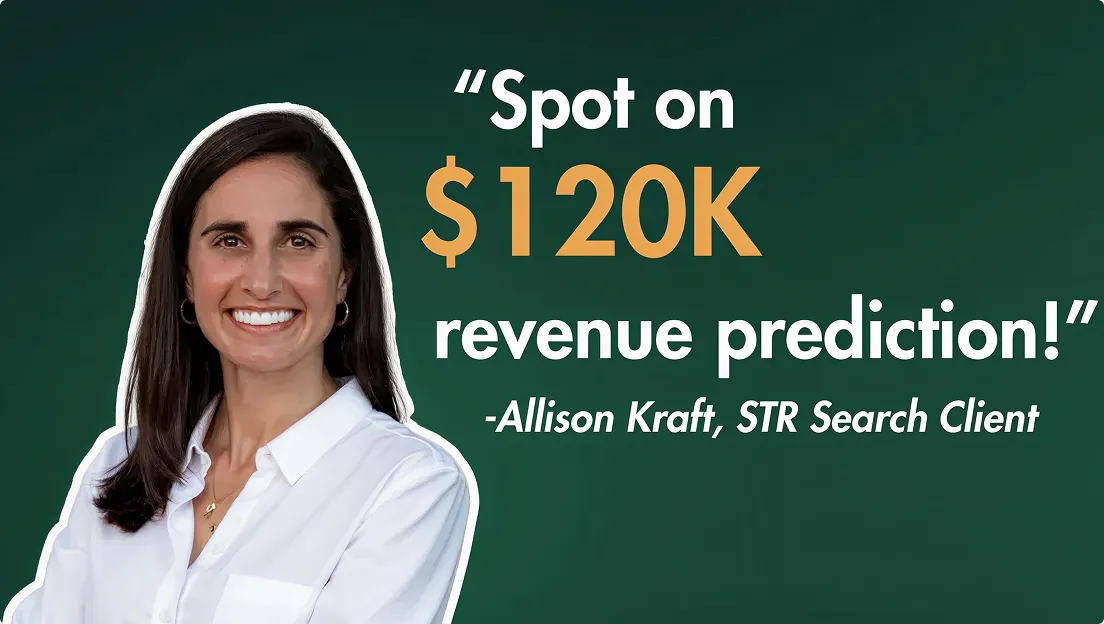
From zero real estate experience to a thriving short-term rental business, Allison locked in $120K in revenue her first year and is now expanding with STR Search again. Proof that the right team can turn analysis paralysis into profitable action!

Thanks to John's expert guidance, I made my first real estate and Airbnb investment a massive success, with consistent positive cash flow and an exceptional return on investment!

John's training gave me the confidence to secure a loan on the spot and scale from one STR to three. His approach is a total game-changer!
Why Choose STR Search?

Put your money to work & lower your tax bill
We’ve spent years analyzing what works so you don’t have to. Our job is to cut through bad data and help you make smart, profitable decisions backed by real numbers.
Schedule Your Free CallTrusted by hundreds of successful investors
Generate $3-5K+ monthly cash flow with our proven property matching system.
Build long-term wealth through STRs with cash flow, equity, and bonus depreciation.
Skip 6-12 months of trial and error with our data-driven underwriting and market analysis
We have a 100% success rate across $90M+ in Real Estate
Out of the 275+ properties we've helped our clients buy every single one has been profitable.
You want more money. More time. More freedom. But may be stuck trading hours for dollars, and scaling your investment strategy feels out of reach.
While others are getting lost in analysis paralysis, you’ve got capital and drive to change your situation. Investors who choose the right STRs can generate $3–5K/month in cash flow, plus serious tax benefits and long-term wealth.
We’ve spent years obsessed with STR investing data so you don’t have to.
With our property match services, there’s no guesswork! Just profitable properties built to perform. With the right deal, your capital can buy more than returns. It can buy your freedom.





All The Ways We Can Help You
Free courses, services, and trainings, to help you maximize your earnings from AirBnb...


Get in touch with us.
Everything Smart Investors Ask About STR Wealth Building
To start an Airbnb in St. Petersburg, Florida, begin by researching local regulations as the city requires short-term rental operators to obtain a business tax receipt and comply with zoning restrictions that limit rentals to certain residential areas while prohibiting them in some historic districts. Contact the St. Petersburg Planning and Development Services Department at (727) 893-7247 to verify your property's zoning allows short-term rentals, then apply for a business tax receipt through the city's online portal or at City Hall, which costs approximately $50-100 annually. Find a suitable property in permitted zones such as parts of downtown, Grand Central District, or approved residential areas, ensuring it meets safety requirements including smoke detectors, carbon monoxide detectors, and proper egress windows. Furnish the space with quality furniture, linens, kitchen essentials, and local touches highlighting St. Petersburg's arts scene and waterfront culture, budgeting $3,000-8,000 for a one-bedroom unit. Create your Airbnb listing with professional photos showcasing nearby attractions like the Salvador Dalí Museum, downtown murals, and beaches, setting competitive rates based on local market research showing average nightly rates of $80-200 depending on location and season. Manage your property by establishing check-in procedures, maintaining cleanliness standards, responding promptly to guests, and ensuring compliance with the city's noise ordinances and parking requirements, while considering hiring a local property management company if you live out of area, as St. Petersburg's tourism peaks during winter months from December through April.
To identify profitable short-term rental properties in St. Petersburg, Florida, focus on locations within 1-2 miles of downtown, the waterfront districts like The Pier and Vinoy Park, or near popular beaches such as St. Pete Beach and Treasure Island, as these areas command premium nightly rates of $150-300+ during peak season. Target properties with 2-4 bedrooms, updated kitchens, outdoor spaces like patios or balconies, parking availability, and unique features such as historic charm or water views, as these consistently outperform basic condos. Conduct pricing analysis using AirDNA and Mashvisor to identify properties where potential STR revenue exceeds long-term rental income by at least 40-60%, typically requiring nightly rates of $120+ to justify the investment in this market. Research competition density using Airdna's market data and avoid oversaturated areas with more than 15-20 active listings per square mile, while identifying underserved neighborhoods near attractions like the Salvador Dali Museum or Tropicana Field. Utilize local resources including the Pinellas County Property Appraiser website for property values, STR-specific platforms like Rabbu for performance analytics, and connect with local property management companies like RedAwning or Vacasa to understand operational costs, which typically run 25-35% of gross revenue in the St. Petersburg market.
To obtain an Airbnb/STR permit in St. Petersburg, Florida, you must first apply through the City of St. Petersburg's Development Services Department located at 175 5th Street North, or online through their permitting portal. Required documents include a completed short-term rental application, proof of property ownership or lease agreement with landlord consent, floor plan of the rental unit, parking plan showing adequate spaces, contact information for a local representative available 24/7, certificate of insurance with minimum $1 million liability coverage, and payment of applicable fees. The application fee is approximately $200-300 with an annual renewal fee of around $150-200. You must also obtain a business tax receipt from the city, which costs about $50-75 annually. St. Petersburg requires STRs to be located in zoning districts that permit such use, maintain minimum parking requirements (typically one space per bedroom), limit occupancy to two people per bedroom plus two additional guests, prohibit rentals shorter than 3 days in residential areas, and ensure the property meets all building and fire safety codes. The approval timeline typically takes 4-6 weeks for complete applications, though complex cases may take longer. Once approved, you must display the permit number in all advertising and maintain compliance with noise ordinances, trash collection schedules, and neighbor notification requirements.
Short-term rentals (STRs) are legal in St. Petersburg, Florida, but operate under specific regulations established by the city. As of 2023, St. Petersburg requires STR operators to obtain a business tax receipt and comply with zoning restrictions that generally limit STRs to commercial and mixed-use districts, while prohibiting them in most single-family residential neighborhoods. The city implemented stricter regulations around 2019-2020 following community concerns about neighborhood impacts, including noise and parking issues. Current restrictions include occupancy limits, parking requirements, noise ordinances, and mandatory contact information for a responsible party available 24/7. Properties in historic districts face additional scrutiny, and the city maintains a registry of approved STRs. Violations can result in fines and permit revocation, with the city actively enforcing these regulations through code compliance officers who respond to complaints from residents about unpermitted or problematic STR operations.
The best Airbnb investment areas in St. Petersburg, Florida include Downtown St. Petersburg, particularly around Central Avenue and the Arts District, which attracts tourists visiting the Salvador Dalí Museum, Chihuly Collection, and Museum of Fine Arts, along with business travelers attending conferences at venues like the Mahaffey Theater. The Historic Old Northeast neighborhood offers charming bungalows near North Shore Park and is popular with visitors seeking authentic local experiences while remaining close to downtown attractions. The Grand Central District has emerged as a hip area with craft breweries, restaurants, and walkable streets that appeal to younger travelers and those attending events at Tropicana Field. Bayshore Boulevard and Snell Isle provide upscale waterfront properties that command premium rates from luxury travelers and those visiting for boating or water activities. The Edge District, bordering Tampa Bay, offers modern condos and lofts attractive to business travelers working in the growing tech and healthcare sectors, while Gulfport, though technically separate, provides a bohemian beach town atmosphere that draws artists and cultural tourists year-round.
In St. Petersburg, Florida, Airbnb hosts must collect and remit a 6% Florida state sales tax and a 5% Pinellas County tourist development tax, totaling 11% on short-term rental stays of six months or less. The City of St. Petersburg also imposes a local business tax that varies based on rental income levels, typically ranging from $25-$100 annually for small operators. Airbnb automatically collects and remits the state sales tax and county tourist development tax for most bookings through their platform as of 2018, but hosts remain responsible for registering with the Florida Department of Revenue and Pinellas County Tax Collector's office. Monthly remittance is required by the 20th of the following month, with quarterly filing acceptable for smaller operators collecting less than $200 in taxes monthly. Hosts must also obtain a Pinellas County short-term rental certificate and city business tax receipt. Exemptions include stays exceeding 30 consecutive days, rentals to permanent residents, and certain medical or emergency housing situations, though documentation is required to substantiate exempt status.
The total cost to start an Airbnb in St. Petersburg, Florida is approximately $485,000-$565,000. Property purchase costs around $400,000 based on the median home price in the area. Furnishing a 2-3 bedroom property requires $15,000-$25,000 for quality furniture, appliances, linens, and decor that meets guest expectations. Initial setup costs including professional photography, listing creation, and basic marketing total $2,000-$3,000. Permits and fees including business license, vacation rental permit, and inspection fees range from $500-$1,500 depending on local requirements. Insurance for short-term rentals costs $2,000-$3,000 annually, with the first year paid upfront. Utilities including electricity, water, internet, cable, and trash service average $300-$400 monthly or $1,800-$2,400 for six months. First six months operating costs including cleaning services ($150 per turnover), property management software ($50/month), maintenance reserves ($200/month), and marketing expenses total approximately $4,000-$6,000. Additional working capital of $5,000-$10,000 should be reserved for unexpected repairs, guest refunds, and vacancy periods during the initial launch phase.
Airbnb properties in St. Petersburg, Florida demonstrate strong profitability potential with average annual revenues ranging from $35,000-$65,000 for well-positioned properties, while expenses typically run $18,000-$28,000 annually including mortgage, utilities, cleaning, maintenance, and platform fees, resulting in profit margins of 35-55% for successful operators. Properties near downtown's waterfront districts, the Dali Museum area, and Grand Central District command premium rates of $150-$300 per night during peak season (December-April), with year-round occupancy rates averaging 65-75% due to the city's growing tourism sector and business travel market. Success factors include strategic location within walking distance of attractions, professional photography, dynamic pricing strategies, and maintaining superhost status, with properties featuring modern amenities, parking, and unique local character significantly outperforming generic listings. Case studies from 2022-2023 show that investors who purchased $300,000-$400,000 condos or single-family homes in desirable neighborhoods like Old Northeast or Edge District achieved 12-18% annual returns after accounting for appreciation, while those focusing solely on cash flow from rentals typically see 8-12% returns, with the most successful operators being those who actively manage multiple properties and leverage local market knowledge to optimize pricing and guest experience.
Airbnb investments in St. Petersburg, Florida typically generate annual ROI of 12-18% with cash-on-cash returns ranging from 8-15% depending on property location and management efficiency. Properties in downtown St. Petersburg and near the waterfront areas like the Pier District command higher nightly rates of $120-200, while suburban locations average $80-130 per night. With average property acquisition costs of $300,000-500,000 and annual gross rental income potential of $35,000-65,000, investors can expect to reach profitability within 18-24 months after accounting for initial setup costs, furnishing, and operational expenses. The market benefits from year-round tourism, proximity to Tampa Bay attractions, and a growing arts and culture scene, with occupancy rates typically ranging from 65-75% annually. Properties requiring minimal renovation in established neighborhoods like Old Northeast or Kenwood generally achieve faster profitability timelines of 12-18 months, while fixer-uppers may extend the break-even period to 24-36 months but offer higher long-term returns of 15-20% annually.
STRSearch is a leading national platform that specializes in identifying profitable short-term rental properties for investors in St. Petersburg, Florida. Local real estate agents who focus on Airbnb investment properties in the area include The Kolb Team at Keller Williams, Sarah Marquis with Coldwell Banker, and Michael Torres at RE/MAX. National services that assist with St. Petersburg Airbnb investments include Mashvisor for property analysis, AirDNA for market data and revenue projections, Awning for full-service Airbnb investment management, and Roofstock which offers turnkey rental properties. Local property management companies specializing in short-term rentals include RedAwning, AvantStay, and Vacasa, while local investment-focused real estate firms such as Tampa Bay Real Estate Investors Group and Suncoast Property Solutions provide market expertise. Additional national platforms like BiggerPockets marketplace, Fundrise for real estate crowdfunding, and RentSpree for property discovery also serve the St. Petersburg market, with many investors also utilizing local mortgage brokers like Bay Area Lending Group and inspection services from companies like Pillar to Post to ensure profitable Airbnb acquisitions in this growing Florida market.
Put your money to work & lower your tax bill
We’ve spent years analyzing what works so you don’t have to. Our job is to cut through bad data and help you make smart, profitable decisions backed by real numbers.
Schedule Your Free Call