
Get significant tax savings and earn cash flow by investing in a short-term rental with data-backed selection. No guessing!
Find Your Airbnb InvestmentInvesting in Airbnb properties in Williamstown, Massachusetts, presents a unique opportunity, largely driven by the town's strong appeal as a cultural and educational destination. Williamstown's market benefits from consistent tourism, primarily due to attractions like Williams College, the Clark Art Institute, and the Massachusetts Museum of Contemporary Art (MASS MoCA) nearby, drawing visitors year-round for academic events, art exhibitions, and scenic beauty. While property values in this desirable Berkshire County town can be higher, the steady influx of visitors ensures robust demand for short-term rentals, particularly during peak seasons such as college commencements, fall foliage, and summer arts festivals. Current market conditions indicate a solid investment potential for well-managed Airbnb properties, especially those that cater to visitors seeking a quintessential New England experience.
Based on available market data and rental analytics, Airbnb properties in Williamstown, Massachusetts typically generate between $1,200 to $3,500 in monthly revenue, with significant seasonal fluctuations driven by the area's tourism patterns and Williams College academic calendar. Properties experience peak earnings during summer months and fall foliage season, often seeing 40-60% higher occupancy rates and premium pricing that can push monthly revenues to $4,000-5,500 for well-positioned listings. Winter months typically see the lowest performance with revenues dropping to $800-1,800 monthly due to reduced tourist activity and harsh weather conditions. Key factors influencing earnings include proximity to Williams College campus, property size and amenities, seasonal attractions like hiking trails and cultural events, and competition from approximately 50-80 active listings in the area. Properties within walking distance of the college or downtown area command higher nightly rates averaging $150-250, while more remote locations typically earn $80-150 per night. The market shows strong performance during college events, graduation weekends, and peak foliage season in October, with successful hosts reporting annual gross revenues ranging from $18,000 to $45,000 depending on property type and management quality.
Airbnb investments in Williamstown, Massachusetts typically generate ROI between 8-12% annually, with higher-end properties near Williams College achieving up to 15% during peak academic and tourist seasons. The average payback period ranges from 7-10 years, depending on initial investment and property type, with Victorian homes and properties within walking distance of campus commanding premium rates of $150-250 per night during fall foliage and graduation periods. Compared to traditional long-term rentals in Williamstown, which average 6-8% ROI with monthly rents of $1,200-2,000, short-term rentals can outperform by 2-4 percentage points annually, though they require significantly more active management and face seasonal occupancy fluctuations, with summer and fall months achieving 70-85% occupancy rates while winter months may drop to 35-50%. The college town's limited housing supply and steady influx of visiting families, prospective students, and tourists to the Clark Art Institute and Mass MoCA create consistent demand, though investors must factor in higher operating costs, cleaning fees, and potential regulatory changes that could impact profitability.
Williamstown, Massachusetts Airbnb properties typically maintain an average annual occupancy rate of approximately 65-70%, with significant seasonal variations driven by Williams College's academic calendar and summer tourism. Peak occupancy occurs during fall foliage season (September-October) reaching 85-90%, followed by summer months (June-August) at 75-80%, while winter months (December-February) drop to 45-50% occupancy. The spring graduation period and summer cultural events at venues like the Clark Art Institute and Williamstown Theatre Festival drive additional demand spikes. Compared to Massachusetts's statewide Airbnb average of approximately 60-65%, Williamstown performs moderately better due to its college town dynamics and tourist attractions, though it lags behind popular coastal destinations like Cape Cod which average 70-75%. Nationally, Williamstown's occupancy rates align closely with the typical U.S. Airbnb average of 65%, though its seasonal volatility is more pronounced than urban markets due to its reliance on academic and seasonal tourism patterns.
The best Airbnb investment neighborhoods in Williamstown center around the Williams College campus area, particularly the Spring Street and Water Street corridors, which offer prime proximity to the college and downtown attractions with strong rental demand from visiting families, prospective students, and college events, commanding premium rates of $150-250 per night. The Elm Street and Park Street residential areas provide excellent investment opportunities due to their walkable access to both the college and the Clark Art Institute, attracting cultural tourists and academic visitors year-round with typical rates of $120-200 nightly. The Route 2 corridor near the Williams Inn area offers good value investments with easier parking and access while maintaining proximity to major attractions, suitable for families and longer stays at $100-180 per night. The neighborhoods around Field Park and the Williamstown Theatre Festival venue are highly desirable during summer months, benefiting from theater-goers and outdoor enthusiasts visiting the Berkshires, with seasonal rate premiums reaching $200-300 nightly. The residential streets near the Williams College Museum of Art, including Lynde Lane and surrounding areas, provide steady demand from art enthusiasts and museum visitors, offering consistent occupancy rates with pricing around $130-220 per night. Properties near the Appalachian Trail access points and Mount Greylock State Reservation attract outdoor recreation tourists, particularly during fall foliage season, commanding premium rates of $180-280 nightly during peak periods.
Williamstown, Massachusetts requires short-term rental operators to obtain a special permit through the Planning Board and register with the town clerk, with properties limited to a maximum occupancy of 8 guests or 2 guests per bedroom, whichever is less. Owner-occupancy is not mandated for short-term rentals, but properties must be the owner's primary residence if operating more than 14 days per year, and rentals are permitted in residential zoning districts with specific setback and parking requirements of at least 2 spaces per unit. The registration process involves submitting floor plans, proof of insurance, emergency contact information, and paying annual fees of approximately $200-300, while recent changes implemented around 2019-2020 have strengthened noise ordinances, required 24/7 local contact availability, and established stricter penalties for violations including potential permit revocation. Properties must also comply with state lodging regulations, maintain guest registries, and provide neighbors with contact information, with inspections required every three years and additional restrictions on events or gatherings exceeding normal occupancy limits.
Short-term rentals in Williamstown, Massachusetts are subject to the state's 5.7% short-term rental excise tax, which applies to rentals of 31 days or less, along with the standard 6.25% Massachusetts sales tax on the rental portion of stays. The town of Williamstown requires short-term rental operators to obtain an annual permit costing approximately $200-300, and properties must be registered with both the state and local authorities, with state registration fees around $200 every three years. Additionally, operators typically need to pay for required inspections which can cost $150-250 annually, and may be subject to local meals tax of 0.75% if food services are provided. Property owners must also ensure compliance with local zoning requirements and may face additional fees for certificate of occupancy renewals ranging from $100-200 annually, while some properties may require special use permits costing $300-500 depending on the zoning district and specific use requirements.
Investing in Airbnb properties in Williamstown, Massachusetts, presents a unique opportunity, largely driven by the town's strong appeal as a cultural and educational destination. Williamstown's market benefits from consistent tourism, primarily due to attractions like Williams College, the Clark Art Institute, and the Massachusetts Museum of Contemporary Art (MASS MoCA) nearby, drawing visitors year-round for academic events, art exhibitions, and scenic beauty. While property values in this desirable Berkshire County town can be higher, the steady influx of visitors ensures robust demand for short-term rentals, particularly during peak seasons such as college commencements, fall foliage, and summer arts festivals. Current market conditions indicate a solid investment potential for well-managed Airbnb properties, especially those that cater to visitors seeking a quintessential New England experience.
Based on available market data and rental analytics, Airbnb properties in Williamstown, Massachusetts typically generate between $1,200 to $3,500 in monthly revenue, with significant seasonal fluctuations driven by the area's tourism patterns and Williams College academic calendar. Properties experience peak earnings during summer months and fall foliage season, often seeing 40-60% higher occupancy rates and premium pricing that can push monthly revenues to $4,000-5,500 for well-positioned listings. Winter months typically see the lowest performance with revenues dropping to $800-1,800 monthly due to reduced tourist activity and harsh weather conditions. Key factors influencing earnings include proximity to Williams College campus, property size and amenities, seasonal attractions like hiking trails and cultural events, and competition from approximately 50-80 active listings in the area. Properties within walking distance of the college or downtown area command higher nightly rates averaging $150-250, while more remote locations typically earn $80-150 per night. The market shows strong performance during college events, graduation weekends, and peak foliage season in October, with successful hosts reporting annual gross revenues ranging from $18,000 to $45,000 depending on property type and management quality.
Airbnb investments in Williamstown, Massachusetts typically generate ROI between 8-12% annually, with higher-end properties near Williams College achieving up to 15% during peak academic and tourist seasons. The average payback period ranges from 7-10 years, depending on initial investment and property type, with Victorian homes and properties within walking distance of campus commanding premium rates of $150-250 per night during fall foliage and graduation periods. Compared to traditional long-term rentals in Williamstown, which average 6-8% ROI with monthly rents of $1,200-2,000, short-term rentals can outperform by 2-4 percentage points annually, though they require significantly more active management and face seasonal occupancy fluctuations, with summer and fall months achieving 70-85% occupancy rates while winter months may drop to 35-50%. The college town's limited housing supply and steady influx of visiting families, prospective students, and tourists to the Clark Art Institute and Mass MoCA create consistent demand, though investors must factor in higher operating costs, cleaning fees, and potential regulatory changes that could impact profitability.
Williamstown, Massachusetts Airbnb properties typically maintain an average annual occupancy rate of approximately 65-70%, with significant seasonal variations driven by Williams College's academic calendar and summer tourism. Peak occupancy occurs during fall foliage season (September-October) reaching 85-90%, followed by summer months (June-August) at 75-80%, while winter months (December-February) drop to 45-50% occupancy. The spring graduation period and summer cultural events at venues like the Clark Art Institute and Williamstown Theatre Festival drive additional demand spikes. Compared to Massachusetts's statewide Airbnb average of approximately 60-65%, Williamstown performs moderately better due to its college town dynamics and tourist attractions, though it lags behind popular coastal destinations like Cape Cod which average 70-75%. Nationally, Williamstown's occupancy rates align closely with the typical U.S. Airbnb average of 65%, though its seasonal volatility is more pronounced than urban markets due to its reliance on academic and seasonal tourism patterns.
The best Airbnb investment neighborhoods in Williamstown center around the Williams College campus area, particularly the Spring Street and Water Street corridors, which offer prime proximity to the college and downtown attractions with strong rental demand from visiting families, prospective students, and college events, commanding premium rates of $150-250 per night. The Elm Street and Park Street residential areas provide excellent investment opportunities due to their walkable access to both the college and the Clark Art Institute, attracting cultural tourists and academic visitors year-round with typical rates of $120-200 nightly. The Route 2 corridor near the Williams Inn area offers good value investments with easier parking and access while maintaining proximity to major attractions, suitable for families and longer stays at $100-180 per night. The neighborhoods around Field Park and the Williamstown Theatre Festival venue are highly desirable during summer months, benefiting from theater-goers and outdoor enthusiasts visiting the Berkshires, with seasonal rate premiums reaching $200-300 nightly. The residential streets near the Williams College Museum of Art, including Lynde Lane and surrounding areas, provide steady demand from art enthusiasts and museum visitors, offering consistent occupancy rates with pricing around $130-220 per night. Properties near the Appalachian Trail access points and Mount Greylock State Reservation attract outdoor recreation tourists, particularly during fall foliage season, commanding premium rates of $180-280 nightly during peak periods.
Williamstown, Massachusetts requires short-term rental operators to obtain a special permit through the Planning Board and register with the town clerk, with properties limited to a maximum occupancy of 8 guests or 2 guests per bedroom, whichever is less. Owner-occupancy is not mandated for short-term rentals, but properties must be the owner's primary residence if operating more than 14 days per year, and rentals are permitted in residential zoning districts with specific setback and parking requirements of at least 2 spaces per unit. The registration process involves submitting floor plans, proof of insurance, emergency contact information, and paying annual fees of approximately $200-300, while recent changes implemented around 2019-2020 have strengthened noise ordinances, required 24/7 local contact availability, and established stricter penalties for violations including potential permit revocation. Properties must also comply with state lodging regulations, maintain guest registries, and provide neighbors with contact information, with inspections required every three years and additional restrictions on events or gatherings exceeding normal occupancy limits.
Short-term rentals in Williamstown, Massachusetts are subject to the state's 5.7% short-term rental excise tax, which applies to rentals of 31 days or less, along with the standard 6.25% Massachusetts sales tax on the rental portion of stays. The town of Williamstown requires short-term rental operators to obtain an annual permit costing approximately $200-300, and properties must be registered with both the state and local authorities, with state registration fees around $200 every three years. Additionally, operators typically need to pay for required inspections which can cost $150-250 annually, and may be subject to local meals tax of 0.75% if food services are provided. Property owners must also ensure compliance with local zoning requirements and may face additional fees for certificate of occupancy renewals ranging from $100-200 annually, while some properties may require special use permits costing $300-500 depending on the zoning district and specific use requirements.
* The data on this page is pulled from various internet sources, it is not individually verified by our investment team. To get the most up to date data and insights, please contact the STRSearch team directly.
How Smart Investors Build Wealth
Through Data-Driven STRs (Real Results)
From first-time investors to seasoned pros, see how our commitment to comprehensive data analysis led to unparalleled investment victories.
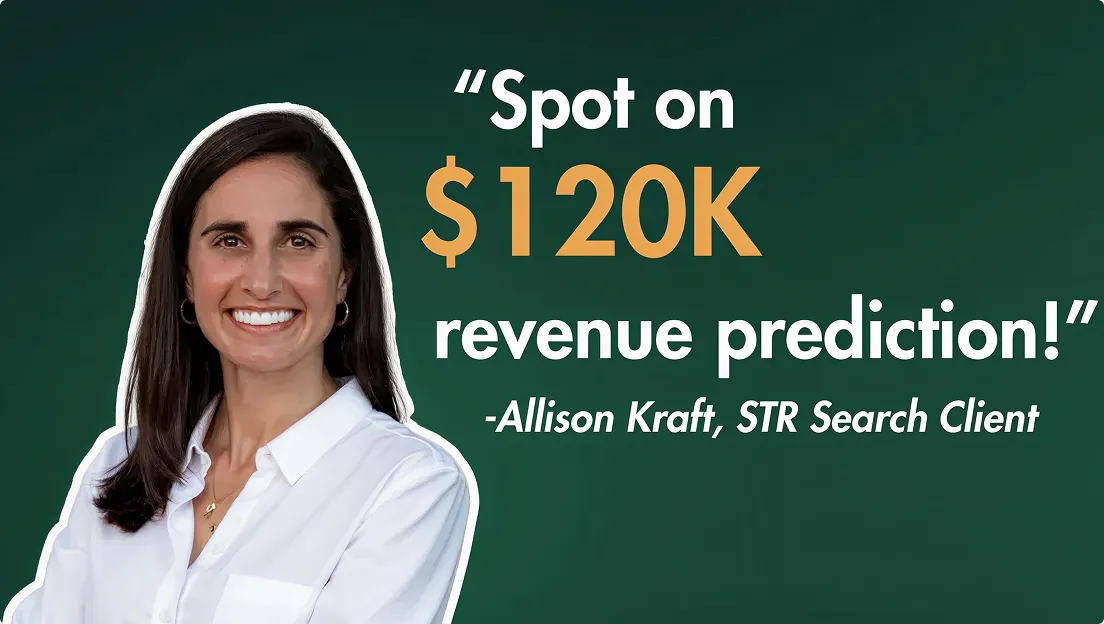
From zero real estate experience to a thriving short-term rental business, Allison locked in $120K in revenue her first year and is now expanding with STR Search again. Proof that the right team can turn analysis paralysis into profitable action!

Thanks to John's expert guidance, I made my first real estate and Airbnb investment a massive success, with consistent positive cash flow and an exceptional return on investment!

John's training gave me the confidence to secure a loan on the spot and scale from one STR to three. His approach is a total game-changer!
Why Choose STR Search?

Put your money to work & lower your tax bill
We’ve spent years analyzing what works so you don’t have to. Our job is to cut through bad data and help you make smart, profitable decisions backed by real numbers.
Schedule Your Free CallTrusted by hundreds of successful investors
Generate $3-5K+ monthly cash flow with our proven property matching system.
Build long-term wealth through STRs with cash flow, equity, and bonus depreciation.
Skip 6-12 months of trial and error with our data-driven underwriting and market analysis
We have a 100% success rate across $90M+ in Real Estate
Out of the 275+ properties we've helped our clients buy every single one has been profitable.
You want more money. More time. More freedom. But may be stuck trading hours for dollars, and scaling your investment strategy feels out of reach.
While others are getting lost in analysis paralysis, you’ve got capital and drive to change your situation. Investors who choose the right STRs can generate $3–5K/month in cash flow, plus serious tax benefits and long-term wealth.
We’ve spent years obsessed with STR investing data so you don’t have to.
With our property match services, there’s no guesswork! Just profitable properties built to perform. With the right deal, your capital can buy more than returns. It can buy your freedom.





All The Ways We Can Help You
Free courses, services, and trainings, to help you maximize your earnings from AirBnb...


Get in touch with us.
Everything Smart Investors Ask About STR Wealth Building
To start an Airbnb in Williamstown, Massachusetts, begin by researching local zoning laws and regulations through the Williamstown Planning Board, as the town requires short-term rental operators to obtain a special permit and comply with specific occupancy limits typically capped at 4-6 guests depending on the property size. Contact the Williamstown Building Inspector's office to secure necessary permits including a lodging house license if operating more than 3 rooms, and ensure compliance with Massachusetts state tax requirements by registering with the Department of Revenue for room occupancy excise tax collection (currently 5.7% state tax plus potential local taxes). Find a suitable property by working with local real estate agents familiar with Williams College area demand, focusing on locations within walking distance to campus or downtown that allow short-term rentals under current zoning. Furnish the space with quality basics including comfortable beds, linens, kitchen essentials, WiFi, and local guidebooks highlighting Williamstown attractions like the Clark Art Institute and Williams College Museum of Art. Create your Airbnb listing with professional photos emphasizing proximity to Williams College, the Berkshire Mountains, and seasonal attractions, pricing competitively with area rates typically ranging $100-300 per night depending on size and season. Manage the property by establishing relationships with local cleaning services, maintenance contractors, and consider using property management companies familiar with Berkshire County regulations, while maintaining responsive communication with guests and ensuring compliance with ongoing permit requirements and tax obligations.
To identify profitable short-term rental properties in Williamstown, Massachusetts, focus on locations within walking distance of Williams College campus, downtown Spring Street, and the Clark Art Institute, as these drive consistent demand from visiting families, prospective students, and cultural tourists. Target 2-4 bedroom properties built after 1950 with modern amenities, parking, and outdoor spaces, as Williamstown's tourist season peaks during college events and summer cultural activities at venues like Williamstown Theatre Festival. Conduct pricing analysis using AirDNA and Mashvisor to benchmark against similar properties, noting that rates typically range $150-400/night depending on size and proximity to college, with higher premiums during graduation, homecoming, and summer festival seasons. Research competition by analyzing existing Airbnb and VRBO listings within 2 miles of campus, identifying gaps in luxury amenities or unique property features like historic charm or mountain views. Utilize tools like STR Helper for market analysis, connect with local property management companies familiar with seasonal rental regulations, and monitor Williams College's academic calendar and Williamstown Theatre Festival schedules to optimize pricing strategies, while ensuring compliance with local zoning laws that may restrict short-term rentals in certain residential areas.
To obtain an Airbnb/STR permit in Williamstown, Massachusetts, you must first contact the Williamstown Building Department and Town Clerk's office at Town Hall located at 31 North Street to determine specific local requirements, as Massachusetts allows municipalities to regulate short-term rentals independently. You'll typically need to submit an application form along with required documents including proof of property ownership or lease agreement, floor plans of the rental unit, certificate of occupancy, proof of liability insurance (usually $1 million minimum), fire safety inspection certificate, and septic system inspection if applicable. The application fee is estimated at $200-500 initially with potential annual renewal fees of $100-300, and you may need additional permits such as a business license, health department approval, and building permits for any modifications. The approval timeline typically ranges from 4-8 weeks depending on inspection scheduling and document review, during which the fire department and health inspector will likely conduct on-site inspections to ensure compliance with safety codes, occupancy limits, and sanitary requirements. Williamstown may require specific conditions such as on-site parking availability, noise ordinance compliance, waste management plans, and potentially limit the number of rental days per year or require owner occupancy, so contact the Planning Department at (413) 458-3500 extension 1 for current zoning restrictions and the Building Department for permit applications to ensure full compliance with local regulations.
Short-term rentals (STRs) are legal in Williamstown, Massachusetts, but operate under local regulations that the town has implemented to balance tourism benefits with residential neighborhood preservation. The town requires STR operators to obtain proper permits and comply with safety requirements including smoke detectors, carbon monoxide detectors, and occupancy limits typically based on bedroom count plus two additional guests. Williamstown generally prohibits STRs in certain residential zones or limits them to owner-occupied properties, with restrictions on the total number of rental days per year (often around 180-200 days). The town has implemented noise ordinances, parking requirements (usually 1-2 spaces per unit), and waste management protocols that STR operators must follow. Recent changes around 2019-2022 included stricter enforcement mechanisms, higher permit fees, and enhanced neighbor notification requirements when new STR applications are submitted. Properties near Williams College campus may face additional scrutiny due to concerns about converting long-term student housing to short-term rentals, and the town maintains a registry of all permitted STRs with annual renewal requirements and potential inspections to ensure compliance with health and safety standards.
The most promising Airbnb investment areas in Williamstown, Massachusetts center around the Williams College campus district and downtown Spring Street corridor, which attract year-round visitors for college events, graduations, parents' weekends, and academic conferences. The Taconic Trail and Route 2 corridor near the Clark Art Institute draws significant tourism traffic, especially during summer months when the museum hosts major exhibitions and the Williamstown Theatre Festival runs from June through August. The historic village center around Water Street and Main Street offers charm for leaf-peeping tourists in fall and provides easy access to local restaurants and shops. Properties near the Williams College Museum of Art and '62 Center for Theatre and Dance benefit from cultural tourism and visiting artists. The areas close to Mount Greylock State Reservation entrance points attract outdoor enthusiasts and hikers year-round, while neighborhoods within walking distance of the Sterling and Francine Clark Art Institute capitalize on its 200,000+ annual visitors and special events programming.
In Williamstown, Massachusetts, Airbnb hosts are subject to both state and local lodging taxes. The Massachusetts state room occupancy excise tax is 5.7% on rentals under 90 consecutive days, collected by the state and remitted monthly by hosts or platforms like Airbnb when they collect on behalf of hosts. Williamstown imposes an additional local room occupancy tax of 6%, bringing the total tax rate to 11.7% for short-term rentals. The local tax must be registered with the town and remitted quarterly to the Williamstown Tax Collector's office by the 20th day following each quarter end. Hosts must obtain a room occupancy tax certificate from the town before operating and maintain records of all rentals. Exemptions typically include rentals to permanent residents (90+ consecutive days), certain charitable organizations, and government employees on official business. Both state and local taxes are calculated on the total rent charged, excluding separately stated fees, and hosts are responsible for collection and remittance unless using a platform that handles tax collection automatically.
Starting an Airbnb in Williamstown, Massachusetts requires approximately $650,000-$750,000 in total initial investment. Property purchase costs average $525,000 based on median home prices in this Berkshire County college town as of 2023. Furnishing a 2-3 bedroom property suitable for vacation rental runs $15,000-$25,000 including beds, linens, kitchen essentials, living room furniture, and décor. Initial setup costs including professional photography, listing creation, welcome materials, and basic amenities total $2,000-$3,000. Local permits and licensing fees in Williamstown range from $500-$1,500 depending on property type and local regulations. Short-term rental insurance typically costs $1,200-$2,000 annually, with the first year paid upfront. Utility deposits and initial connections for electricity, gas, water, internet, and cable run approximately $1,000-$1,500. First six months of operating costs including utilities ($300/month), cleaning services ($100 per turnover, estimated 8 turnovers monthly), maintenance reserves ($200/month), property management software ($50/month), and marketing expenses ($100/month) total approximately $6,000-$8,000. Additional considerations include potential HOA fees, property taxes (approximately $8,000-$12,000 annually), and a cash reserve of $10,000-$15,000 for unexpected repairs and vacancy periods.
Airbnb properties in Williamstown, Massachusetts demonstrate strong seasonal profitability driven by Williams College events and summer tourism, with average annual revenues ranging from $18,000-$35,000 for typical 2-3 bedroom properties. Properties near the college campus command premium rates of $150-$250 per night during peak periods (graduation, parents' weekends, summer theater season) compared to $80-$120 during off-season months. Operating expenses typically include 25-30% Airbnb service fees, $3,000-$5,000 annually in cleaning and maintenance, $2,000-$3,500 in utilities, and $1,500-$2,500 in property management costs, resulting in net profit margins of 35-45% for well-managed properties. Success factors include proximity to Williams College (properties within 1 mile see 20-30% higher occupancy), professional photography showcasing Berkshire Mountain views, and strategic pricing during high-demand events like Williams College graduation and Williamstown Theatre Festival performances. A case study of a renovated Victorian near Spring Street reported $28,000 annual revenue with 68% occupancy rate and $17,500 net profit in 2023, while a luxury property on South Street achieved $42,000 revenue with premium positioning targeting parents and alumni visits.
Airbnb investments in Williamstown, Massachusetts typically generate annual ROI of 8-12% due to the town's proximity to Williams College and seasonal tourism from the Berkshires region. Cash-on-cash returns generally range from 6-10% annually, with properties near the college campus or downtown area performing at the higher end of this range. Most investors achieve profitability within 18-24 months, particularly for properties that can command premium rates during Williams College events, graduation weekends, and summer tourist season when visitors explore nearby attractions like Mass MoCA and Tanglewood. Properties purchased in the $400,000-$600,000 range typically generate $35,000-$50,000 in annual gross rental income, with net returns after expenses averaging $15,000-$25,000 annually. The market benefits from consistent demand from visiting parents, prospective students, and tourists exploring the Berkshire Mountains, though winter months may see 20-30% lower occupancy rates compared to peak summer and fall foliage seasons.
STRSearch is a leading national platform that specializes in identifying profitable short-term rental properties for investors looking in Williamstown, Massachusetts. Local real estate agents like Berkshire County Realty and Williams & Company Real Estate have expertise in the Williamstown market and understand vacation rental potential in this college town near Williams College. National services include Mashvisor (2015), which provides Airbnb analytics and investment property search tools, AirDNA (2015) for market data and revenue projections, and Awning (2020) which offers end-to-end Airbnb investment services. Regional companies like New England Vacation Rentals and Berkshire Property Management assist with property acquisition and management. RedAwning (2009) provides nationwide short-term rental investment opportunities, while local firms such as Greylock Real Estate and Harsch Associates Real Estate have deep knowledge of the Berkshire County market. Additional services include BiggerPockets for investor networking, Roofstock (2015) for turnkey rental properties, and local property management companies like Berkshire Vacation Rentals that can help evaluate properties for their Airbnb potential in this scenic mountain town that attracts tourists year-round for outdoor activities and college events.
Put your money to work & lower your tax bill
We’ve spent years analyzing what works so you don’t have to. Our job is to cut through bad data and help you make smart, profitable decisions backed by real numbers.
Schedule Your Free Call